
Digital Agency

Growth Focus
  • Helping Businesses Grow Worldwide — SEO Services That Drive Visibility,     High-Performance Website Development,     PPC Marketing for Better Reach,     Digital Marketing Built for Growth,     Social Media That Builds Your Brand,     Smart Solutions. Real Business Growth.

March 2026

white hat seo

White Hat SEO vs Black Hat SEO: What Google Really Likes

Why White Hat SEO vs Black Hat SEO Still Confuses Business Owners Last month a small business owner from Laxmi Nagar, Delhi asked me a very direct question. He said, “Rohit ji, one SEO person promised ranking in 15 days. You are saying 4 months. Why such a big difference?” This is exactly where the confusion between white hat SEO and black hat SEO starts. In many founders, startups, and even students learning SEO still face this situation. One side talks about fast ranking by SEO tricks. The other talks about slow but stable growth. Both sound convincing if you do not know what Google actually checks today. What makes this more confusing now is: While working with businesses through Groxify Web Projects, I regularly see this pattern. Companies that chase shortcuts usually come back after traffic drops or penalties hit. Those who stay patient with clean SEO usually build stable enquiries. If you are: then understanding this difference can save months of time and money. Let us first clearly understand what white hat SEO actually means and why Google prefers it. What is White Hat SEO and Why Google Actually Rewards It In simple words, white hat SEO means doing SEO the way Google officially recommends. No tricks. No shortcuts. Just real work that improves website quality and user experience. When I explain this to business owners in places like Nehru Place or Connaught Place, I usually say one thing. Google is not trying to rank websites. Google is trying to rank helpful answers. If your site genuinely helps users, ranking by SEO becomes a natural outcome. White hat SEO usually includes work like: At Groxify Web Projects, when we onboard new clients, we first fix basics. Many times we see sites with good products but poor structure. After improving content clarity and page speed, engagement improves within weeks. Rankings usually follow in a few months. Why Google rewards this approach: Simple reality I tell every client:White hat SEO feels slow in the beginning but becomes very difficult to shake once rankings stabilise. Now let us understand the other side. Why black hat SEO still attracts people even after so many risks. What is Black Hat SEO and Why It Looks Attractive but Risky Black hat SEO is the opposite approach. It focuses on manipulating search rankings instead of improving user experience. The goal is fast ranking by SEO tactics that try to exploit algorithm gaps rather than build real authority. Many business owners get attracted because the promises sound very tempting. I still remember a trader from Karol Bagh who showed me a message from an SEO seller promising page-1 ranking in 10 days. The method they suggested was bulk backlinks and AI spun pages. This is a very common trap. Typical black hat SEO methods include: Why it looks attractive: But the risks are very real: At Groxify Web Projects, we sometimes get recovery projects where businesses from Noida Extension or Ghaziabad come after traffic crashes. Cleaning spam links and rebuilding trust takes much more effort than doing clean SEO from day one. Reality is simple. Black hat SEO sells speed. White hat SEO builds stability. Next, let us compare both clearly side by side. White Hat SEO vs Black Hat SEO: Side-by-Side Comparison Table When founders ask me which approach is better, I usually do not explain theory first. I show a simple comparison. Once people see long-term impact clearly, decision becomes much easier. Here is the same comparison I often explain to business owners from Preet Vihar, Mayur Vihar, and startup teams in Noida Sector 18 when they are evaluating SEO vendors. Factor White Hat SEO Black Hat SEO Approach Follows Google guidelines Breaks or manipulates rules Ranking Speed Slow but stable growth Fast but unstable jumps Risk Level Very low risk High penalty risk Content Strategy Useful, original content Copied or AI spam content Backlinks Natural, relevant websites Paid or spam link networks Bounce Rate SEO Impact Improves user engagement Users leave quickly due to poor quality Long Term Results Rankings can stay for years Rankings often disappear suddenly Google Penalty Chance Rare Very common after updates Cost Reality Investment type expense Cheap upfront but costly later Business Value Builds brand authority No real brand value created What most businesses realise after some time: One pattern I repeatedly observe while guiding clients at Groxify Web Projects is this: businesses that choose clean SEO may wait 3–5 months, but after that their leads become more predictable. Businesses choosing shortcuts often restart SEO again after penalties. Key Takeaways Now the real question becomes more important.How does Google actually judge which site deserves ranking? How Google Really Decides Rankings (Bounce Rate, Trust Signals & User Behaviour) Many people still think ranking by SEO means just keywords and backlinks. That was true years ago. In Google is much more focused on how users behave after clicking your website. When we audit websites at Groxify Web Projects, we do not just check keywords. We check what real visitors are doing. Are they staying? Are they clicking another page? Or leaving in 5 seconds? Some real signals Google indirectly watches: User behaviour signals Bounce rate SEO realityBounce rate alone is not a direct ranking factor, but behaviour patterns matter. If users land and leave instantly, Google assumes the page did not help. We improved one service website for a Gurgaon Sector 48 business just by: Within about 8–10 weeks, engagement improved and rankings moved gradually without any aggressive backlinks. Trust signals Google looks for: Simple way I explain this: Google rewards websites that behave like real businesses, not ranking machines. If your site helps users genuinely, rankings usually follow as a side effect. Next, let us talk about the biggest practical mistakes that stop businesses from getting SEO results. Common SEO Mistakes I See Indian Businesses Making Across the last few years while working with startups, coaching institutes, and service businesses around Delhi NCR, one thing is very clear.

White Hat SEO vs Black Hat SEO: What Google Really Likes Read More »

seo checklist

Best SEO Checklist Tools, SEO Audit Methods and SEO Checker Options Compared

Why Most Bloggers Fail at SEO (And What This SEO Checklist Fixes) Many bloggers today face the same situation. They write good articles. They publish regularly. Still traffic does not come. I meet founders in areas like Nehru Place, Laxmi Nagar and even startup teams in Gurgaon who tell me the same thing: “Content likh rahe hain but Google rank nahi de raha.” The problem is not effort. The problem is missing structure. In Google is not ranking random content. It checks: Most bloggers fail because they: This SEO checklist fixes these gaps by giving a practical flow. What to check before writing. What to fix before publishing. What to improve after ranking. If you are learning SEO, running a startup, freelancing, or building authority content, this guide will help you avoid mistakes many discover only after wasting 6–12 months. What Is an SEO Checklist and Why Every Content Writer Needs One A seo checklist is simply a practical verification list you follow before and after publishing content. Think of it like a pre-flight check pilots use. Content writers also need this because small missed steps often decide whether a blog ranks or stays invisible. In simple words, it answers three things: While working with early stage founders around Connaught Place and Noida Sector 62, I often noticed writers focusing only on writing quality. But ranking improved only after we added a simple seo audit routine before publishing. A basic checklist usually covers: SEO Area What gets checked Why it matters Keyword intent Search purpose match Prevents wrong targeting On-page SEO Title, headings, links Helps Google understand topic Technical basics Speed, mobile view Impacts ranking stability Content originality seo plagiarism check Builds trust signals SEO checker review Errors and gaps Prevents silent ranking issues Without a checklist, content becomes guesswork. With one, writing becomes a repeatable system that improves results over time. Complete SEO Checklist Before You Publish Any Blog (Step-by-Step) Before any blog goes live, I always tell writers to pause for 15–20 minutes and run a quick check. This small habit alone has saved many blogs from staying stuck on page 3 or 4. Even in projects we handled around South Delhi and Noida startups, this simple routine improved indexing speed. Here is the practical seo checklist we follow before publishing: Content readiness check: Basic on-page checks: User experience check: Quick seo audit tools check: Key Takeaways On-Page SEO Checklist That Actually Improves Rankings On-page SEO is where most ranking improvements actually happen. Not backlinks. Not tricks. Just proper page structure. Many bloggers I guided around Karol Bagh and Netaji Subhash Place saw movement within 6–10 weeks after fixing only on-page basics during a proper seo audit. Here is the practical on-page seo checklist that usually works: Content structure checks: Readability improvements: Trust signals Google checks now: CTR improvement factors: Quick On-Page SEO Impact Table Factor Common mistake What actually works Keyword usage Stuffing same keyword Natural placement Headings Generic headings Question based headings Content length Writing long without value Writing clear and useful Internal links Random linking Context linking SEO checker score Ignored Used as improvement guide Key Takeaways Technical SEO Basics Bloggers Usually Ignore (Simple SEO Audit Guide) Technical SEO sounds complex but most fixes are very basic. The real issue is bloggers ignore them because they think it is only for developers. That is not true. Many ranking drops I reviewed for small businesses in Delhi NCR were caused by simple technical gaps, not content quality. Here are the technical seo audit basics every blogger should check: Website health basics: Indexing checks most people forget: Core Web Vitals basics (simple meaning): Simple Technical SEO Audit Checklist Technical Factor What to check Expected result Page speed Test with seo checker Under 3 seconds Mobile usability Google mobile test No errors Index status Search site:url Page appears Broken links SEO audit tool Zero errors Security HTTPS check Secure site From what I observed while guiding content teams at Groxify Web Projects, fixing just speed and indexing issues sometimes improved impressions within 3–5 weeks without writing new content. Key Takeaways Content Quality, SEO Plagiarism & EEAT Signals Google Checks Now In Google is very strict about content quality. Just writing long articles does not work. It checks whether the content shows real understanding, real use, and original thinking. This is where many blogs fail during a seo audit. One common issue I still see when reviewing content from freelancers and students around Pitampura and Rohini is heavy rewriting from top ranking pages. Even if words change, structure remains same. Google detects this pattern. This is where seo plagiarism becomes a ranking risk. Content quality checks that matter now: EEAT signals Google quietly checks: Practical originality check routine we follow: Check area What we verify Why it matters SEO plagiarism Run originality check Avoid duplication signals Content depth Does it solve problem Improves usefulness score Experience signals Real scenarios added Builds EEAT Update check Old stats removed Keeps relevance SEO checker review Content gaps Improves completeness I usually suggest writers: write like you are explaining to one real person, not to a search engine. That mindset alone improves quality naturally. Key Takeaways Common SEO Mistakes I See Bloggers and Startups Making When I review blogs during a seo audit, the mistakes are often very similar. Whether it is a student blogger or a funded startup team from areas like Okhla Phase-2 or Cyber City Gurgaon, the gaps usually come from rushing publishing without process. Here are the most common mistakes I repeatedly come across: Content mistakes: Technical and structure mistakes: Strategic mistakes startups make: Do’s and Don’ts Table Do this Avoid this Follow a seo checklist Random publishing Improve old blogs Only writing new posts Fix technical issues Ignoring seo audit reports Build topical authority Writing on random topics Track progress monthly Checking rankings daily One pattern I keep noticing is this: blogs start improving only after consistency crosses 3–4 months. Most quit before this stage. Key Takeaways

Best SEO Checklist Tools, SEO Audit Methods and SEO Checker Options Compared Read More »

seo content writing

SEO Content Writing: A Practical Guide to Writing Content That Actually Ranks on Google

SEO Content Writing: Why Most Content Does Not Rank on Google Many founders and students tell me the same thing. They write blogs regularly. They post on their website. Still no traffic. No calls. No enquiries. This is very common, especially with businesses around Delhi areas like Rohini, Pitampura, Karol Bagh, and even startups working from Noida and Gurugram. The real issue is simple. Most people write content. Very few understand seo content writing. What usually goes wrong: • Writing what they want to say, not what people search• No keyword planning• No search intent understanding• Copying competitors instead of adding value• Publishing and forgetting instead of updating• Ignoring mobile readability (most Indian users search on phone) In client projects at Groxify Web Projects, we often audit websites where 50–100 blogs exist but only 3–5 bring traffic. After fixing structure and intent alignment, results normally start improving in 8–12 weeks. Reality is clear. Google does not rank content because it exists. Google ranks content that solves the exact problem better than others. Key Takeaways • Ranking depends on usefulness, not word count• Search intent matters more than writing style• Structure affects ranking more than people think• Consistency beats random publishing• Real problem solving content wins long term If you understand this one thing, you already think differently from most people doing seo writing. What Is SEO Content Writing and How Is It Different From Normal Writing In simple words, seo content writing means writing content that people can find on Google when they search for a problem, question, or solution. Normal writing focuses only on expression. SEO writing focuses on discovery plus usefulness. When students ask me what is seo writing, I explain it like this. Normal content is like speaking in a room. SEO content is like speaking on a microphone where the right people can hear you. Here is a simple difference I usually explain to business owners: Factor Normal Writing SEO Writing Goal Share information Get found on Google Focus Topic based Search intent based Structure Free flow Structured for readability Keywords Not important Planned naturally Results Readers only if shared Continuous organic traffic Updates Rarely updated Regular optimisation One bakery owner near Rajouri Garden once told me he wrote blogs about his journey but got no visitors. When we changed the approach to questions people search like best eggless cake in Delhi and improved formatting, traffic started coming within about 2 months. Good seo writing always answers:• What user is searching• Why they are searching• What solution they expect• What next step they may take That is the real difference. SEO content is written for real users first, search engines second. How I Approach SEO Content Writing at Groxify Web Projects (Rohit Singh Founder) My name is Rohit Singh. I started Groxify Web Projects after working closely with small businesses that were spending money on websites but not getting enquiries. Around 2019–2020 I realised one clear pattern. Most websites failed not because of design. They failed because their content did not match what customers were searching. At our office discussions, whether it is a local Delhi service provider from Laxmi Nagar or a startup founder from Noida Sector 62, the first thing we study is always search behaviour. What people actually type. Not what businesses assume. At Groxify Web Projects we usually handle SEO content like this: • First understand business goals• Then study customer questions• Then map content to buying stages• Then write simple problem-solving pages• Then improve based on data after publishing Over the years I have worked with businesses in education, healthcare, local services, ecommerce and B2B companies. One thing repeats. When content becomes clear and practical, conversions improve even without increasing traffic. Our team discussions are very practical. Writers, SEO analysts and developers sit together. We focus on clarity, not fancy words. A client from Netaji Subhash Place once told me after 3 months, now customers already understand our service before calling. That feedback stayed with me because it showed what good SEO content actually does. It educates before selling. My working belief is simple. Content should reduce confusion. If a page cannot help a customer decide, it needs improvement. Step-by-Step Process I Use to Write SEO Content That Actually Ranks Over time I realised ranking content is not about tricks. It is about following a practical process. Whether we work with a coaching institute in Mukherjee Nagar or a service company in Janakpuri, we follow almost the same structure because user behaviour is predictable. This is the simple process we follow at Groxify Web Projects when doing seo content writing: Step 1: Understand what people actually search We list real search phrases. Not just keywords. Real questions. Example:• how to improve website traffic• seo content writing samples• why blog not ranking This helps match real intent. Step 2: Study what Google is already ranking We check top pages and ask:• What did they cover?• What did they miss?• Where is confusion? Then we try to make something clearer, not longer. Step 3: Create structure before writing We plan headings first. Like you are seeing in this article. This avoids random writing and improves readability. Step 4: Write for clarity first, SEO second We focus on:• short paragraphs• simple English• clear answers• mobile readability If a Class 10 student cannot understand it, we rewrite it. Step 5: On-page improvements after publishing Real SEO writing continues after publishing: • Title optimisation• Internal linking• Content updates after 30–60 days• Adding missing answers Step 6: Measure and improve Usually we see movement in:• 4–6 weeks → indexing• 8–12 weeks → ranking movement• 3–6 months → stable traffic (if done correctly) Key Takeaways • Process matters more than talent• Structure improves ranking chances• Updates are part of SEO writing• Patience is required for results Most people skip steps. That is why most content stays invisible. Types of SEO Content That Work Best One big change I am seeing recently is this. Google is rewarding content

SEO Content Writing: A Practical Guide to Writing Content That Actually Ranks on Google Read More »

keyword research

Keyword Research Step-by-Step: How to Find the Right Keywords for SEO Growth

What Is Keyword Research in SEO and Why It Matters? Many founders and business owners I meet in areas like Laxmi Nagar, Karol Bagh, and Noida Extension often ask one simple question. Why is my website not getting traffic even after making a good site? The real issue usually starts here. No keyword research. Keyword research means finding the exact words people type on Google before they find a business, service, or answer. In simple terms, it is understanding what your customer is already searching. In this matters more because search behaviour has changed:• People search in questions not just words• Mobile searches dominate• Voice search is increasing• Google AI Overview shows only highly relevant content For example:A Delhi business may target digital marketing services. But real searches are:• best digital marketing company in Delhi• SEO expert near me• how to grow local business online At Groxify Web Projects, we handle this daily. When we corrected keyword targeting for a small coaching institute near Preet Vihar, their impressions grew in about 8 weeks because we aligned content with real search intent. Key Takeaways • Keyword research connects your business with real search demand• Without it SEO becomes guesswork• Right keywords bring the right visitors not just traffic• In intent matters more than volume• Local search behaviour matters more than generic keywords If someone is just starting SEO, keyword research is always the first real step. Everything else like content, optimisation, and SEO tracking depends on this foundation. How Do People in Delhi and Other Indian Cities Actually Search on Google Today? Search behaviour today is very practical. People in Delhi, Gurgaon, Noida, and even smaller areas like Shahdara or Uttam Nagar do not search like SEO books explain. They search fast. Mostly from mobile. Mostly with urgency. During client projects at Groxify Web Projects, one clear pattern comes again and again. Users search in mixed intent style: • problem based → website not getting traffic• local intent → seo company near me• comparison → seo price in Delhi• trust check → best seo agency reviews• quick decision → seo expert contact number Many also search in broken phrases:• seo help delhi• website ranking problem• google ranking kaise kare This is why keyword research must include real behaviour not just tool data. What We Commonly See in Indian Search Behaviour • 80% searches happen on mobile• People check 2–3 websites only• Google Maps and reviews influence clicks• AI Overview answers basic questions quickly• Trust signals matter before contacting One startup founder from South Delhi once told us he got leads only after we targeted decision keywords instead of general traffic keywords. Key Takeaways • Indian users search with intent, not perfect grammar• Local + problem keywords work better• Decision keywords bring leads faster• Understanding behaviour improves SEO tracking results• Real keyword research means understanding people, not just data What Are the Types of Keywords You Must Understand Before Starting Keyword Research? Before starting keyword research, understanding keyword types saves a lot of wasted effort. Many business owners directly target high volume keywords and later realise they bring traffic but no enquiries. While working with local service businesses in areas like Mayur Vihar and Indirapuram, our team at Groxify Web Projects usually explains keyword intent first. Because type matters more than volume. Main Keyword Types That Actually Matter Keyword Type Example Why It Matters Informational keywords what is keyword research in seo Good for learning traffic Navigational keywords Groxify Web Projects SEO services Users already know brand Commercial keywords best seo company in Delhi Users comparing options Transactional keywords hire seo expert Delhi High conversion intent Local keywords seo services near Laxmi Nagar Important for local leads Long-tail keywords affordable seo for startups in Delhi Less competition, better results One ecommerce client we guided earlier was only targeting broad keywords. After shifting focus to long-tail commercial keywords, their qualified leads improved within around 10 weeks. Common Beginner Mistakes • Targeting only high search volume• Ignoring search intent• Avoiding long-tail keywords• Not including local keywords• No SEO tracking after selection Key Takeaways • Keyword type decides traffic quality• Intent matters more than numbers• Long-tail keywords often bring better ROI• Balanced keyword mix gives stable SEO growth• Proper keyword research starts with classification, not tools What Is My Real Step-by-Step Keyword Research Process That Actually Works? Most guides make keyword research sound technical. In real projects, the process is much more practical. Over the years while working with startups and service businesses through Groxify Web Projects, this is the simple process we actually follow. My Practical Keyword Research Steps Step 1 – Understand the real business goalFirst question I always ask. Do you want traffic, leads, or sales? Keywords change based on this. Step 2 – Find seed keywordsBasic terms related to service like:• keyword research• seo services• website ranking Step 3 – Expand using real search dataWe check:• Google suggestions• People also ask• Competitor pages• Local searches from Delhi NCR Step 4 – Check intent not just volumeWe group keywords:• learning• comparing• ready to buy Step 5 – Difficulty and opportunity checkWe avoid unrealistic keywords for new sites. Instead we target achievable ones first. Step 6 – Create keyword clustersInstead of one keyword per page, we map related terms together. This improves SEO tracking stability. A small real estate consultant from Noida we guided started ranking after about 3 months when we shifted from random keywords to structured clusters. Key Takeaways • Start with business goal not tools• Group keywords by intent• Target achievable keywords first• Cluster strategy works better than single keywords• Keyword research is planning, not just finding words Which Free and Paid Keyword Research Tools Do SEO Professionals Actually Use? Many beginners think SEO professionals use only expensive tools. Reality is different. Most real work uses a mix of free + paid tools depending on project size and budget. In daily SEO work at Groxify Web Projects, we normally combine Google data tools with 1–2 professional platforms. Because no

Keyword Research Step-by-Step: How to Find the Right Keywords for SEO Growth Read More »

technical seo

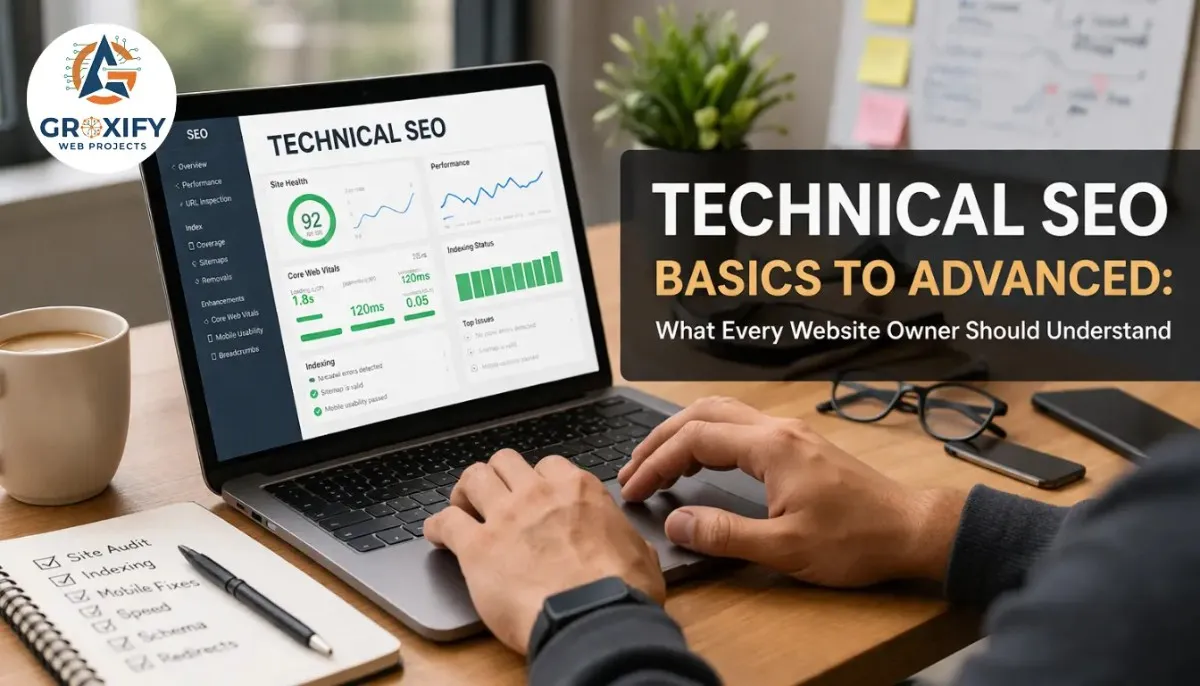
Technical SEO Basics to Advanced: What Every Website Owner Should Understand

Why Technical SEO Still Decides Rankings (And Why Many Sites Fail Without It) Many founders and business owners come to me with the same problem. Their website looks good. Content is written. Keywords are added. Still rankings do not move. Traffic stays flat. Leads do not come. In most of these situations the real issue is not content. It is technical SEO. In Google is more strict about website quality. If a site is slow, broken, not mobile friendly, or difficult for Google to read, rankings drop even if content is good. I have worked with businesses around Delhi areas like Laxmi Nagar, Karol Bagh and Noida Sector 62 where just fixing technical problems improved impressions within 6–10 weeks. Common reasons websites fail: • Pages not indexed• Wrong canonical setup• Poor site speed• Broken internal links• No schema structure• Mobile usability problems At Groxify Web Projects, we usually explain this simply to clients: Content helps you compete. Technical SEO allows you to enter the competition. Key Takeaways • Technical SEO is the base of ranking, not an extra task• Google first checks usability then relevance• Small technical fixes often give faster gains than rewriting content• Most ranking drops today are technical quality issues, not keyword problems If someone is still only focusing on keywords and ignoring technical health, they are fighting with one hand tied. What Is Technical SEO in Simple Words? (Real Explanation for Beginners) If I explain technical seo the way I explain to first-time clients, I say this: Technical SEO means making your website easy for Google to access, understand, and trust. Think like this. Your website is a shop in a busy market like Connaught Place or Nehru Place. Content is your products. But technical SEO is your shop entrance, lighting, navigation and billing system. If entry itself is blocked, customers will not come inside. In simple terms technical SEO covers: • Website speed• Mobile friendliness• Proper page structure• Secure HTTPS setup• Clean URLs• Sitemap and robots setup• Fixing errors Google shows in Search Console At Groxify Web Projects, when we audit new websites, around 60–70% problems are basic technical gaps, not strategy issues. Many startups and SEO learners think SEO means backlinks only. Reality is different. Beginner vs Practical Understanding Beginner Thinking Real Technical SEO Reality SEO means keywords SEO starts with website health Content alone ranks Technical trust comes first Backlinks fix ranking Structure fixes crawling Design is enough Performance matters more Key Takeaways • Technical SEO is website health management• Without it Google may ignore your pages• Beginners should start with basics not advanced tricks• Strong foundation makes future SEO easier Once this base is clear, understanding checklists and advanced fixes becomes much easier. Technical SEO Checklist We Actually Use on Real Client Projects When new clients approach us at Groxify Web Projects, they usually expect some complex audit. Reality is more practical. Most results come from fixing fundamentals consistently. This is a simplified version of the technical seo checklist we normally follow whether the business is a startup in Gurugram or a local service provider in East Delhi. Core Technical SEO Checklist Area What we check Why it matters Indexing Pages indexed in Google No index means no ranking Speed Page load under 3 seconds Users leave slow sites Mobile Mobile usability errors Google uses mobile first Structure URL and internal linking Helps crawling Security HTTPS setup Trust signal Sitemap XML sitemap present Helps discovery Errors 404 and redirect issues Stops ranking loss Schema Structured data added Improves visibility Canonical Duplicate control Prevents confusion Practical Process We Follow Normally our workflow looks like this: • Run Search Console error review• Check crawl issues using audit tools• Fix indexing blocks• Improve speed bottlenecks• Clean duplicate pages• Add structured schema where useful• Recheck after 30 days One ecommerce founder from Noida told me after these fixes:“Traffic did not jump overnight, but within two months impressions started growing steadily and bounce rate reduced.” That is usually how technical SEO works. Quiet improvements first. Rankings follow later. Key Takeaways • A checklist prevents missing basics• Most gains come from fixing errors not chasing hacks• Rechecking after fixes is important• Technical SEO is maintenance work, not one-time work This checklist alone solves many hidden ranking blockers before advanced work even begins. Website Foundations That Matter Most (Speed, Mobile, Core Web Vitals) If technical SEO is the base, then speed and mobile experience are the pillars. In the last two years especially, I have seen Google become very sensitive about user experience signals. Most Indian users browse on mobile. Many searches happen while travelling in metro, sitting in a shop, or comparing options quickly. If your site loads slowly, they simply close it. In audits we do at Groxify Web Projects, these three factors usually create the biggest difference: Foundations That Impact Rankings Factor What it means What we usually target Page Speed How fast page opens Under 2–3 seconds Mobile Experience Layout on phone No text overlap Core Web Vitals User experience signals Good performance scores Common Problems We Regularly Fix • Heavy images from designers• Too many WordPress plugins• Cheap hosting delays• No caching setup• Layout shifts on mobile• Buttons too close together A coaching institute website near Preet Vihar improved enquiry calls after we reduced load time from 5.8 seconds to 2.1 seconds. No new content. Only performance fixes. Key Takeaways • Speed directly affects user trust• Mobile experience is no longer optional• Core Web Vitals reflect real user comfort• Faster sites usually see better engagement signals If these three are strong, many other SEO efforts start working better automatically. Crawling and Indexing: How Google Really Reads Your Website Many people think publishing a page means Google will automatically rank it. That does not always happen. First Google must find the page (crawl) and then store it (index). Only after that ranking starts. I explain this to business owners like this. Crawling is Google visiting your shop. Indexing is Google adding your shop to

Technical SEO Basics to Advanced: What Every Website Owner Should Understand Read More »

off page seo

How To Do Off Page SEO Step By Step Without Risky Shortcuts

Why Off Page SEO Still Matters in Even After AI Search Changes Many founders and business owners ask me one common question now. If Google AI Overview is answering everything directly, does off page SEO still matter? Fair question. I also had the same discussion with a startup founder from Laxmi Nagar last month after his traffic dropped even though his website was technically strong. What I am seeing is simple. Google still depends on trust signals. AI can summarise content. But it still checks who the internet trusts. That trust mostly comes from external links in SEO, brand mentions, and real authority signals outside your website. For example, we worked with a service business near Connaught Place. Their on-page SEO was good. But rankings improved only after we started authority link building and niche article submission work. Within about 10–14 weeks their keyword positions moved from page 3 to page 1. If you are: Then understanding off page SEO is still necessary. AI changed search display. It did not remove reputation signals. Off page SEO is still how Google measures real credibility. What Is Off Page SEO Actually (Simple Explanation With Real Examples) In simple words, off page SEO means everything that happens outside your website to improve your Google trust. Many beginners think SEO means only website changes. In real projects, that is only half the work. Off page SEO mainly includes: I usually explain this with a simple example I share with clients in Delhi NCR. If your website is like a shop in Karol Bagh, off page SEO is like other shop owners recommending you. The more trusted people talk about you, the more customers trust you. We guided one training institute near Rajouri Garden. Their website was decent but unknown. After consistent article submission and industry mentions, enquiries improved because Google started seeing them as a referenced business, not just another website. Key Takeaways Which Off Page SEO Techniques Still Work in (And Which Are Dead) This is where most confusion happens. Many people still follow 2018 link building lists. Then they wonder why rankings do not move. What is working today is very different from what worked earlier. From what we are actively executing at Groxify Web Projects across Delhi businesses from Nehru Place to Noida Sector 62, the difference is very clear. Google now checks relevance and trust more than quantity. Here is a practical comparison based on what is giving results now: Still Working Techniques Techniques Losing Value Niche relevant guest posting Bulk directory submissions High quality article submission Spun article posting Digital PR mentions Random profile backlinks Founder branding & authority posts Forum spam links Real blog commenting in SEO discussions Automated blog comments Local citations with real data Fake location listings Partnerships & collaborations Paid link farms Community participation (Reddit, Quora type discussions) Private Blog Networks (PBNs) Techniques giving steady results right now What we normally prioritise when building off page SEO: Practices we usually advise clients to avoid These still look attractive because they are cheap. But recovery later becomes difficult: One ecommerce client from Preet Vihar came after losing rankings due to cheap link packages. Cleaning toxic links took almost 3 months before recovery even started. Key Takeaways How External Links in SEO Still Decide Your Google Trust Score If I explain this based on real work, Google still treats external links in SEO like trust votes. But not every vote counts. Only relevant and natural links help. One pattern that became very clear in recent projects around South Delhi and Gurugram businesses is this. A single relevant backlink from an industry site often performs better than 50 random links. Google mainly checks three things when evaluating links: For example, we helped a B2B software company working from Nehru Place. Instead of mass links, we focused on 12 niche backlinks through partnerships and expert content. Around 8–12 weeks later their domain trust improved and impressions almost doubled. What usually makes a strong backlink What weakens trust instead Key Takeaways Does Article Submission and Blog Commenting in SEO Still Give Results Short answer. Yes. But only if done properly. Most people fail because they follow outdated methods. I still see article submission working when the content is original and posted on relevant platforms. When we handle off page SEO campaigns at Groxify Web Projects, we treat article submission like reputation building, not link dumping. For example, a digital course provider from Patel Nagar worked with us after wasting months on low-quality submission sites. We shifted focus to fewer but relevant platforms. After around 2–3 months their referral traffic started coming and rankings improved gradually. When article submission still works Reality about blog commenting in SEO Yes, blog commenting in SEO still works but only when it is genuine discussion. We guide clients to comment only where: What usually fails One startup founder from Saket told me he got more partnership enquiries from thoughtful comments than from random backlinks. That shows the real purpose. Visibility first. Links second. Key Takeaways Real Off Page SEO Mistakes Indian Businesses Still Make Most Indian businesses do not fail in off page SEO because of lack of effort. They fail because of wrong direction. I regularly see this while auditing projects from areas like Janakpuri, Rohini, and even Gurgaon startups trying to scale fast. Some mistakes repeat again and again: Common mistakes that still hurt rankings One practical mistake I keep noticing Many founders think off page SEO is a one-time activity. In reality it behaves more like reputation building. When activity stops, growth also slows. One manufacturing client near Okhla paused link work for 4 months. Rankings gradually dropped because competitors stayed active. Key Takeaways Real Client Case Studies From Delhi Projects (What Worked and Timeline Results) Real understanding comes from actual campaigns. Below are two realistic cases from projects we handled around Delhi where off page SEO made measurable difference. Case Study 1 – Local Service Business (West Delhi) Factor Details

How To Do Off Page SEO Step By Step Without Risky Shortcuts Read More »

Scroll to Top