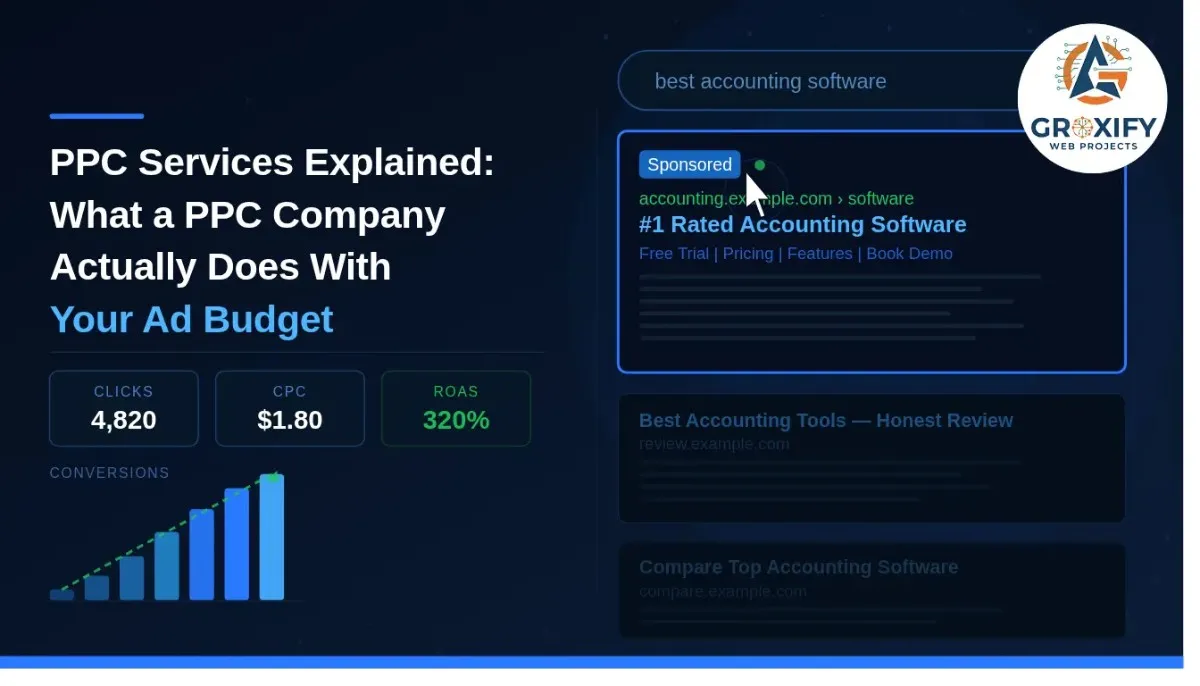
PPC Services Explained: What a PPC Company Actually Does With Your Ad Budget
You searched for PPC services because someone told you it is the fastest way to get customers online. Or maybe you are already spending money on ads and not seeing results. Either way, you want to know what you are actually paying for. This article breaks down exactly what PPC services include, what a PPC company does day to day, what results you should realistically expect, and how to tell if the agency you hired is earning their fee. No filler. No jargon without explanation. Just the clear picture you came here for. What Are PPC Services? PPC services is the work a company does to plan, run, and manage paid ads for your business. PPC stands for pay per click, which means you only pay when someone actually clicks your ad, not just when it shows up on screen. Google Ads is the most common platform. But PPC also runs on Meta (Facebook and Instagram), YouTube, LinkedIn, and Bing. The platform depends on where your customers actually spend time. The word “services” covers everything from setting up the campaign to daily management and monthly reporting. It is not a one-time setup job. Ad performance shifts constantly, and someone needs to be watching it. Think of it this way. The ad platform is the highway. PPC services are what decides which lane you drive in, how fast, and where you exit. What Does a PPC Advertising Company Actually Do? This is where most agency pages give you a vague list. Here is the specific version. Keyword Research Before any ad goes live, the team identifies which search terms your customers are actually typing. This is called keyword research. Bad keyword choices are the single most common reason ad budgets vanish without results. Good PPC research does not just pick the obvious terms. It finds keywords with buying intent. “Buy accounting software for small business” is more valuable than “accounting software” because the first one tells you the person is ready to act, not just browsing. Campaign Setup Once keywords are locked in, the team builds the campaign structure inside the ad platform. This includes: Conversion tracking is not optional. Without it, you have no idea what is actually working. Bid Management Every keyword has a cost per click. Bid management is the ongoing process of deciding how much to pay. Bid too low and your ad never appears. Bid too high and you drain budget on clicks that never convert. The team adjusts bids based on real performance data. Keywords bringing in leads get higher bids. Keywords burning budget with no results get cut back or paused. Ad Copy Testing Running one version of an ad and leaving it alone is a mistake. Good pay per click services include A/B testing, where two versions of an ad run against each other to see which gets more clicks or more conversions. A single headline change sometimes doubles click-through rate. Landing Page Review A landing page is the page a visitor lands on after clicking your ad. If the ad promises a free consultation but the landing page is your homepage with no mention of it, visitors leave immediately. A solid PPC company flags these gaps and works with your team to fix them. Reporting Every week or month, you should receive a clear report covering: how much was spent, how many clicks came in, how many converted into leads or sales, and what the cost per conversion was. If you are not getting this without asking for it, that is a problem. What Actually Happens Between Reports This is something competitors rarely explain. What does a PPC agency do between the campaign launch and the monthly report? They review search term reports. These show which actual searches triggered your ad. Sometimes an ad for a dentist shows up when someone searches “dentist school near me.” The team adds irrelevant searches as negative keywords, which are blocked terms your ad will not show for. This alone can save a meaningful chunk of budget every month. They track Quality Score. Quality Score is a Google rating from 1 to 10 that measures how relevant your ad, keywords, and landing page are to each other. Higher scores mean lower costs per click. A good PPC team works to keep this number healthy by improving ad relevance and landing page alignment. They watch budget pacing. If your daily budget runs out by midday, you miss afternoon and evening traffic entirely. The team adjusts spending to spread evenly across the day. They test new variations. Responsive search ads, which automatically mix and match your headlines and descriptions to find the best-performing combination, are standard now. The team feeds fresh headline options regularly to keep testing alive. This is the unglamorous daily work. But it is exactly what separates a PPC team that earns their retainer from one that set up your campaign once and went quiet for three months. PPC Services vs. Doing It Yourself Fair question. Google Ads is a self-serve platform. Anyone can create an account and run ads. So why pay for PPC services? Factor DIY PPC Company Setup time High, steep learning curve Done for you Learning cost You pay while figuring it out Agency already knows the platform Ongoing optimization Only if you have daily time Handled regularly Mistakes Common and expensive Fewer, caught faster Reporting You build it yourself Structured and regular Best for Very small budgets, simple campaigns Serious growth targets Honest answer: if your monthly ad spend is small, agency fees can eat too large a share of the total. But once you are spending a meaningful amount, the cost of beginner mistakes usually exceeds what good management costs. Choosing wrong keywords for three months costs more than the service fee. When Paid Advertising Actually Works Most PPC service pages skip this. They should not. Paid advertising works when your website actually converts. If the page visitors land on is slow, cluttered, or has no clear next
PPC Services Explained: What a PPC Company Actually Does With Your Ad Budget Read More »