Why Did Traditional Advertising Stop Working for Most Businesses?
This is a question I hear often from founders and shop owners. Many of them still remember when a newspaper ad or a few hoardings were enough. I have worked with businesses that spent lakhs on print ads and local cable TV, but could not track a single serious enquiry.
Table of Contents
The biggest reason is behaviour change. People stopped trusting one-way messages. Today, before buying anything, they check Google, compare options, read reviews, and ask friends on WhatsApp. Traditional ads do not fit into this flow.
From real projects we handled at Groxify Web Projects, I noticed three clear gaps:
- No way to measure who saw the ad or acted on it
- No targeting based on intent or interest
- No follow-up journey after first exposure
Traditional advertising did not become useless overnight. It simply failed to adapt. Digital channels filled that gap by meeting users where they already were, on search, social, and mobile screens.
How Did the Emergence of Digital Marketing Change Customer Behaviour?
When digital marketing started becoming visible in India, the biggest shift was not platforms. It was mindset. Customers stopped depending only on ads. They started depending on information.
I have seen this clearly while working with local service businesses and startups through Groxify Web Projects. Earlier, people asked, “How much does it cost?” Now they ask, “Is this brand genuine?” and “Who else has used this?”
Customer behaviour changed in very practical ways:
- People search before they speak to a seller
- Reviews matter more than brand claims
- Comparison happens silently on mobile screens
- Trust builds over multiple touchpoints, not one ad
Digital marketing allowed customers to control the journey. They decide when to click, read, compare, or ignore. This forced businesses to shift from shouting offers to explaining value. Those who adapted survived. Those who did not slowly lost relevance.
What Is the Real Evolution of Digital Marketing Over the Last 25 Years?
The evolution of digital marketing did not happen in one jump. It moved slowly, shaped by how people used the internet at different stages.
Around the early 2000s, it started with basic websites and email. The goal was simple visibility. Then search engines changed everything. When Google became the first stop for questions, SEO and search ads took centre stage. Businesses realised intent mattered more than reach.
Social media came next. Not as ads first, but as conversations. Brands that listened did better. Those who only posted offers struggled.
In the last few years, while working on campaigns at Groxify Web Projects, I saw data, automation, and AI quietly entering daily work. Marketing shifted from guesswork to patterns. The core stayed the same though. Understand people. Be useful. Show up at the right time.
How Digital Media Marketing Became the Backbone of Business Growth
Digital media marketing became important when businesses realised one simple thing. Growth needs consistency, not one-time visibility.
I have worked with brands that ran ads only during festive seasons. Results came and disappeared. Once they started using digital media marketing in a planned way, search, social, content, and email together, growth became predictable.
From real execution work at Groxify Web Projects, this pattern is very common:
- Search brings high-intent users who are ready to act
- Social builds familiarity and recall over time
- Content answers doubts before sales calls
- Email and retargeting bring people back
Digital media marketing works because it supports the full journey. From discovery to decision. Traditional channels usually touch only one point. Digital connects all of them and keeps improving through data.
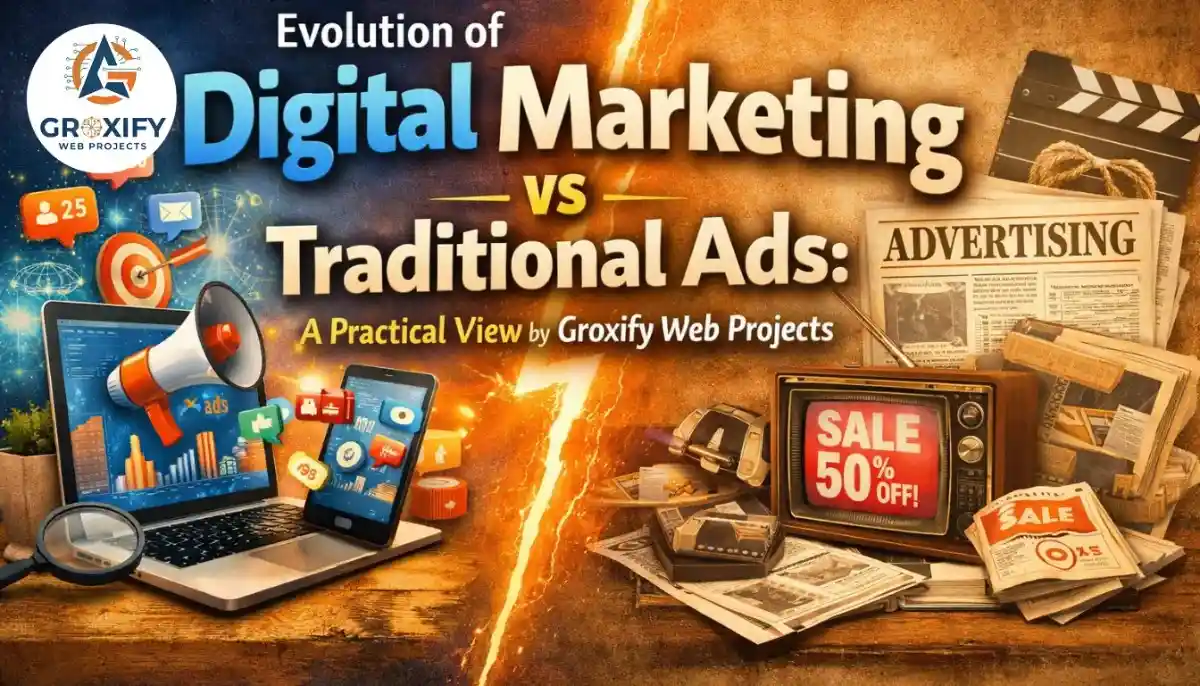
Traditional Marketing vs Digital Marketing: What Actually Works Today?
This question comes up in almost every client discussion. The honest answer is not emotional. It is practical.
Traditional marketing still creates visibility, but digital marketing creates decisions. In real campaigns we handled at Groxify Web Projects, results became clear once tracking started.
Real Comparison Based on Live Work
| Factor | Traditional Marketing | Digital Marketing |
| Targeting | Broad and fixed | Intent, interest, location based |
| Tracking | Almost none | Every click and action visible |
| Cost control | Fixed spend | Flexible and optimised |
| Customer journey | One-way message | Step-by-step engagement |
| Results timeline | Hard to predict | Clear within weeks |
What works today depends on the goal.
For trust at a local level, traditional can support.
For growth, leads, and clarity, digital marketing does the heavy lifting.
Most businesses now need a balance, but digital must lead.
Where Most Businesses Go Wrong While Adapting to Digital Marketing
Most businesses do not fail in digital marketing because the platform did not work. They fail because of wrong expectations and shortcuts.
While handling audits and recovery projects at Groxify Web Projects, I repeatedly saw the same mistakes, across startups and established brands.
Common Mistakes I See in Real Projects
- Expecting instant results within a few days
- Running ads without fixing the website or landing page
- Copying competitors without understanding their audience
- Chasing every new tool instead of basics
- Ignoring follow-up and lead handling
Another big issue is treating digital marketing as a one-time setup. It is not. It is a system that needs testing, learning, and adjustment.
Businesses that slow down, understand data, and improve step by step usually win within 2 to 3 months. Those looking for hacks usually stop midway.
How Search, Social, Content, and Paid Ads Evolved Together
Many people still treat these as separate channels. In real work, they evolved together and now depend on each other.
Search tells us what people are actively looking for. Content answers those questions. Social keeps the brand familiar. Paid ads push visibility at the right moment. When one is missing, the system weakens.
In several campaigns managed at Groxify Web Projects, performance improved only after all four were aligned.
Here is how they now work as one flow:
- Search brings intent-driven users
- Content builds clarity and trust
- Social reinforces recall and credibility
- Paid ads speed up reach and testing
Earlier, each channel worked alone. Today, they share data and signals. That is why digital marketing feels more predictable now. It is not magic. It is connected effort, measured over weeks, not days.
Real Client Case Studies: Digital Marketing Shifts That Changed Outcomes
These shifts become clear only when you see them on the ground. I am sharing two real patterns from work handled at Groxify Web Projects. Names are kept simple, situations are real.
Case Study 1: Local Service Business (Tier-2 City)
Situation: A home services company relied on newspaper ads and referrals.
Problem: Calls were dropping and ad spend had no tracking.
Action Taken:
- Built a simple mobile-first website
- Focused on local search and Google reviews
- Ran small paid search ads for “near me” queries
Result:
Within 6 weeks, enquiries doubled. Cost per lead dropped by almost 40 percent.
Case Study 2: Startup Selling Online Courses
Situation: Heavy social posting but low conversions.
Problem: No search visibility and weak content clarity.
Action Taken:
- Reworked content based on search intent
- Connected content with retargeting ads
Result:
Better quality leads and longer session time within 2 months.
Short Client Feedback
“We finally understood where leads were coming from and what to fix. Earlier everything felt like guesswork.”
How AI Is Reshaping Digital Marketing in Real Life (Not Theory)
AI in digital marketing is not about robots replacing people. In real work, it is about reducing guesswork and saving time.
When we started using AI-driven tools in live campaigns at Groxify Web Projects, the impact was practical, not dramatic. Planning became faster. Testing became smarter.
Here is where AI actually helps today:
- Predicting which keywords or ads may perform better
- Automating bid adjustments in paid campaigns
- Personalising email and content based on behaviour
- Spotting drop-offs in funnels early
Where AI does not work well is strategy and context. It cannot understand Indian buying behaviour fully. It cannot judge emotion or local trust signals.
AI supports decisions. Humans still make them. Teams that treat AI as an assistant see better results within weeks. Those who expect miracles usually get confused.
What Will Matter in Digital Marketing in the Next 1–2 Years
Looking ahead, the changes are not about new platforms. They are about how carefully users choose whom to trust.
From patterns we are already seeing at Groxify Web Projects, a few things are becoming very clear.
What Will Matter More
- First-hand experience content over generic posts
- Mobile speed and simple user journeys
- Local search visibility and real reviews
- Honest positioning, not aggressive selling
What Will Slowly Fade
- Fake urgency tactics and clickbait ads
- Over-automation without human checks
- Traffic without conversion planning
Businesses that focus on clarity and usefulness usually see steady improvement within 2 to 3 months. Those chasing trends often restart every year. The next phase of digital marketing will reward patience, consistency, and real value.
How Founders, Marketers, and Learners Should Decide the Right Approach
This is where most confusion happens. Everyone is at a different stage, but many follow the same advice. That usually creates frustration.
From day-to-day conversations and work handled at Groxify Web Projects, I have noticed one simple rule. The right approach depends on where you are starting from, not where others are.
If You Are a Founder or Business Owner
Focus on basics first.
- Clear website and mobile experience
- One main acquisition channel, usually search
- Simple tracking for leads and calls
Do not spread budgets thin. One working channel is better than five weak ones.
If You Are a Marketer or Freelancer
Build depth before width.
- Learn how one channel performs end to end
- Understand numbers, not just tools
- Test, measure, improve every month
If You Are a Student or Learner
Start by observing real campaigns. Theory alone does not stick.
- Follow live brand journeys
- Track why some ads convert and others do not
The right approach feels boring at first. It works because it is focused.
How We Work and Think at Groxify Web Projects (Author Introduction)
I am Rohit Singh, Founder of Groxify Web Projects. I started this company after spending years working on real campaigns where theory did not match ground reality. Many businesses were confused, spending money without clarity, and getting advice that looked good on paper but failed in practice.
At Groxify Web Projects, we work like operators, not presenters. I work closely with a hands-on team that handles SEO, content, paid ads, websites, and tracking together. We do not separate strategy from execution because problems never come separately in real life.
I have worked with local businesses, startups, and growing brands who needed direction more than promises. Some needed fixing basics. Some needed scaling. What stayed common was patience, testing, and honest feedback loops.
Our thinking is simple. Understand users first. Build systems that work quietly. Improve every month. That approach has helped many businesses grow steadily without panic marketing.
Key Takeaways From the Evolution of Digital Marketing
If you look at the full journey calmly, a few things become very clear. These are not textbook points. These are patterns that repeat in real work.
What the Evolution of Digital Marketing Has Taught Us
- Marketing moved from pushing messages to earning attention
- Customers now control the journey, not brands
- Data matters, but context matters more
- One strong channel beats many weak ones
- Systems outperform one-time campaigns
From work done at Groxify Web Projects, the biggest learning is this. Tools keep changing. Platforms keep updating. Human behaviour changes slowly.
Businesses that focus on clarity, trust, and consistency usually see steady results within a few months. Those chasing shortcuts keep restarting.
Digital marketing did not replace traditional thinking. It exposed weak thinking. The evolution rewarded businesses that adapted patiently and punished those who rushed decisions.
Frequently Asked Questions
It refers to how marketing shifted from print, TV, and radio to search, social, content, data, and now AI-led systems. Over time, control moved from brands to users, and marketing became more measurable and intent-driven.
In India, digital marketing started gaining attention in the early 2000s with websites and emails. Real growth happened after smartphones and cheap data, when Google search and social media became part of daily life.
No, it is not dead. I have seen traditional channels still support local trust. But alone, they struggle. In most real cases, traditional works best when digital marketing leads and handles tracking and follow-up.
Digital media marketing allowed people to compare, read reviews, and decide quietly. From real projects, I noticed buyers now contact businesses only after shortlisting, which means fewer leads but higher-quality conversations.
Based on real campaign timelines, early signals appear in 4 to 6 weeks. Stable results usually take 2 to 3 months. Anyone promising overnight success is usually skipping important groundwork.
Common mistakes include expecting instant results, running ads without fixing websites, ignoring tracking, and copying competitors blindly. I have seen most failures come from impatience, not from the platform itself.
AI is mainly used for analysis, automation, and testing. In live work, it helps predict performance and save time. Strategy, creativity, and understanding Indian users still need human judgement.
Yes, but carefully. Small businesses benefit the most when they focus on one clear channel like local search. I have seen small setups outperform bigger brands by doing basics properly.
It can be, if learning is practical. Watching real campaigns, understanding data, and handling mistakes matter more than certificates. Theory alone does not prepare anyone for real client work.
Start by understanding your stage. If you are learning, observe. If you are selling, focus on intent. From years of work, clarity and focus always beat complexity and trend chasing.
Conclusion
Digital marketing did not change because tools improved. It changed because people changed how they think, search, and decide. From traditional ads to AI-supported systems, the evolution of digital marketing shows one clear lesson. Businesses that listen, adapt, and stay consistent move forward. Others keep resetting.
If you are still learning, take time to understand behaviour before tactics. If you are evaluating options, focus on what solves your immediate problem, not everything at once. If you are ready to act, start small, measure honestly, and improve step by step.
From the kind of work we handle daily at Groxify Web Projects, thoughtful decisions always age better than rushed ones. You can take time, ask better questions, and explore the right path calmly. The right approach usually becomes obvious when clarity comes first.