
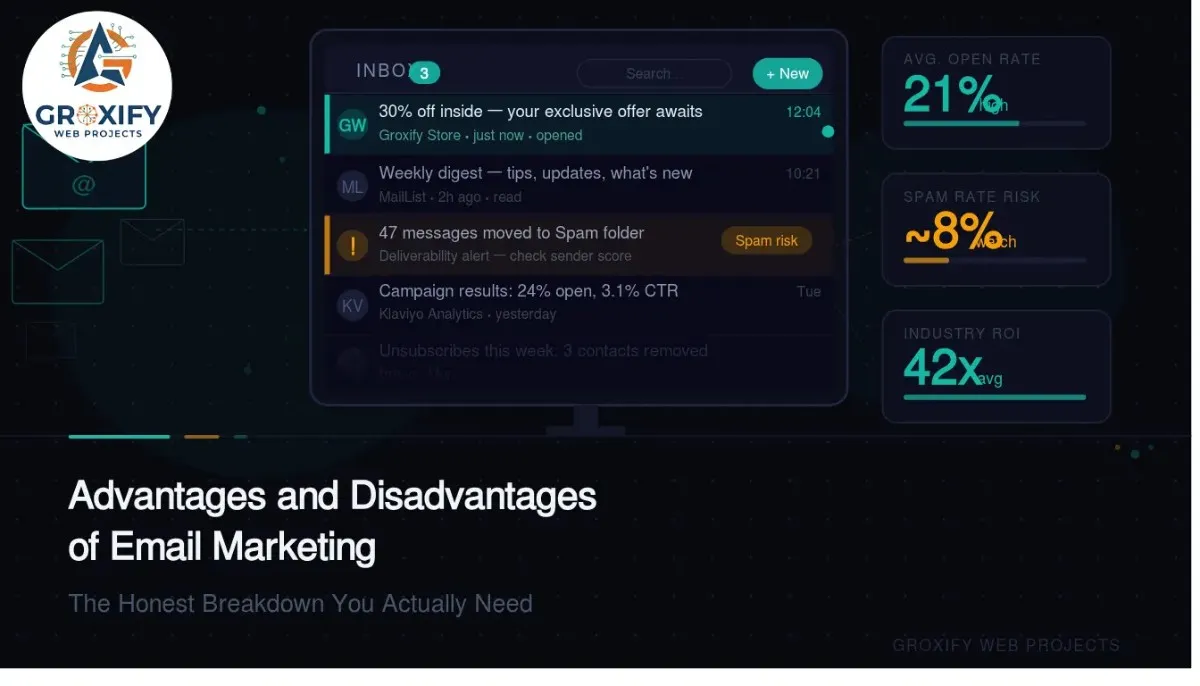
Advantages and Disadvantages of Email Marketing (The Honest Breakdown You Actually Need)
You search for email marketing advice and everyone sounds excited. “It has the highest ROI of any channel.” “Your list is your biggest asset.” All true. But nobody warns you that building that list takes months before a single sale happens. Nobody mentions the emails that quietly land in spam. Or the campaigns that got opened by 8% of people and ignored by the rest. The advantages and disadvantages of email marketing are both very real. Whether you are a business owner deciding if this is worth your budget, a freelancer figuring out if you should offer it as a service, or just someone trying to understand the full picture before jumping in, this article gives you exactly that. No hype, no sugarcoating. What Is Email Marketing (Before We Get Into the Pros and Cons) Email marketing is sending targeted messages to a list of people who have agreed to hear from you. That consent part is not just a nice-to-have. It is the foundation. Without it, you are not doing email marketing. You are spamming. These messages can be anything: a welcome email when someone signs up, a weekly newsletter, a product launch announcement, a discount offer, or even a simple “here is something useful” update. The goal is to stay connected with your audience and, at the right moment, get them to take action. The tool you use is called an ESP, which stands for Email Service Provider. Think Mailchimp, ConvertKit, Brevo, or similar platforms. They handle the sending, tracking, and automation so you do not need any technical background to get started. One thing to understand early: email marketing is not one big blast to your whole list. Done well, it is a series of relevant, timed messages going to the right people at the right moment. The Real Advantages of Email Marketing It Costs Very Little to Start Compared to paid ads, print, or sponsorships, email marketing is genuinely affordable. Most ESPs have a free plan for smaller lists, and even paid plans are priced for small businesses. You are essentially paying for the tool, not for each person you reach. For anyone watching their budget closely, this is a real advantage. The cost to send 1,000 emails versus 10,000 emails is not wildly different, which changes the math compared to most advertising channels. You Actually Own Your Audience This is the one that does not get enough attention. Your Instagram following, your Facebook page, your LinkedIn connections, none of that is truly yours. If a platform changes its algorithm or gets less popular, your reach shrinks and you have no say in it. Your email list belongs to you. You can export it, move it to a different tool, or keep it forever. No third party can cut your access to it. That ownership is the foundation that makes email a long-term asset and not just a tactic. The Return on Investment Is Consistently High Across industries, email marketing delivers one of the strongest returns compared to other digital channels. The exact numbers vary depending on your industry, your list quality, and your content, but the direction is consistent. What drives that return is relevance. An email to people who actually want to hear from you and actually care about what you sell performs very differently from a blast to a random list. The channel is not magic. The relationship behind it is. You Can Personalize Without Doing It Manually Modern ESPs let you send different messages to different people based on what they clicked, what they bought, where they signed up, or how long they have been on your list. This is called segmentation, which means splitting your audience into groups so each group gets content that fits them specifically. Someone who just signed up does not need the same email as someone who has bought from you three times. Email lets you set that up once and let it run automatically. That kind of personalization used to require a full marketing team. Now a solo business owner can do it with a basic email tool. Every Campaign Gives You Data You Can Actually Use With email, you know how many people opened each message (that is the open rate), how many clicked something inside it (the click-through rate, or CTR), how many bought, and how many left your list. Every send is a learning opportunity. You can test two different subject lines on two groups of subscribers to see which one gets more opens. This is called A/B testing. Over time, those small improvements compound into much better performance. Compare that to handing out flyers and having no idea what happened next. It Works Automatically Once You Set It Up Once you build email sequences, they run on their own. Someone signs up at 11pm, they get a welcome email. They abandon a product in their cart, they get a follow-up three days later. You built it once. It works while you sleep. This is called email automation, and it is where the real efficiency comes in. A solo freelancer or small business can punch well above their weight because the system handles the repetitive parts. It Reaches People Directly Social media is noisy. Your post competes with everyone else’s posts, paid ads, trending content, and whatever is happening in the news. An email lands in someone’s inbox. It is personal and direct, and if your subject line earns the open, you have their full attention for a few seconds. People also open email with intent. They are not passively scrolling. They sat down to check their inbox. That different mode of reading makes email a better environment for actual communication than a social feed. The Disadvantages of Email Marketing Nobody Talks About Honestly Building a Quality List Takes Real Time This is where most beginners get discouraged. You cannot start today and have 500 engaged subscribers by next month unless you already have a large audience somewhere. Building a quality list,
Advantages and Disadvantages of Email Marketing (The Honest Breakdown You Actually Need) Read More »