
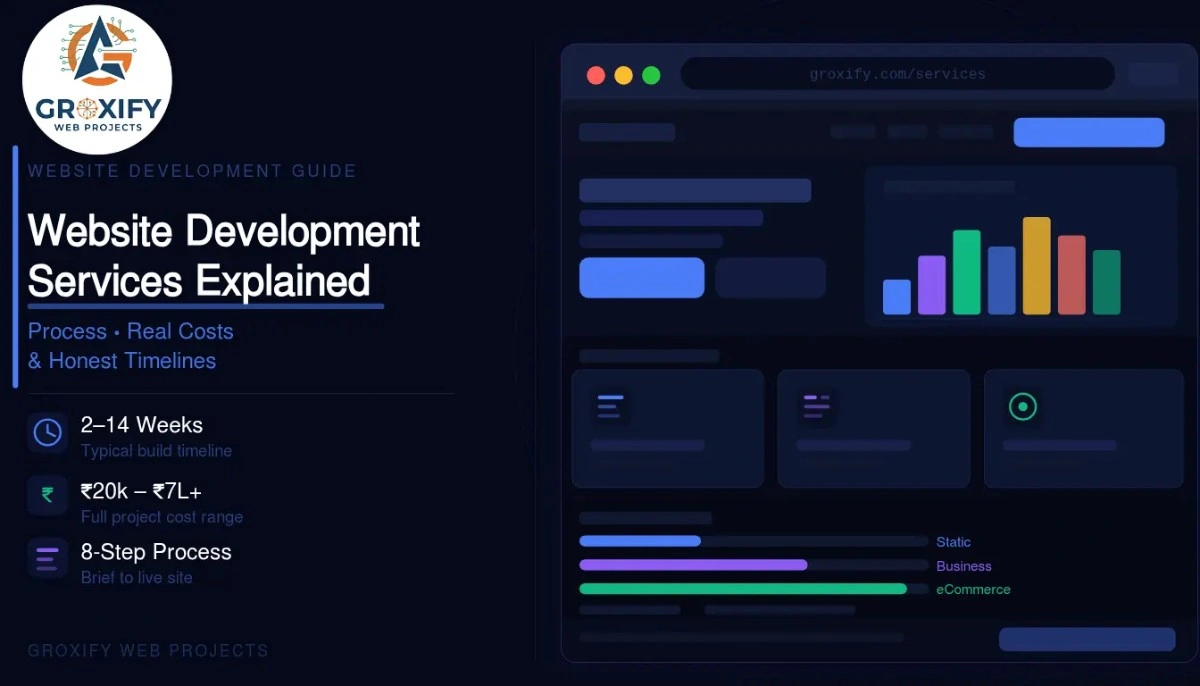
Website Development Services Explained: Process, Real Costs, and Honest Timelines
You called three agencies for a quote. One said ₹20,000. One said ₹1.5 lakh. One said ₹6 lakh. Same project description. Now you have no idea who is right and who is just making up numbers. That confusion is not your fault. Pricing in website development services is genuinely unclear because most agencies do not explain what actually goes into a quote. Most articles online also just throw vague ranges at you without telling you what drives the number. This article covers the full process of how a website gets built, what each stage costs and why, and how long it realistically takes. By the end, you will know exactly what to ask before signing anything. What Do Website Development Services Actually Include Most people think getting a website built means someone writes code and hands over a login. That is maybe half the story. A proper service covers a lot more. It starts with understanding your business goals, then planning the site structure, which is called information architecture (organizing pages so users find things easily without getting lost). After that comes designing the visual layout, integrating your content, building the actual code, setting up hosting (the server where your site lives), testing across devices and browsers, and finally handing everything over with documentation. Some packages include SEO setup as part of the work. Here, SEO setup means adding the technical signals that search engines need to find and rank your pages, things like page titles, meta descriptions, and site speed optimization. Others charge for this separately or skip it entirely. So when you are comparing quotes from different web development services providers, the number means nothing until you know the line items. A quote that just says “complete website” is not a quote. It is a placeholder. Website Development Types: Which One Fits Your Project This is where most people either overpay for features they will never use or buy something too basic for what they actually need. Projects generally fall into four categories. Type What It Is Best For Complexity Static Website Fixed pages, no database Portfolios, landing pages Low CMS-Based Site Editable via a dashboard Business sites, blogs Medium eCommerce Site Products, cart, payments Online stores Medium-High Custom Web App Built from scratch for a function Portals, SaaS, booking tools High A CMS is a Content Management System, software that lets you edit your own pages without touching any code. WordPress is the most common one currently, and most small business websites run on it for good reason. It is flexible, well-supported, and manageable without technical skills. An eCommerce site is a different beast. It needs a payment gateway (a service that securely processes card payments online, like Razorpay or Stripe), product management, inventory tracking, and order notifications. It is not a regular site with a “Buy Now” button slapped on at the end. A custom web application is built specifically for a function that no standard solution handles well. Think a hospital appointment portal, a property booking platform, or a SaaS product dashboard. This is a completely different conversation in terms of both budget and timeline. Knowing which category your project actually falls into before talking to anyone will save you hours of confusing back-and-forth. The Build Process, Step by Step Here is how a properly run project actually moves from your idea to a live site. One thing most guides do not say out loud: projects almost always stall at step 5, not step 4. Content delays are the single biggest reason websites go overdue. If you want your project delivered fast, have your page copy, images, and logo files ready before the kickoff call. Website Development Cost: What Really Drives the Number This is the section most people are actually here for. So here is the honest version, without the vague ranges that make most guides useless. Three things drive the website development cost more than anything else. Complexity of features. A contact form takes less than an hour to build. A booking system with calendar sync, automated email confirmations, and payment collection takes several weeks. Every feature has a hidden time cost, and time is ultimately what you are paying for. Volume of content. A 5-page site and a 15-page site are not triple the work. But a 15-page site and a 100-page site genuinely are a different project. More pages mean more design decisions, more content integration, more testing, and more time. Who is building it. This is the biggest variable of all. A junior freelancer, an experienced senior freelancer, a small boutique agency, and a large agency all charge differently for the same output. None of them is wrong. They represent different experience levels, risk profiles, and support structures. Here is a rough guide to current pricing in the Indian market: Provider Type Basic Site Business Site eCommerce Junior Freelancer ₹8k – ₹25k ₹20k – ₹60k ₹40k – ₹1L Experienced Freelancer ₹25k – ₹70k ₹60k – ₹1.5L ₹1L – ₹3L Small Agency ₹50k – ₹1.2L ₹1.2L – ₹3.5L ₹2.5L – ₹7L Mid-Large Agency ₹1.5L+ ₹4L – ₹12L ₹7L – ₹25L+ These are rough market indicators. Actual quotes depend heavily on what is included in each one. Also budget separately for costs that most agencies do not mention at the quoting stage: Maintenance is the one people forget until something breaks badly. For a WordPress site, budget at least ₹3,000 to ₹8,000 a month for managed maintenance from a professional. Without it, the site becomes a security risk within a year. That cost is real and it belongs in your planning from day one. Why Timelines Vary So Much Most agencies give ranges like “4 to 8 weeks” without explaining what pushes a project to the far end. Here is the actual picture. A simple 5-page static or WordPress site, with all content ready from day one: 2 to 4 weeks. A 10 to 20 page business site with a blog, contact forms, and basic SEO setup: 4 to 8 weeks.
Website Development Services Explained: Process, Real Costs, and Honest Timelines Read More »