Why Are Businesses Still Confused Between Traditional Marketing and Digital Marketing?
This confusion still comes up in almost every discussion I have with founders and business owners. Even, many people ask the same question across the table. “Should I put money in hoardings and newspapers, or go all in on online marketing?”
Table of Contents
The confusion usually starts because traditional marketing feels familiar and safe. Digital marketing feels fast and sometimes overwhelming. I have seen businesses trust what they can see physically, like flyers or local ads, even when results are unclear. At the same time, they hear success stories about internet marketing and expect instant sales.
Another reason is mixed advice. Vendors push what they sell, not what the business needs. At Groxify Web Projects, we often step in at this point and slow things down. Once businesses understand how each method actually works in real situations, the confusion reduces quickly.
What Exactly Is Traditional Marketing and Where Does It Still Work Today?
Traditional marketing is all the offline ways businesses promoted themselves before internet marketing became common. This includes newspapers, magazines, radio, TV ads, hoardings, banners, pamphlets, events, and local sponsorships. Many Indian businesses still rely on these because they have worked for years.
From real work on ground, I have seen traditional marketing still perform well in very local and trust-driven situations. For example, a coaching centre near a busy market, a real estate project, or a hospital opening in a specific area. In such cases, visibility matters more than clicks.
Where it works best today:
- Local businesses targeting a fixed area
- Brands focused on awareness, not immediate sales
- Businesses with older or less online audiences
Where it struggles:
- Tracking real results
- Adjusting campaigns quickly
- Reaching younger, mobile-first users
Traditional marketing is not dead. It is just limited. It works when the goal is visibility, not precision or scale.
What Is Digital Marketing and Why Has It Become the First Choice for Most Businesses?
Digital marketing means promoting your business using online channels where people already spend their time. This includes search engines, social media, websites, email, paid ads, and content. In simple words, it is about meeting customers on their mobile phones and laptops, not waiting for them to notice a banner outside.
What I see on ground is very clear. People now search before they buy. They compare on Google, check reviews, watch reels, and then decide. This behaviour has only increased in the last few years. That is why online marketing has become the first choice.
At Groxify Web Projects, we handle this daily for different businesses. Digital marketing works because you can:
- Reach the right people, not everyone
- Track what is working and what is wasting money
- Start small and scale based on results
- Make changes quickly without waiting weeks
It gives control, clarity, and speed. That is the main reason businesses prefer it today.
Traditional Marketing vs Digital Marketing: Key Differences That Actually Matter
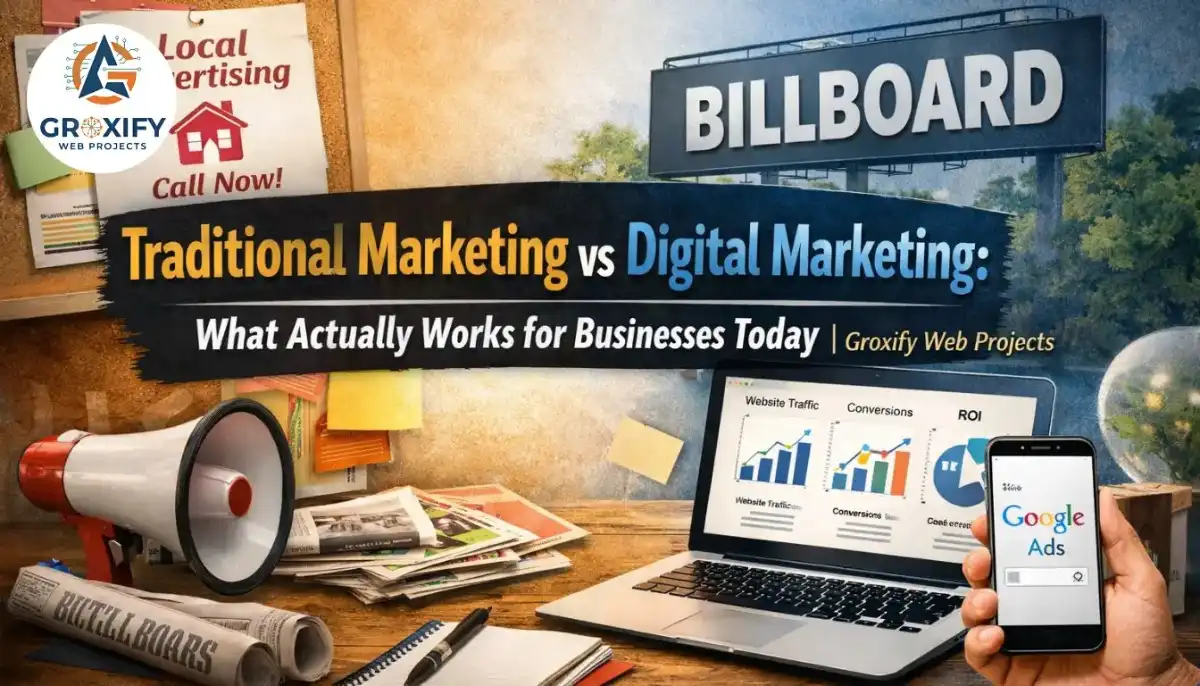
Most people compare traditional marketing vs digital marketing on the surface. Print versus online. Offline versus internet marketing. But in real business decisions, the differences that matter are deeper.
When I sit with founders and shop owners, these are the points that actually change their mind. Not theory. Daily reality.
| Factor | Traditional Marketing | Digital Marketing |
| Targeting | Broad and location-based | Specific by age, interest, intent |
| Cost control | Fixed and often high | Flexible. Start small |
| Tracking | Very limited or guesswork | Clear data and reports |
| Speed | Slow to launch and change | Fast setup and instant edits |
| Customer intent | Passive viewers | Active searchers |
The difference between traditional marketing and digital marketing is not about old versus new. It is about control and clarity. Digital marketing lets businesses see what is happening and adjust before money is wasted. That single point makes a big impact today.
Cost, Reach, Tracking, and Speed: Which Marketing Really Makes Sense for Indian Businesses?
This is where decisions usually become clear. When Indian business owners break marketing into cost, reach, tracking, and speed, the picture changes fast.
Cost
Traditional marketing often needs a big upfront spend. Printing, media booking, and placement costs are fixed. Digital marketing allows small starts. Many clients begin with limited budgets and scale only after seeing results.
Reach
Offline reach is limited to one area. Online marketing reaches people across cities, states, or even countries. This matters a lot for service businesses and D2C brands.
Tracking
This is the biggest gap.
- Traditional: calls and walk-ins are hard to connect to ads
- Digital: clicks, leads, sales are visible
Speed
Offline campaigns take weeks to plan. Digital campaigns go live in hours.
At Groxify Web Projects, this clarity helps businesses choose what fits their size and growth stage, not trends.
Key Takeaways
- Small budgets need digital
- Fast decisions need data
- Local visibility may still need offline support
Real Business Case Studies: What I Have Seen Working on Ground
Let me share two real patterns I have seen repeatedly while working with businesses across different sectors.
Case Study 1: Local service business
- Situation: A home renovation firm depended only on flyers and local ads.
- Problem: Leads were random and untrackable.
- Action: We shifted part of the budget to digital marketing. Local SEO, Google Ads, and basic landing pages.
- Result: Within 6–8 weeks, enquiry quality improved. Cost per lead dropped by almost half. Offline ads were later reduced.
Case Study 2: Retail brand
- Situation: A clothing store relied only on Instagram posts.
- Problem: Good reach, low sales.
- Action: We added search-based online marketing and local intent keywords.
- Result: Walk-ins increased because people searched first, then visited.
The pattern is clear. Digital works best when intent matters. Traditional supports visibility when location matters.
Common Marketing Mistakes I Regularly See Businesses Making
These mistakes come up again and again, across cities and industries. Most are not about budget. They are about decisions.
- Choosing comfort over data
Many businesses stick to traditional marketing only because it feels familiar, not because it performs. - Expecting instant results from digital marketing
Online marketing is fast, but it still needs testing time. Panic stops campaigns too early. - No clear goal before spending
Awareness, leads, walk-ins, sales. Everything gets mixed, so results feel confusing. - Copying competitors blindly
What works for another brand may fail badly for you. - Ignoring tracking completely
If you cannot measure, you cannot improve. Simple as that.
At Groxify Web Projects, we spend a lot of time fixing these basics first. Once mistakes are removed, marketing starts making sense.
Key Takeaways
- Decide based on data, not habit
- Match expectations with timelines
- Track before you scale
How We at Groxify Web Projects Actually Guide Businesses Through This Decision
When businesses come to us, most are already confused and tired of mixed advice. So we keep it simple. We do not start with packages or channels. We start with questions.
At Groxify Web Projects, this is how we usually guide the decision:
- We understand the business stage. New, growing, or stable
- We check how customers are actually finding them today
- We look at past spends and what really worked
- We map short-term needs versus long-term growth
In many cases, the answer is not traditional or digital. It is a mix, used correctly.
I remember a founder telling me later, “For the first time, marketing feels clear. We know why we are spending.” That clarity matters more than tactics. Once the direction is right, execution becomes easier and waste reduces naturally.
Which Marketing Should You Choose Based on Your Business Stage?
This question comes up a lot, and the answer changes with stage. What works for one business can waste money for another.
If you are just starting
- Focus on digital marketing first
- Local SEO, basic Google Ads, simple social presence
- Goal is visibility and early leads, not branding
If you are growing
- Mix digital with selective traditional
- Digital for leads and tracking
- Offline only where local trust or visibility helps
If you are stable or well-known
- Traditional marketing can support brand recall
- Digital marketing should still drive measurable growth
At Groxify Web Projects, we usually see digital marketing make sense at every stage. Traditional marketing works only when the business already understands its audience clearly.
Key Takeaways
- Early stage needs data, not guesswork
- Growth stage needs balance
- Scale stage needs recall plus performance
What Will Change in the Next 1–2 Years and How You Should Prepare
The next couple of years will reduce this confusion even further. User behaviour is already changing fast.
What I am seeing clearly:
- Search is becoming more intent-based and local
- Mobile decisions are quicker and more direct
- People trust reviews and real content more than ads
- Tracking and data clarity will matter more than reach
Traditional marketing will not disappear, but its role will shrink to awareness and recall. Digital marketing will handle decision-making moments.
To prepare:
- Build a strong website that answers real questions
- Focus on local search and mobile experience
- Track every campaign properly
- Avoid shortcuts and fake promises
At Groxify Web Projects, we guide businesses to prepare early so changes do not feel sudden.
Key Takeaways
- Intent will beat visibility
- Local search will grow
- Data will decide winners
Key Takeaways Before You Decide
Before you choose between traditional marketing vs digital marketing, pause and look at the full picture. Most wrong decisions happen because this pause is skipped.
Here is what usually helps businesses decide clearly:
- Traditional marketing works best for local visibility and brand recall
- Digital marketing works best for leads, sales, and tracking results
- Small budgets need control. Digital gives that control
- Offline ads are hard to measure. Online marketing shows clear data
- A mix works only when each channel has a clear role
If you are still comparing options, start with clarity, not trends. At Groxify Web Projects, once businesses understand this balance, decisions become calmer and smarter.
Frequently Asked Questions
Yes, but only in specific cases. I have noticed it works for local awareness, events, and trust-building in fixed areas. It does not work well for tracking leads or scaling growth. Digital marketing handles that part better.
The core difference is control and tracking. Traditional marketing shows your message to many people blindly. Digital marketing shows it to people who are already searching or interested, and you can clearly see results.
Yes. In fact, small businesses benefit the most. From real projects I have handled, starting with small budgets in online marketing gives learning and results without heavy risk, unlike print or hoardings.
Digital marketing gives faster feedback. You can see leads or data within days or weeks. Traditional marketing takes longer and results are often unclear, especially for new businesses.
No. Many people think this way and get confused. Digital marketing includes search, websites, Google Ads, email, content, and more. Social media is just one part of internet marketing.
Not always. I have seen businesses benefit from a mix. If local visibility matters, offline can support. But core growth and tracking should still come from digital channels.
In most real cases, initial signals appear in 4–6 weeks. Strong, stable results usually take 2–3 months. Anyone promising instant results is usually cutting corners.
For local businesses, digital marketing with local SEO and Google search works very well. Traditional marketing can support awareness, but online search is where decisions now happen.
The biggest mistake is copying competitors or choosing based on comfort. From experience, businesses that decide based on data and goals avoid long-term losses.
Start by understanding how your customers search and decide. If clarity feels missing, get guidance. At Groxify Web Projects, we usually help businesses map this before spending blindly.
Final Thoughts and the Right Next Step
If you read till here, one thing should feel clear now. The debate between traditional marketing vs digital marketing is not about choosing sides. It is about choosing what actually works for your business today.
Traditional marketing still has a place, but it is limited. Digital marketing has become central because customers have changed. They search, compare, and decide online first. Businesses that accept this early face fewer surprises later.
If you are still learning, take time to observe how your customers behave.
If you are comparing options, write down your goals and budget honestly.
If you are ready to act, start small, track everything, and scale only what works.
At Groxify Web Projects, we see better results when decisions are calm and informed, not rushed. The right next step is not spending more. It is understanding better, then moving forward with clarity and confidence.