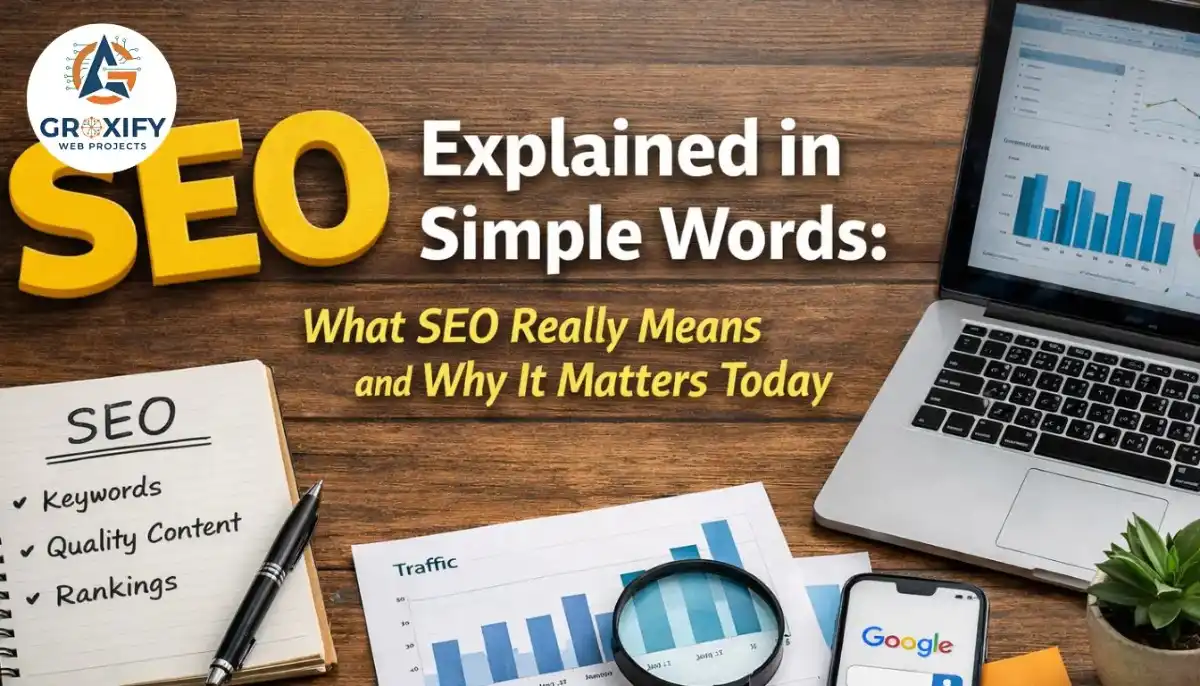
Why Everyone Is Talking About SEO
If you run a business, startup, or even a small shop today, you have probably faced this situation. You build a website, launch a product, or start a service. But when you search on Google, your business is nowhere to be found. Meanwhile, competitors appear on the first page and keep getting customers.
Table of Contents
This is exactly why seo has become such a big topic.
Today almost every decision starts with a search. A founder checks marketing ideas. A student searches for learning resources. A customer looks for nearby services in places like Shahdara, Laxmi Nagar, or Karol Bagh in Delhi using simple searches like “best service near me”. If a business does not appear in those results, it often loses that opportunity.
During the last few years while working with clients through Groxify Web Projects, I noticed a clear pattern. Businesses that focused on search engine optimization early started receiving steady traffic without depending only on ads. After 2–4 months many of them began seeing enquiries coming directly from Google search.
SEO matters even more today because Google now focuses strongly on:
- Real experience-based content
- Mobile-first websites
- Fast loading pages and good user experience
- Helpful information that answers real questions
Google AI Overview is also changing how results appear. Only content that clearly explains topics and shows real expertise tends to get visibility.
So whether someone is a startup founder, digital marketer, freelancer, or student trying to learn online skills, understanding seo meaning and how it works has become almost essential.
What Is SEO? Simple Meaning Every Beginner Should Understand
Let us keep this very simple.
SEO full form is Search Engine Optimization.
In basic words, seo means improving a website so that it appears higher in Google search results when people search for related topics, services, or products.
For example, imagine someone in Laxmi Nagar or Shahdara in Delhi searches on Google:
- “digital marketing agency near me”
- “best website developer in Delhi”
- “seo expert for startup”
Google shows many results. The websites appearing on the first page usually get most of the clicks. SEO is the process that helps a website reach those positions naturally.
In my work at Groxify Web Projects, many new business owners initially think SEO is some kind of trick to push a website to the top. But in reality, it is mostly about making a website helpful, trustworthy, and easy for search engines to understand.
At a basic level, search engine optimization works through three main things:
| SEO Area | What It Means | Why It Matters |
| Content | Clear pages answering real questions | Helps Google understand the topic |
| Technical setup | Fast loading site, mobile-friendly pages | Improves user experience |
| Trust signals | Backlinks, authority, consistent updates | Builds credibility in search results |
When these things are done correctly, Google starts recognising the website as a useful source for that topic.
Over the years, I have guided founders and small business owners who were completely new to SEO. Once they understood this simple idea, they realised something important. SEO is not about gaming Google. It is about becoming the most helpful answer for the user.
That mindset usually changes how people approach their entire digital strategy.
How Search Engine Optimization Actually Works Behind Google Search
Many beginners think SEO means adding some keywords to a page and Google will rank it. In reality the process is more structured.
Behind every Google search, three major steps happen.
| Step | What Google Does | Why It Matters for SEO |
| Crawling | Google bots scan websites across the internet | Helps Google discover new pages |
| Indexing | Google stores and understands page content | Determines if the page is relevant |
| Ranking | Google decides which pages appear first | Best answers get top positions |
Let us understand this in a practical way.
When someone in Delhi, Laxmi Nagar, or Shahdara searches something like “what is seo”, Google sends automated bots to scan millions of pages already stored in its index. These bots check:
- page topic
- website speed
- mobile friendliness
- content quality
- user experience signals
Then Google ranks pages that appear most useful and trustworthy.
While guiding businesses through Groxify Web Projects, I often explain it like this. Google is simply trying to answer the user’s question in the best possible way. The website that explains clearly, loads fast, and helps the reader usually moves upward in search results over time.
This is also why shortcuts do not work anymore.
Some practices that often fail today include:
- stuffing too many keywords on a page
- copying content from other websites
- buying low quality backlinks
- creating thin or AI-only content without real insight
Google updates its algorithm regularly. In recent years it strongly prioritises experience-based content and helpful information, especially for AI Overview results.
So the real focus of search engine optimization today is simple. Build a website that genuinely helps people and makes it easy for Google to understand that value.
What Are the Main Types of SEO That Businesses Use Today
When people first learn about seo, they often think it is just about keywords. In reality, search engine optimization has several parts working together. Each type solves a different problem.
Over the years while guiding clients through Groxify Web Projects, I usually explain SEO in four simple categories.
| Type of SEO | What It Focuses On | Example in Real Life |
| On-Page SEO | Content, keywords, page structure | Optimising blog posts and service pages |
| Technical SEO | Website speed, mobile usability, site structure | Improving loading time and Core Web Vitals |
| Off-Page SEO | Authority and trust from other websites | Backlinks and brand mentions |
| Local SEO | Visibility in location-based searches | Ranking for “services near me” |
On-Page SEO
This is where most SEO work begins. It includes:
- Writing useful content that answers real questions
- Using keywords naturally such as seo meaning or what is seo
- Proper page titles and headings
- Clear page structure and internal linking
Many businesses ignore this and publish thin content. Google now prefers detailed helpful pages that solve user problems.
Technical SEO
Even good content struggles if the website itself has issues. Technical SEO focuses on things like:
- Fast page loading
- Mobile-friendly design
- Secure website (HTTPS)
- Clean site structure
For example, I once worked with a startup website whose pages took 7 seconds to load. After fixing speed and mobile layout, traffic improved within a couple of months.
Off-Page SEO
This part builds trust. When other websites mention or link to your site, Google sees it as a credibility signal.
However, shortcuts here can cause damage. Buying spammy links or using fake link networks usually leads to ranking drops later.
Local SEO
This is especially important for businesses serving specific locations.
People in areas like Karol Bagh, Preet Vihar, or Shahdara in Delhi often search using phrases like:
- “best service near me”
- “digital marketing agency in Delhi”
Local SEO helps businesses appear in those results through Google Business profiles, location pages, and local citations.
Most successful SEO strategies combine all these types together. When one part is ignored, results usually stay limited.
Why SEO Matters for Businesses, Startups, and Personal Brands
Most people realise the importance of seo only after facing a common problem. They launch a website, start a business, or build a personal brand. But traffic stays very low. Customers simply cannot find them.
This is where search engine optimization becomes important.
Today people rarely visit websites directly. They search first. Whether someone is a founder in Noida, a local shop owner in Karol Bagh, or a freelancer working from Shahdara, the first step is usually a Google search.
When a website appears on the first page, several benefits follow.
- Consistent organic traffic without paying for every click
- Higher credibility, because users trust Google rankings
- Better leads, since people are already searching for that service
- Long-term visibility compared to short-term ads
In my work through Groxify Web Projects, I often notice a turning point when a business starts ranking for its main keywords. Suddenly enquiries begin arriving from search. Some clients tell us their customers say, “We found your website on Google.”
For startups and personal brands, SEO also builds authority over time. A well-optimised website with helpful content can keep bringing visitors for years.
That is why many businesses now see SEO not just as marketing, but as a long-term digital asset that supports growth.
Common SEO Mistakes I Often See Businesses Making
Many businesses start seo with good intentions but end up frustrated because results do not appear. Most of the time the problem is not effort. It is the wrong approach.
While working with different businesses through Groxify Web Projects, I often notice a few repeating mistakes, especially with startups and local companies around areas like Laxmi Nagar, Preet Vihar, and Karol Bagh in Delhi.
Some of the most common issues include:
- Expecting instant rankings
SEO takes time. Real improvements usually begin after 2–3 months. Quick promises often lead to disappointment. - Keyword stuffing
Some websites repeat the same words like seo meaning or search engine optimization everywhere. This makes the content unnatural and Google now recognises it easily. - Ignoring mobile experience
Most Indian users search on mobile. If the website loads slowly or looks messy on a phone, visitors leave quickly. - Copying content from other sites
Duplicate or slightly modified content rarely performs well today. Google prefers original explanations and real insights. - Buying cheap backlinks
This is a risky shortcut. Low-quality links may give temporary movement but often cause ranking drops later. - Publishing content without strategy
Many blogs exist but they do not answer real user questions.
Key Takeaways
- SEO works best when content, technical setup, and authority grow together
- Avoid shortcuts that promise overnight ranking
- Focus on helpful content and strong user experience
Businesses that correct these basic mistakes often see gradual improvement in search visibility over time.
Real SEO Case Studies From Client Work and What Actually Worked
Theory helps people understand seo, but real examples explain how search engine optimization actually performs in the market. Over the years while working through Groxify Web Projects, I have handled projects for startups, service businesses, and online brands. A few situations stayed memorable because they clearly showed what works and what does not.
Case Study 1 — Local Service Business in East Delhi
| Case Detail | Explanation |
| Situation | A small service company based near Laxmi Nagar had a website but almost zero Google visibility. |
| Problem | The site had only two pages and no useful content explaining their services. |
| Action | We rebuilt the service pages, added detailed FAQs, improved site speed, and optimised their Google Business listing. |
| Result | Within about 3 months, the website started appearing for local searches. Enquiries increased from 2–3 per month to around 20+ monthly leads. |
The owner later told us something simple but meaningful:
“Most customers now say they found us through Google search.”
Case Study 2 — Startup Website Targeting Global Clients
| Case Detail | Explanation |
| Situation | A startup offering digital services wanted international visibility. |
| Problem | Their blog content existed but it did not target real search questions. |
| Action | We redesigned the content strategy around actual user queries such as what is seo, seo meaning, and related topics. |
| Result | Organic traffic began improving after 8–10 weeks, and within six months the site was receiving visitors from multiple countries. |
Case Study 3 — E-commerce Brand Struggling With Visibility
| Case Detail | Explanation |
| Situation | An online store selling niche products had decent products but low traffic. |
| Problem | Product pages had thin descriptions and slow loading speed. |
| Action | We improved product content, optimised page speed, and built internal linking between category pages. |
| Result | Over 4–5 months, several product pages began appearing on the first two pages of Google results, increasing sales gradually. |
What These Projects Taught Me
Across different projects, a few patterns repeat:
- Websites with clear helpful content tend to grow steadily.
- Technical improvements often produce quick gains in user experience.
- Consistency matters more than shortcuts.
Key Takeaways
- SEO success usually appears gradually within 2–6 months.
- Real improvements come from better content, strong site structure, and trust signals.
- Businesses that stay patient often see the most stable results.
These real projects also remind business owners of one important point. SEO is not a single activity. It is a continuous process of improving how a website helps its users.
How Long SEO Takes and What Results You Should Realistically Expect
One of the most common questions people ask about seo is very direct.
“Kitna time lagta hai Google ranking ke liye?”
The honest answer is that search engine optimization takes time. It is not instant like paid ads. But when it works, the results stay much longer.
From many projects handled through Groxify Web Projects, a realistic timeline usually looks like this.
| Timeline | What Usually Happens |
| First 1–4 weeks | Technical fixes, content optimisation, indexing improvements |
| 2–3 months | Early keyword movement and small traffic increase |
| 3–6 months | Stable rankings start appearing for targeted keywords |
| 6–12 months | Strong organic traffic if the strategy stays consistent |
However, timelines also depend on several factors.
- Competition in that industry
- Website age and authority
- Content quality and consistency
- Technical health of the website
For example, a local business in areas like Shahdara or Karol Bagh may start seeing visibility faster because local competition is smaller. But national or global keywords may take longer.
Important Reality Most People Do Not Hear
SEO is not a magic switch. Some websites improve quickly, while others take longer depending on their starting point.
Shortcuts such as buying spam links or using automated tricks may create temporary jumps. But Google algorithm updates usually remove those gains later.
Key Takeaways
- Expect visible improvements after 2–3 months
- Strong results usually appear within 6–12 months
- Consistency matters more than quick tactics
Businesses that understand this timeline usually stay patient and allow SEO to build steady long-term visibility.
SEO vs Paid Ads vs Social Media Marketing – What Should You Choose
Many founders and business owners often ask a practical question.
“Should we invest in seo, run paid ads, or focus on social media?”
The honest answer is that each channel solves a different problem. The right choice depends on your business stage and goals.
Here is a simple comparison.
| Channel | How It Works | Speed of Results | Long-Term Value |
| SEO (Search Engine Optimization) | Improves organic ranking on Google search | Slow in the beginning | Very strong long-term traffic |
| Paid Ads (PPC) | You pay for clicks from Google or social platforms | Immediate visibility | Stops when ad budget stops |
| Social Media Marketing | Builds audience and engagement | Medium speed | Strong brand awareness |
In my work through Groxify Web Projects, I usually guide clients to look at their current situation first.
- Startups launching a new product often begin with paid ads to generate quick traffic.
- Established businesses benefit more from strong search engine optimization because it creates consistent organic leads.
- Personal brands or creators often grow faster through social media combined with SEO-based content.
For example, a service business in East Delhi, areas like Preet Vihar or Laxmi Nagar, may get quick leads through Google Ads initially. But once their website starts ranking organically through SEO, they rely less on paid traffic.
What Most Businesses End Up Doing
In real projects, the best results usually come from combining all three channels:
- Paid ads bring immediate leads
- SEO builds long-term search visibility
- Social media builds trust and brand awareness
Key Takeaways
- Ads are fast but temporary
- SEO grows slowly but lasts longer
- Social media strengthens audience connection
Choosing the right balance depends on where the business currently stands and how quickly results are needed.
How Much SEO Costs and What Businesses Should Budget
One question I hear very often from founders and small business owners is simple.
“SEO ka cost kitna hota hai?”
The truth is that seo pricing varies widely because every website starts from a different stage. Some businesses only need content improvement. Others require full technical fixes, strategy, and ongoing optimisation.
From projects handled through Groxify Web Projects, I usually explain SEO budgets in practical ranges.
| Type of SEO Work | Typical Monthly Cost (India) | What Is Usually Included |
| Basic SEO | ₹8,000 – ₹20,000 | On-page fixes, basic keyword optimisation |
| Standard SEO | ₹20,000 – ₹60,000 | Content strategy, technical improvements, link building |
| Advanced SEO | ₹60,000 – ₹1,50,000+ | Full SEO strategy, authority building, ongoing optimisation |
For local businesses in areas like Shahdara, Laxmi Nagar, or Karol Bagh, a moderate monthly plan often works well because the competition is manageable.
However, startups targeting national or global audiences usually require a larger SEO investment.
What Actually Influences SEO Pricing
Several factors decide the real budget.
- Number of pages or products on the website
- Competition level in that industry
- Content creation requirements
- Technical improvements needed
- Link building and authority development
Important Advice Before Choosing Cheap SEO
Many businesses choose extremely low-cost SEO packages expecting quick rankings. In many cases this leads to:
- automated backlinks
- copied content
- outdated SEO tactics
These shortcuts often create problems later.
Key Takeaways
- Small businesses usually start between ₹10k–₹40k monthly
- Competitive industries may require higher investment
- SEO should be viewed as long-term digital growth, not a one-time task
When businesses treat SEO like a strategic investment rather than a quick fix, the results usually become far more stable over time.
Groxify Web Projects
My name is Rohit Singh, and I am the founder of Groxify Web Projects LLP. Over the years I have been working closely with businesses that want to grow online but often feel confused about where to start. Many founders come to us after trying different marketing ideas that did not give stable results.
The idea behind Groxify Web Projects started from a simple observation. Many businesses were investing in websites and digital marketing, but the foundation was weak. Websites were built without search visibility, campaigns ran without clear strategy, and content was created without understanding how people actually search on Google.
In the early years I personally handled many projects end to end. This included SEO, WordPress website development, content strategy, paid advertising, and social media campaigns. Over time we built a small but dedicated team that now works together on these areas. Each project usually involves planning, implementation, and continuous improvement.
Our work has included helping:
- startups launch search-optimised websites
- local businesses improve their Google visibility
- service companies generate leads through search engine optimization
- brands build stronger digital presence across multiple channels
One pattern I repeatedly noticed while guiding clients is that businesses succeed when they focus on clarity and consistency rather than shortcuts.
A client from East Delhi near Preet Vihar once told us something after a few months of SEO work. He said that earlier most of his customers came through referrals, but gradually people started mentioning they found his service through Google search. That shift is often the moment when businesses realise the long-term value of strong SEO foundations.
At Groxify Web Projects, our approach stays practical. We guide businesses step by step, improve their digital setup, and focus on strategies that continue delivering results over time.
The goal has always been simple. Help businesses build a digital presence that actually works in the real world, not just in theory.
What the Future of SEO Looks Like in the Next 1–2 Years
SEO has changed many times over the last decade. But the changes happening now are more noticeable because search behaviour itself is evolving. Google is introducing AI-generated summaries, smarter search results, and stronger quality filters.
In the next 1–2 years, several shifts are already becoming clear.
1. AI Overview Will Change How People See Search Results
Google now often shows AI-generated answers at the top of results. This means websites that provide clear, structured, trustworthy information are more likely to be referenced.
Websites with shallow or copied content usually disappear from visibility.
2. Experience-Based Content Will Matter More
Search engines increasingly prioritise real expertise and experience. Content that explains real observations, case studies, and practical insights tends to perform better than generic articles.
This is one reason why at Groxify Web Projects we focus heavily on experience-driven content rather than keyword-heavy writing.
3. User Experience Will Influence Rankings
Technical factors are becoming more important.
Websites that perform well usually have:
- fast loading pages
- mobile-friendly design
- easy navigation
- clear page structure
Google often measures these through signals like Core Web Vitals.
4. Local Search Will Continue Growing
More people now search using location-based queries like:
- “service near me”
- “best agency in Delhi”
Businesses in areas such as Shahdara, Laxmi Nagar, and Preet Vihar increasingly depend on local search visibility. Local SEO and Google Business optimisation will remain important.
Key Takeaways
- AI search summaries will influence traffic distribution
- Real expertise and helpful content will outperform generic blogs
- Technical website quality will continue affecting rankings
For businesses, the future direction is becoming clearer. Instead of chasing shortcuts, the focus should remain on building helpful websites that genuinely solve user questions.
Key Takeaways Before You Start SEO
Before starting seo, it helps to step back and understand a few realities. Many businesses jump into search engine optimization with high expectations, but clarity at the beginning usually saves time, money, and frustration later.
From working with founders, startups, and local companies through Groxify Web Projects, these are the lessons that consistently matter.
Key Things to Remember
- SEO is a long-term process
Real improvements normally appear after a few months, not a few days. - Content must answer real user questions
Pages that clearly explain topics such as what is seo or solve practical problems perform better in search. - Technical health of the website matters
Slow or poorly structured websites struggle even if the content is good. - Local visibility can be powerful
Businesses in areas like Laxmi Nagar, Preet Vihar, and Shahdara often gain strong results through local search optimisation. - Shortcuts usually create problems later
Practices like buying spam backlinks or copying content may show temporary movement but rarely sustain rankings.
Simple Checklist Before Starting SEO
| Step | Why It Matters |
| Clear website structure | Helps Google understand your pages |
| Helpful content strategy | Answers real user queries |
| Mobile-friendly design | Most searches happen on phones |
| Consistent updates | Signals activity and reliability |
Many people feel overwhelmed when first learning about seo meaning and how it works. But once the basics are clear, the process becomes much easier to manage.
Starting with the right expectations usually leads to stronger and more stable results over time.
Frequently Asked Questions About SEO
SEO means improving a website so it appears higher on Google search results. When someone searches for a topic, service, or product, search engine optimization helps the website become easier for Google to understand and recommend to users.
The seo full form is Search Engine Optimization. It refers to the process of improving a website’s visibility on search engines like Google by optimising content, website structure, and authority signals.
In most real projects, early improvements appear within 2–3 months, while stronger rankings often take 4–6 months. The timeline depends on competition, website quality, and consistency of SEO work.
Both serve different purposes. SEO builds long-term organic traffic, while paid ads provide immediate visibility. Many businesses eventually use both together for balanced growth.
Yes. In fact, small businesses often gain strong results through local SEO. For example, businesses in places like Shahdara or Laxmi Nagar in Delhi can appear in searches when people look for nearby services.
SEO may look complicated initially, but the basics are manageable. Once someone understands seo meaning, search intent, and content quality, the process becomes much easier to learn step by step.
Yes, but they must be used naturally. Keywords help Google understand the topic of a page, but overusing them or forcing them into content can harm rankings.
No honest SEO professional can guarantee the first position. Search rankings depend on many factors such as competition, content quality, and Google algorithm changes.
One common mistake is expecting instant results. Another is using shortcuts like cheap backlinks or copied content, which often damage rankings later.
Yes. Even with AI search features growing, search engine optimization remains one of the strongest ways to generate consistent organic traffic for businesses, creators, and websites.
Final Thoughts Before You Decide Your SEO Strategy
If you reached this point, you now have a clear understanding of what is SEO, how search engine optimization works, and what results to realistically expect.
The most important thing to remember is that SEO is not a quick trick. It is a process of gradually building trust, helpful content, and strong website foundations so search engines can confidently recommend your pages to users.
Businesses across places like Shahdara, Laxmi Nagar, Karol Bagh, and many other parts of Delhi are already seeing how search visibility changes their customer flow. When a website starts appearing in relevant Google searches, enquiries often begin arriving naturally without constant advertising.
At the same time, thoughtful decisions matter. It is worth taking time to:
- understand your audience
- build a clear website structure
- create genuinely helpful content
- avoid shortcuts that promise overnight rankings
If you are still learning, keep exploring the topic step by step. If you are evaluating SEO for your business, compare strategies carefully and focus on long-term value rather than quick wins.
And if you ever want deeper guidance or simply want to discuss your situation, the team at Groxify Web Projects is always open to conversations, collaboration, or sharing practical insights from real projects.
The goal is simple. Build a digital presence that continues working for your business long after the initial effort.

Rohit Singh is the Founder of GROXIFY WEB PROJECTS LLP with many years of hands-on experience in digital marketing, including SEO, PPC, social media, email marketing, content writing, and WordPress development. He has worked with global clients across industries and helped businesses achieve 5x–10x revenue growth through data-driven strategies and practical execution. Rohit actively manages digital teams, builds business strategies, plans marketing systems, and oversees execution to drive consistent traffic, leads, and long-term business growth.