What Is PPC?
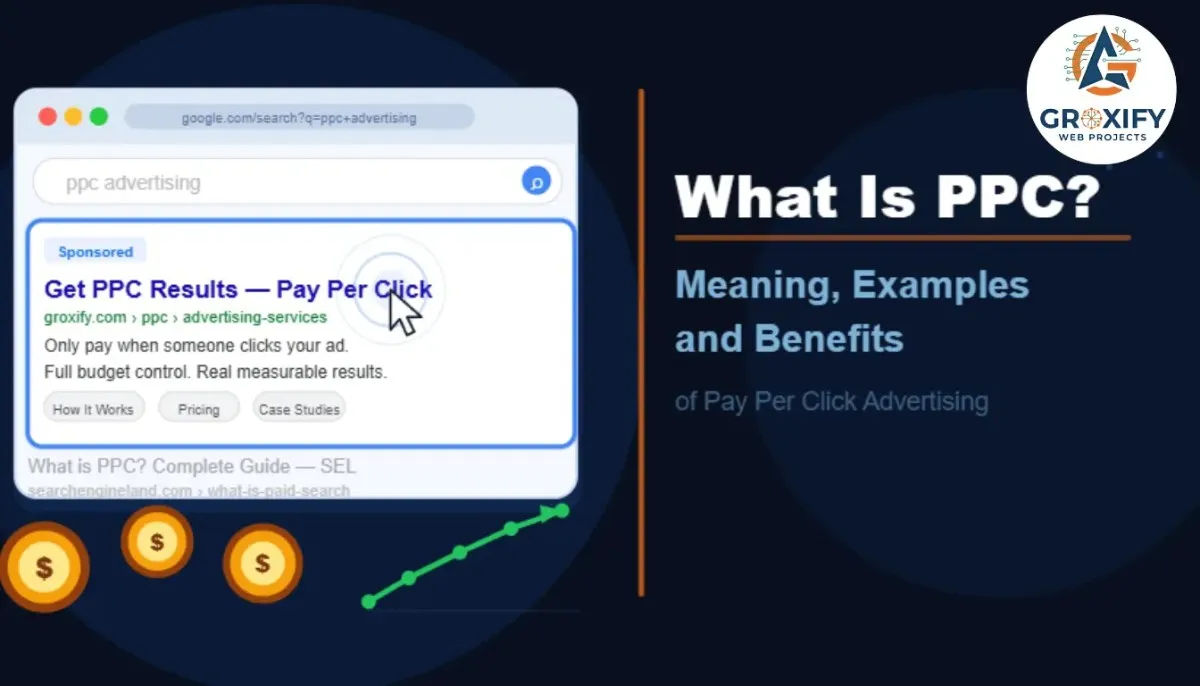
PPC stands for Pay Per Click. It is a type of online advertising where you only pay when someone actually clicks your ad — not when it shows up, not when someone sees it, only when they click.
So your ad can appear a thousand times. If nobody clicks, you pay zero. The moment someone clicks and lands on your page, that is when the cost happens. That one idea is the whole foundation of pay per click advertising.
You see PPC every single day. Those “Sponsored” results sitting above Google’s organic listings — that is PPC. The product ads that appear when you search for something to buy — also PPC. The ad that plays before a YouTube video — PPC again.
It runs across Google, Facebook, Instagram, YouTube, LinkedIn, and almost every major platform online.
How Does PPC Work?
This is where most beginners get lost, but it is actually simple once you see it clearly.
When someone searches on Google, an auction happens in milliseconds behind the scenes. Advertisers who have bid on that keyword compete for the available ad slots. The winner’s ad shows up. If the person clicks — the advertiser pays.
But here is the part most people do not know.
Google does not just pick whoever bids the highest. It looks at two things together — your bid amount and your Quality Score. Quality Score is Google’s rating of how relevant your ad and landing page are to the keyword you are targeting, scored from 1 to 10.
A well-written ad with a relevant landing page and a lower bid can beat a poorly made ad with a much higher bid. This means money alone does not win PPC. Relevance does. That is why two businesses spending the same budget can get completely different results.
The whole auction — search, competition, decision, ad display — happens before the page even loads.
What Is a Bid in PPC?
A bid is simply the maximum amount you are willing to pay for one click. You set this yourself. If your bid is 50 rupees, you are saying you will pay up to 50 rupees every time someone clicks your ad.
You almost never pay your full bid though. Google’s system usually charges you just slightly more than the next competitor’s bid — so actual cost per click is often lower than what you set.
What Is Quality Score?
Quality Score is Google’s way of measuring how useful your ad actually is to the person searching. It considers three things — how relevant your ad text is to the keyword, how good your landing page experience is, and your expected click-through rate based on past performance.
Higher Quality Score means lower costs and better placement. It rewards advertisers who genuinely help users, not just those with the biggest budgets.
Types of PPC Ads
PPC is not just Google search ads. It runs across multiple formats and platforms, each working slightly differently.
Search Ads
These are the text ads that appear on Google or Bing when someone searches a keyword. They show above and below the organic results with a small “Sponsored” label. This is the most common form of PPC and works best when someone is actively searching for something specific.
Shopping Ads
These are the product image cards with prices that appear at the top of Google when you search for something to buy. Each click goes directly to that product page. E-commerce businesses use these heavily because they show the product and price before the click — so the person clicking already has some buying intent.
Display Ads
These are image or banner ads that appear on websites, apps, and Gmail across Google’s network. They work on PPC or CPM (cost per thousand impressions — meaning you pay per view, not per click). Display ads are better for brand awareness than direct conversions.
Video Ads
The ads you see on YouTube before or during videos. You pay when someone watches past a certain point or clicks. Good for reaching people who are not yet searching but might be interested.
Social Media PPC
Facebook, Instagram, and LinkedIn all use PPC models. You target based on interests, demographics, and behavior rather than search keywords. These work well when you want to reach a specific type of person rather than someone searching a specific phrase.
PPC vs SEO — Honest Comparison
Almost every beginner asks this. And most articles dodge the real answer. So here it is straight.
| PPC | SEO | |
| Speed | Traffic within hours | Takes months |
| Cost | Pay per click | No cost per click |
| Traffic stops when | Budget runs out | Rankings drop |
| Control | Very high | Medium |
| Best for | Quick results, testing, launches | Long-term sustainable growth |
| Trust factor | Lower — marked as Sponsored | Higher — feels organic |
PPC is not better than SEO. SEO is not better than PPC. They solve different problems at different stages.
If you need traffic this week for a product launch or a sale — PPC. If you are building something for the long term and want traffic that does not disappear the moment you stop paying — SEO. Most serious businesses eventually run both together.
The thing is, PPC also gives you keyword data. You find out which searches actually convert into customers. Then you use that data to build your SEO strategy smarter. That combination is where real growth happens.
Real Benefits of PPC
Honest benefits — not marketing talk.
You pay for actual interest. Someone saw your ad and chose to click. That is a signal of real curiosity. You are not paying to be ignored like a billboard on a highway.
Immediate traffic. A well-set campaign can bring visitors within hours of going live. No waiting months for rankings to build.
Precise targeting. You can choose who sees your ad based on what they searched, where they are, what device they use, what time of day it is, and even what they have looked at before. Less wasted reach.
Full budget control. Set a daily limit. Pause anytime. You decide exactly how much you spend. No surprise bills.
Fast learning. Want to know which headline gets more clicks? Run two versions. Real data in days. This kind of testing would take months with organic content.
Measurable results. Every click, every conversion, every rupee spent is trackable. You know exactly what is working and what is not.
When PPC Fails — The Part Most Articles Skip
This is the honest section. PPC does not automatically work just because you paid for it.
The biggest reason PPC campaigns fail is not the ad — it is the page people land on after clicking. If your landing page is slow, confusing, or unconvincing, people leave immediately. You paid for the click and got nothing back. In practice, this is where most first-time PPC campaigns bleed money silently.
Thin profit margins make PPC very difficult. If you sell something for 300 rupees and a click costs 40 rupees, you need an unusually high percentage of visitors to convert just to break even. The math has to work before you spend.
Highly competitive keywords get expensive fast. Certain industries — insurance, real estate, legal, finance, education — have cost per click running into hundreds of rupees. A small budget in these spaces gets used up very quickly with very little to show.
PPC also needs ongoing attention. You cannot set it up and forget it. Without regular monitoring, budgets quietly drain on irrelevant clicks, underperforming ads keep running, and costs creep up without results improving.
PPC works when your ad, landing page, targeting, and budget all work together. Weakness in any one of them weakens the whole campaign.
How Much Does PPC Cost?
You control your own budget completely. There is no fixed minimum for most campaign types. You can technically start with 500 rupees a day and test what happens.
Cost per click depends entirely on competition. More advertisers bidding on the same keyword means higher prices. Less competition means cheaper clicks.
In India, Google Ads cost per click generally ranges from 5 rupees to 200 plus rupees depending on the industry. Local services and e-commerce tend to sit on the lower end. Finance, education, and healthcare run significantly higher.
What actually matters is not how much you spend — it is what comes back. Spend 15,000 rupees, generate 80,000 in revenue — that campaign is working. Spend 15,000 and generate 9,000 — something needs fixing before you spend more.
Start small. Read the data. Scale only what is proving to work.
Is PPC Right for You?
- You need traffic fast — PPC makes sense
- Your margins are healthy — PPC can be profitable
- You have a tested, clear landing page — PPC will work better
- You have zero budget — start with SEO first
- Your product is niche with low search volume — PPC on search may not scale, try social PPC
- You are testing a new product or offer — PPC is the fastest way to get real feedback
There is no universal answer. But that checklist tells you honestly whether now is the right time to run PPC for your specific situation.
At Groxify Web Projects, we see businesses rush into Google Ads before their landing page is ready. The budget disappears in two weeks and they blame PPC. The truth is PPC was fine — the foundation was not.
Key Takeaways
- PPC means Pay Per Click — you pay only when someone clicks, not just when your ad shows
- Google picks ad winners based on bid plus Quality Score — not just highest budget
- PPC brings traffic fast, SEO builds traffic long-term — smart businesses use both
- The landing page matters as much as the ad — a weak page wastes every click you pay for
- Cost per click varies by industry and competition — start small and scale what works
- PPC gives measurable, trackable results — every rupee spent tells you something useful
FAQ
PPC stands for Pay Per Click. It is an online advertising model where you pay only when someone clicks your ad. It is used across Google, Facebook, Instagram, YouTube, and most major digital platforms where advertising runs.
PPC brings paid traffic immediately but stops the moment your budget runs out. SEO builds organic rankings over time with no cost per click but takes months to show results. PPC is for speed, SEO is for sustainability. Most growing businesses use both.
You set your own daily budget with no forced minimum on most platforms. Cost per click on Google Ads in India typically ranges from 5 to 200 plus rupees depending on how competitive your industry is. Start small, test, then increase based on what the data shows.
Yes, but only when the basics are right. Small businesses with a clear offer, a decent landing page, and realistic margins can do well with PPC. Without those three things, small budgets disappear fast. Start with a small test campaign before committing serious spend.
Quality Score is Google’s rating of how relevant your ad and landing page are to the keyword you are targeting, scored from 1 to 10. A higher score means lower cost per click and better ad placement. It rewards relevance over raw budget.
Clicks can come within hours of launching. But meaningful data to actually optimize from takes around 7 to 14 days minimum. Do not make big decisions based on two or three days of data — give any new campaign at least two weeks before changing course.
No. PPC ads send people somewhere after they click — usually a landing page or product page. Without a destination the ad cannot run. Also, that destination page directly affects how well the campaign performs, so a weak page hurts results even when the ad is strong.
A landing page is the specific page someone reaches after clicking your ad. It is not your homepage — it is a focused page built around one goal, whether that is getting a call, a signup, or a purchase. A good landing page is what turns clicks into actual customers.
PPC is the advertising model — pay per click. CPC stands for Cost Per Click and is the actual amount you pay for each click. PPC describes how the billing works. CPC is the specific price. So PPC is the system, CPC is the number inside that system.
If you need results within weeks, start with PPC on a small budget while building your SEO in the background. If budget is very tight, focus on SEO first and use PPC only when you have something tested and ready to scale. They work best together, not as either-or choices.

Rohit Singh is the Founder of GROXIFY WEB PROJECTS LLP with many years of hands-on experience in digital marketing, including SEO, PPC, social media, email marketing, content writing, and WordPress development. He has worked with global clients across industries and helped businesses achieve 5x–10x revenue growth through data-driven strategies and practical execution. Rohit actively manages digital teams, builds business strategies, plans marketing systems, and oversees execution to drive consistent traffic, leads, and long-term business growth.