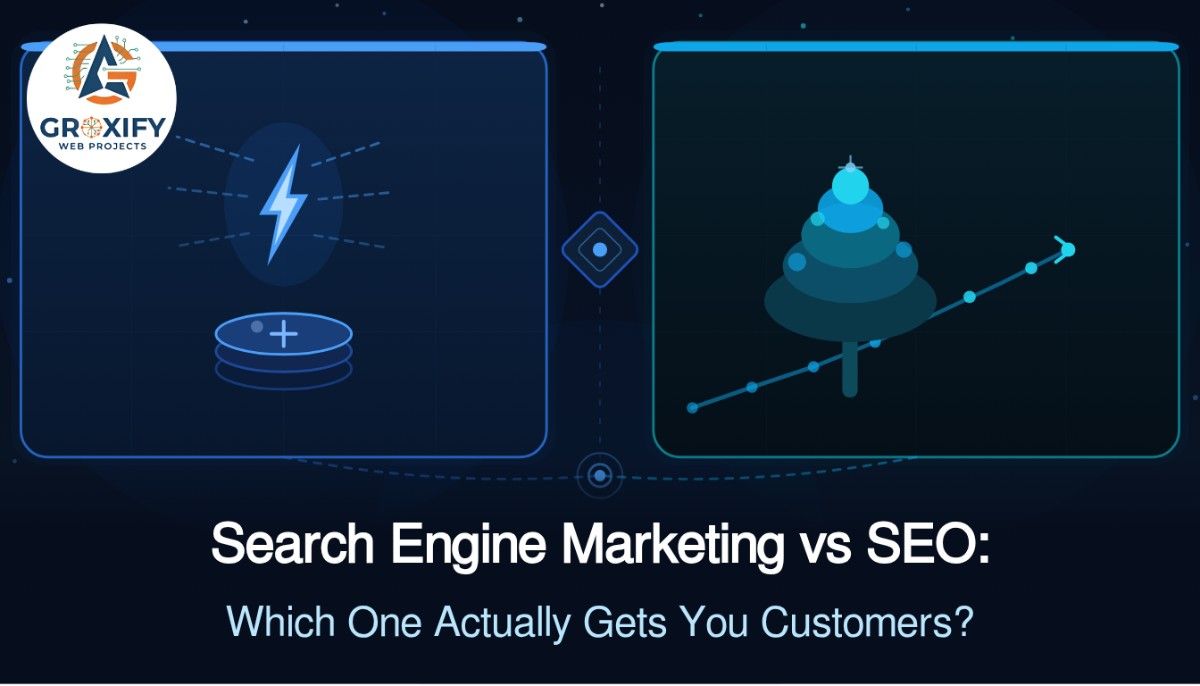
Two terms, same search results page, completely different strategies. That is where most people get confused. You search something on Google and you see results marked “Sponsored” at the top, then a bunch of regular results below. Both came from different approaches. One costs money every time someone clicks. The other took months to earn its spot.
Search engine marketing is the paid side. SEO is the organic side. But knowing just that is not enough to make a real decision for your business or project. In this article, you will understand how both actually work, where each one wins, where it fails, and how to decide what makes sense for you right now.
What Search Engine Marketing Actually Means
Most people hear “search engine marketing” and assume it covers everything related to Google. It does not. SEM, short for search engine marketing, specifically refers to paid advertising on search engines. When a business pays Google to show their ad at the top of search results for specific keywords, that is SEM.
The most common form is Google Ads, where you bid on keywords and pay each time someone clicks your ad. This model is called PPC, or pay-per-click, meaning your wallet gets charged per click, not per impression.
The “Sponsored” label is the giveaway
Every time you see “Sponsored” next to a Google result, that business is running SEM. They picked a keyword, set a budget, and their ad appeared. The moment they stop paying, the ad disappears. That is the core dynamic of paid search.
SEM gives you visibility fast. No waiting, no earning it. But it runs entirely on budget, and the moment that budget stops, so does your traffic.
What SEO Does (And Why It Takes Time)
SEO, or search engine optimization, is the process of improving your website so Google naturally shows it higher in search results, without you paying for each click. The word “organic” is used here because this traffic grows naturally over time rather than being bought.
You improve things like your content quality, page structure, site loading speed, and how many other credible websites link back to yours. Google evaluates all of this and decides where to rank you against every competing page on the same topic.
Why organic rankings take months
Google needs time to discover your content, crawl it (meaning Google’s bots visit and read your pages), compare it against millions of other pages, and then decide where it belongs. That whole process takes weeks, sometimes months.
But once you rank? Clicks come in without paying for each one. Over time, a well-ranked page becomes one of the most cost-efficient traffic sources a business can have. That is the real appeal of SEO.
SEM vs SEO: The Differences That Actually Matter
Here is a clean side-by-side so nothing stays vague:
| Factor | SEM (Paid Search) | SEO (Organic Search) |
| Speed | Immediate visibility | Takes 3 to 6+ months |
| Cost model | Pay per click, ongoing | Time and effort upfront |
| Traffic lifespan | Stops when budget stops | Continues without payment |
| Placement | Above organic results, marked Sponsored | Below ads, based on ranking |
| Control | You set exact keywords and timing | Google decides rank based on quality signals |
| Trust perception | Some users skip ads instinctively | Most users treat organic as more credible |
| Best suited for | Launches, short campaigns, testing | Long-term authority and brand building |
One thing worth understanding here: organic results still get the majority of clicks, even with ads sitting above them. For informational searches (someone researching, not buying yet), users tend to scroll past ads. For commercial searches (someone ready to buy), ads perform much better.
When Search Engine Marketing Makes More Sense
If you need traffic now, not three months from now, SEM is the right call. A product launch, a limited-time offer, a new service going live, or a business with no online presence but an active budget. These are SEM scenarios.
It also works well as a testing tool. Before spending months optimizing a page for a keyword, you can run a quick Google Ads campaign to check if people actually search for it, click on it, and buy. That data is genuinely valuable, and you would have waited a long time to get it through SEO alone.
And for competitive industries where the top organic spots are locked by massive, established brands, paid search can be the only realistic way to show up on page one in any reasonable timeframe.
Honestly, SEM rewards people who understand their numbers. If you know that every 100 clicks brings 5 customers and each customer is worth a certain amount, you can run ads profitably and keep scaling. The math has to work, though. Running ads without tracking conversions (the moment a visitor completes a goal, like a purchase or a form fill) is just burning money.
When SEO Is the Smarter Investment
If your budget is tight and you are thinking long-term, SEO builds something that compounds. A well-ranking article or product page can bring traffic for years without additional spending. SEM simply cannot match that.
SEO also builds trust in a way ads do not. Users know the “Sponsored” label means someone paid to be there. Organic results feel more credible for research-heavy searches like “best accounting software for freelancers” or “how to register a company in India.”
Businesses building a brand, an audience, or an information-heavy product tend to benefit enormously from organic search over time. Groxify Web Projects consistently sees this pattern in practice: businesses that invest in SEO early end up with lower customer acquisition costs as they scale.
One thing to be honest about: SEO is not free. You are trading money for time and skill. Writing quality content, earning backlinks (links from other websites pointing to yours, which signal credibility to Google), and fixing technical site issues all take real effort or money paid to someone doing it well. The cost is just less visible than an ad bill.
Can Both Work Together?
Yes, and this is actually the smartest setup for most growing businesses. They are not either-or options. They solve different problems and cover each other’s blind spots.
Use SEM to get traffic and revenue flowing while your SEO is still building. Once certain keywords start ranking organically, you can reduce ad spend on those specific terms and shift budget toward newer pages that still need visibility.
Another practical combination: run Google Ads first to discover which keywords actually convert, then prioritize those exact keywords in your SEO strategy. This removes most of the guesswork from content planning.
There is also a subtler benefit. When your brand appears in both the paid and organic sections of the same search results page, users are more likely to click one of them. Repeated exposure builds familiarity even for users who never click. That kind of recognition compounds quietly over time.
How to Decide Which One to Start With
Ask yourself three honest questions:
- Do I need results in the next 30 to 60 days? If yes, start with SEM.
- Can I commit a monthly ad budget without depending on returns to cover it immediately? If yes, SEM is viable right now.
- Am I building something that needs to grow without constant spending? If yes, make SEO your foundation from day one.
Most small businesses and freelancers benefit from doing some version of both, even if the SEO side is just one solid, well-researched piece of content published consistently each month. The compounding effect is real, even at a slow pace.
If your budget is genuinely limited, start with SEO. It takes longer to pay off but it does not stop working the moment you cannot afford to keep it running.
So here is the simplest way to think about all of this. SEM and SEO are not rivals. They are tools built for different timelines. Paid search gets you visible now. SEO earns that visibility and keeps it without ongoing payment. The goal for most businesses is to build toward using both together. Start where your current situation demands, but always keep the other in your plans. Search engine marketing gives you speed. SEO gives you staying power. That one distinction, understood properly, is worth more than any checklist.
FAQ
SEM is paid advertising on search engines where you pay for each click your ad receives. SEO is organic search optimization where you improve your site to earn unpaid rankings over time. SEM delivers instant visibility. SEO builds traffic that does not stop when a budget runs out.
No, they are separate strategies. SEM refers specifically to paid search ads. SEO covers unpaid, organic ranking improvements. Both appear on the same search results page but work through different methods. Some marketing definitions group them both under digital marketing, but operationally they are completely different channels.
Most websites see meaningful organic ranking movement within three to six months. Competitive keywords in crowded industries can take a year or longer. Speed depends on your domain authority (a credibility score Google assigns your site), content quality, and how consistently you build and optimize pages over time.
If you have budget and need leads quickly, start with SEM. If budget is limited, build SEO from day one and accept a longer timeline. The strongest setup for a new business is running SEM for early revenue while SEO builds in the background, then gradually shifting spend as organic traffic grows.
No. Paid ads and organic rankings are completely separate in Google’s system. Running ads does not improve where your pages rank organically. What SEM does indirectly help is your SEO strategy because the keyword and conversion data from campaigns helps you make smarter content and optimization decisions.
Yes, Google Ads has no minimum budget. The real question is whether your profit per customer justifies the cost per click in your specific industry. Some sectors are expensive to advertise in, others are quite affordable. Start with a small test budget you are comfortable spending while you learn the numbers before scaling.
Yes, Google Ads has no minimum budget. The real question is whether your profit per customer justifies the cost per click in your specific industry. Some sectors are expensive to advertise in, others are quite affordable. Start with a small test budget you are comfortable spending while you learn the numbers before scaling.
There is no universal number because keyword costs vary widely across industries and markets. The smarter approach is to start with whatever you can afford to spend while learning, without expecting a return in the first month. Watch your cost per click, your conversion rate, and your cost per acquisition before committing to scale.
Most freelancers benefit more from SEO. It builds consistent visibility without ongoing ad spend, which matters when income varies month to month. A well-optimized service or portfolio page can bring in leads for years. SEM makes sense for freelancers in high-margin work where they can clearly calculate what a new client is worth versus what a click costs.
It means the moment you stop paying, the traffic stops completely. There is no residual effect. Unlike SEO, where content can keep ranking and driving visitors long after it was published, SEM only delivers results while the campaign is actively funded. That is why it works best as a short-term or supplementary channel, not a standalone long-term strategy.

Rohit Singh is the Founder of GROXIFY WEB PROJECTS LLP with many years of hands-on experience in digital marketing, including SEO, PPC, social media, email marketing, content writing, and WordPress development. He has worked with global clients across industries and helped businesses achieve 5x–10x revenue growth through data-driven strategies and practical execution. Rohit actively manages digital teams, builds business strategies, plans marketing systems, and oversees execution to drive consistent traffic, leads, and long-term business growth.