
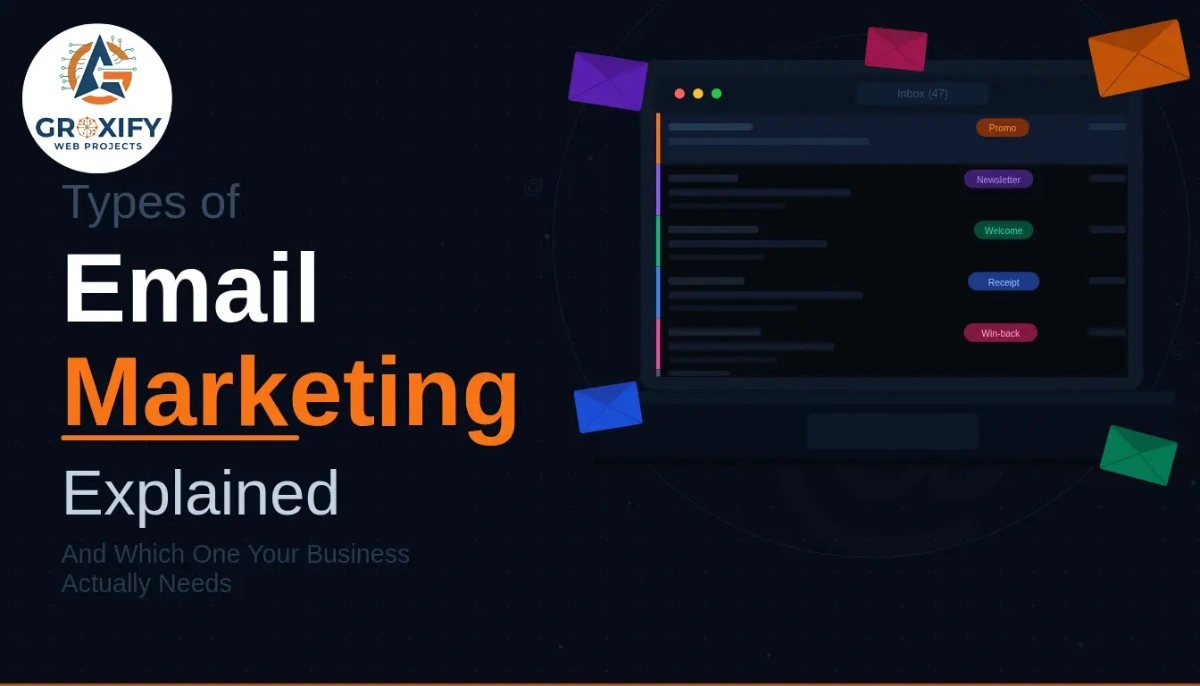
Types of Email Marketing Explained (And Which One Your Business Actually Needs)
You open your inbox and there are 47 unread emails. Some you actually want. Most you ignore. A few you delete before they even finish loading. That split — that difference in how you react to each email — that is email marketing doing its job, or failing at it.
Businesses send different types of email marketing for very different reasons. Some emails are meant to sell. Some are meant to inform. Some are quietly trying to win you back. Knowing the difference changes how you build a strategy that actually works. This article covers every major type, what it does, and how to figure out which one you should be sending right now.
What Email Marketing Actually Is
Email marketing is when a business sends emails to a list of people who have, at some point, shown interest or signed up. That is the core of it.
It is not cold emailing strangers. It is not spam. Those are different things and get treated very differently by email providers. Real email marketing is permission-based — meaning the person agreed to receive emails from you.
The goal varies. Sometimes the goal is to sell something directly. Sometimes it is to stay in someone’s mind until they are ready to buy. Sometimes it is just to be useful. The type of email you send depends entirely on what you are trying to do at that moment in the relationship.
The Main Types of Email Marketing
There is no single “email marketing.” It is an umbrella term covering several distinct strategies, each with its own purpose, timing, and tone. Here is every major one broken down.
Welcome Emails
A welcome email goes out the moment someone joins your list, creates an account, or makes their first purchase. It is the first real conversation between your brand and that person.
This is the most opened type of email in all of email marketing. People are curious right after signing up. Open rates for welcome emails are consistently higher than any other type. That makes this email too valuable to waste on a generic “thanks for joining.”
A strong welcome email does a few things. It confirms the person made a good decision. It tells them what to expect next. And it often includes one clear action — read this, download that, check this out. One action, not five.
If you are not sending a welcome email yet, that is the first thing to fix.
Newsletter Emails
A newsletter is a regular email — weekly, biweekly, monthly — that shares updates, content, insights, or news. It is not a sales pitch. Or at least, it should not feel like one.
Newsletters are about staying present. People forget brands quickly. A good newsletter keeps you in their inbox and in their mind without being pushy. Over time it builds trust.
The mistake most businesses make with newsletters is treating them like an announcement board. Nobody wants to read your “Company Update Q3.” But they will read something that teaches them something useful or makes them feel smart for opening it.
A newsletter works best when it has a consistent voice, a consistent schedule, and a reason for existing beyond just “keeping in touch.”
Promotional Emails
Promotional emails are the straightforward ones. They announce a sale, a new product, a limited offer, or a discount. The goal is a direct action — usually a click or a purchase.
These are the emails that look like email campaigns (email campaign means a planned email or series of emails sent toward a specific goal) with bold visuals, a headline offer, and one big button.
They work when the offer is genuinely good and the timing is right. They backfire when you send them too often, because then every email from you looks like a sales pitch and people stop opening them.
One honest rule in practice: if every email you send is promotional, your open rates will fall over time. Mix it up.
Transactional Emails
Transactional emails are triggered by something the user did. Order confirmations, shipping updates, password resets, billing receipts. These are not marketing in the traditional sense, but they are a massive opportunity.
People actually read these emails. Open rates are extremely high because there is always something at stake — a delivery, a login, a payment. That attention is worth something.
Smart businesses use transactional emails to do a little extra. A shipping confirmation might remind you of a related product. A receipt might include a referral code. It does not feel salesy because the context is helpful. It just feels thoughtful.
If you are ignoring your transactional emails, you are ignoring the most-read emails your business sends.
Re-engagement Emails
At some point, people on your list go quiet. They stop opening. They stop clicking. They are technically still subscribed but emotionally they have left.
A re-engagement email (also called a win-back email) is sent specifically to these inactive subscribers — people who have not opened or clicked in a defined period, usually 60 to 90 days. The goal is simple: get their attention back or let them go cleanly.
A strong re-engagement email does not pretend nothing happened. It acknowledges the silence. Something like “We have not seen you in a while” works because it is honest. Often it includes an incentive — a discount, something new, a direct question about whether they want to stay.
If they still do not respond after one or two attempts, the right move is to remove them from your active list. Sending to unresponsive subscribers hurts your deliverability (which means how often your emails actually land in inboxes vs. going to spam). It is better to have a smaller, engaged list than a large dead one.
Triggered or Behavioral Emails
These emails are sent automatically based on something specific the person did — or did not do.
A common example: someone visits your pricing page three times and does not buy. An automated triggered email goes out 24 hours later. Or someone adds products to a cart and abandons it. A cart abandonment email arrives soon after.
Triggered emails feel personal because they are responding to real behavior. That is exactly why they convert so well. You are not guessing what someone needs — you are responding to what they already showed you.
Setting these up takes more effort than a regular campaign. You need an email platform with automation built in (most modern ones have it) and some planning upfront. But once running, they work in the background without you touching them.
Lead Nurturing Emails (Drip Campaigns)
A drip campaign is a series of emails sent over time to guide someone through a process. Lead nurturing means warming up someone who is interested but not yet ready to buy.
Imagine someone downloads your free guide. That is interest, not purchase intent. A nurture sequence might be five emails over two weeks — one that delivers the guide, one that shares a related tip, one that tells a relevant story, one that introduces your product naturally, and one that makes a direct offer.
Each email builds on the last. The goal is to move someone from “this looks interesting” to “I think I need this.”
Drip campaigns (the term comes from the idea of slowly dripping information rather than flooding someone at once) are especially useful for higher-ticket products or services where people need more time and information before they decide.
Types of Email Campaign vs. Types of Email Marketing
People often use these terms interchangeably and they are close — but not the same.
An email campaign is a specific planned effort. It has a goal, a defined audience, a set of emails (sometimes just one), and a timeline. It ends.
Email marketing is the broader ongoing practice of using email to connect with and convert your audience. It includes campaigns but also includes automated sequences, transactional emails, newsletters, and everything else.
Think of email marketing as the entire relationship. A campaign is a specific conversation within that relationship.
| Term | What It Means | Example |
|---|---|---|
| Email Marketing | The full strategy | Building and emailing your list over months |
| Email Campaign | A specific planned effort | Black Friday sale with 3 emails over 5 days |
| Email Sequence | Automated multi-email series | Drip campaign triggered after a download |
Types of Email Account You Need to Get Started
This is something beginners almost always overlook and then regret.
You do not want to send marketing emails from a personal Gmail or Yahoo account. Email providers like Gmail flag bulk sends from personal accounts quickly, and your emails will land in spam before anyone sees them.
There are two types of email accounts that matter for marketing:
A professional domain email — something like hello@yourbusiness.com — builds trust and protects your personal inbox. This is the sender address your audience sees.
A dedicated sending service — platforms like Mailchimp, Brevo, Kit, or similar tools handle the technical delivery. They manage things like unsubscribes, spam compliance, and analytics (data showing open rates, clicks, and other performance stats) automatically. You write the email inside the platform, build your list there, and let the platform handle the rest.
The combination of a branded domain email plus a reputable sending platform is the foundation. Without that, even the best email content will underperform.
Which Types of Email Marketing Work Best Together
No single type works alone forever. The businesses that see real results from email are the ones that layer types intelligently.
A solid starting setup for most businesses looks like this: a welcome email the moment someone joins, a short nurture sequence over the next few weeks, a regular newsletter to stay present, promotional emails around actual reasons to offer a deal, and triggered emails that respond to specific actions.
That is not complicated. But it covers the full relationship — from “hello” to “here is a reason to buy today” to “we have not heard from you in a while.”
Start with one type — the welcome email — and build from there. Trying to set up everything at once leads to nothing being done well. Groxify Web Projects has seen this across multiple client setups: simple, intentional email systems outperform complicated ones almost every time.
Conclusion
The types of email marketing are not random categories. Each one maps to a real moment in the relationship between a business and a customer. Welcome emails open the conversation. Newsletters keep it going. Promotional emails make the ask. Triggered emails respond to behavior. Drip campaigns build trust over time.
Pick one type of email marketing, set it up properly, and watch what happens before adding another layer. The businesses that treat email as a serious channel — not just an afterthought — consistently see it become their most reliable source of repeat revenue. That is the real reason this channel still matters more than most people think.
FAQ
Email marketing is the full, ongoing strategy of using email to build relationships and drive sales. An email campaign is a specific planned effort within that strategy — like a sale announcement or a product launch sequence — with a defined goal and timeline.
Start with a welcome email. It is the most opened type of email and sets the tone for your relationship with subscribers. Once that is running well, add a short nurture sequence and a regular newsletter. Build step by step, not all at once.
There is no universal right answer, but most audiences tolerate one to four emails per month comfortably. Promotional emails need a real reason. Newsletters work on a consistent schedule. Triggered emails go out based on behavior, not a calendar. Frequency matters less than relevance.
A drip campaign is a series of automated emails sent over time to guide someone toward a goal — usually a purchase or a decision. Each email builds on the last. It is called a drip because it delivers information gradually rather than all at once.
Technically, transactional emails like order confirmations and receipts are triggered by user actions, not sent as marketing. But they are powerful opportunities. People open them reliably, so smart businesses use them to reinforce trust, suggest related products, or share useful next steps.
You need two things. A professional domain-based email address like yourname@yourbusiness.com as your sender identity, and a reputable email sending platform like Mailchimp or Brevo to actually deliver your emails at scale. Sending from a personal Gmail account will get your emails flagged as spam.
A re-engagement email targets subscribers who have stopped opening your emails, typically after 60 to 90 days of inactivity. It tries to reconnect with a direct message or offer. If they still do not respond after one or two attempts, it is better to remove them from your active list.
Yes, and most businesses should. A welcome email, a nurture sequence, and a monthly newsletter can all run together without conflicting. The key is making sure each type has a clear purpose and that they do not feel repetitive or overwhelming to the person receiving them.
A newsletter is scheduled and goes to your whole list on a regular basis. A triggered email is automated and goes to a specific person based on something they did — like abandoning a cart or visiting a pricing page. Triggered emails feel more personal because they are responding to real behavior.
Look at three core metrics. Open rate shows how many people opened the email. Click rate shows how many clicked something inside it. Conversion rate shows how many completed the goal — a purchase, a signup, a download. Each email type has different benchmarks, so compare results within the same type over time.

Rohit Singh is the Founder of GROXIFY WEB PROJECTS LLP with many years of hands-on experience in digital marketing, including SEO, PPC, social media, email marketing, content writing, and WordPress development. He has worked with global clients across industries and helped businesses achieve 5x–10x revenue growth through data-driven strategies and practical execution. Rohit actively manages digital teams, builds business strategies, plans marketing systems, and oversees execution to drive consistent traffic, leads, and long-term business growth.