
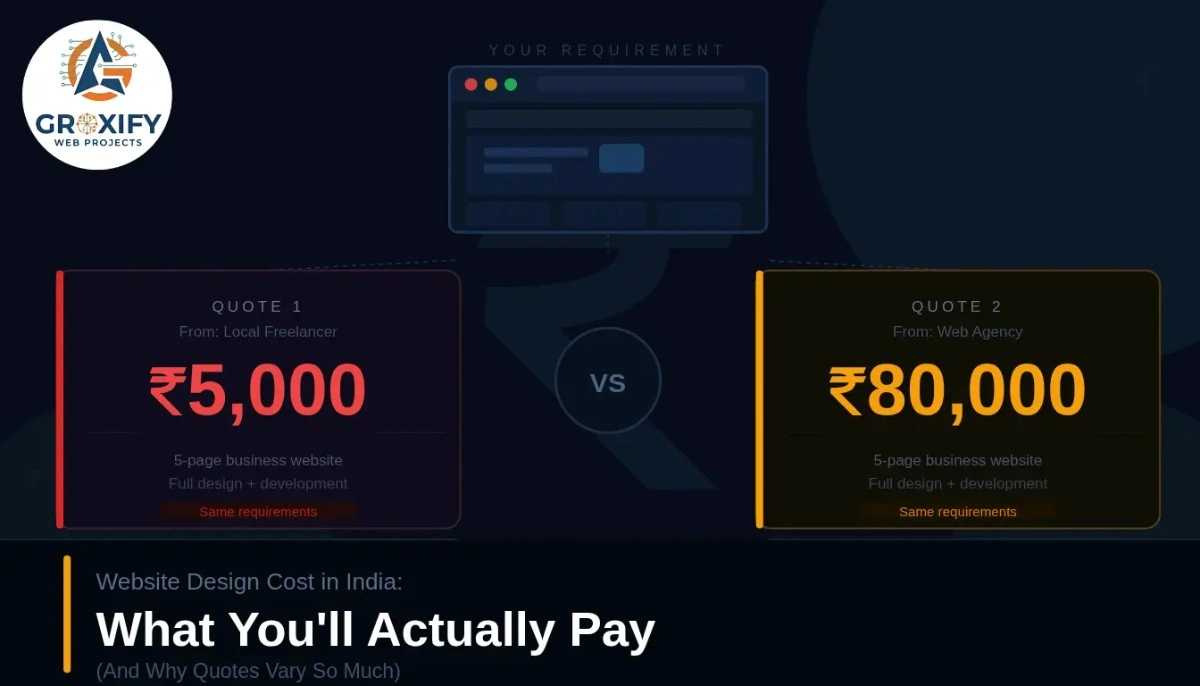
Someone sends you a quote for ₹5,000. Another sends ₹80,000. Same requirement. Both call it a “business website.” You have no idea who to trust or what the right number even is.
This is where most people get stuck. The website design cost in India has no fixed price, and that is not a bad thing once you understand why. Price depends on what you are building, who builds it, and what features you actually need versus what sounds good in a sales call.
This article gives you a full breakdown. By the end, you will know what different websites cost, what pushes prices up or down, and exactly what to ask before paying anyone a single rupee.
What Does Website Design Cost in India Actually Include?
Before looking at numbers, you need to know what you are even paying for. Most people think website design means someone makes the site look good. That is only part of it.
A complete website project usually includes design (how it looks), development (how it works), content setup (adding your text, images, and pages), and sometimes hosting and domain setup too.
Some providers bundle all of this into one quote. Others charge separately for each piece. That is why two quotes for the “same thing” can look completely different on paper.
Also, design and development are different skills. Design is the visual layout, colors, fonts, and structure. Development is the code that makes everything function. Cheaper providers often do one but not both well. That gap shows up later, not upfront.
Website Design Cost in India by Website Type
Here is what the market currently looks like, broken down by what you are actually building.
| Website Type | What It Is | Typical Price Range |
|---|---|---|
| Landing Page | Single page, one goal — lead capture or product launch | ₹3,000 – ₹15,000 |
| Static Brochure Website | 3–5 pages, no backend, just information | ₹5,000 – ₹25,000 |
| WordPress Business Website | Multi-page, CMS-based, editable by you | ₹15,000 – ₹60,000 |
| E-Commerce Website | Product listings, cart, payments, order management | ₹30,000 – ₹2,00,000+ |
| Custom Web Application | Built from scratch, specific or complex features | ₹1,00,000 – ₹10,00,000+ |
CMS means Content Management System, basically a backend panel that lets you edit your own website without touching any code. WordPress is the most common one in India.
These ranges are wide because provider type, feature list, and timeline all affect the final number. A WordPress site from a solo freelancer costs differently than the same from a full agency team.
One thing most people miss: a ₹10,000 WordPress site and a ₹50,000 one can look identical at first glance. The difference shows up in page speed, mobile experience, security setup, and how easy the site is to manage six months later.
Freelancer vs Agency vs DIY: Where the Price Difference Actually Comes From
This is the comparison most people need before deciding.
Freelancers charge less because their costs are low. A good freelancer can absolutely build a solid website. But you are working with one person, so timelines slip when they get busy, and you may need to hire separately for design, content, or SEO if those are not their strengths.
Agencies charge more because they have teams — a designer, a developer, a project manager, sometimes a strategist. You get structure, clearer communication, and accountability. You also pay for all of that overhead.
DIY platforms like Wix or Squarespace let you build a site yourself for ₹800–₹2,500 per month as a subscription. These work for very simple needs. But customization has real limits, and you are renting the platform — not owning your website outright. Stop paying, site goes down.
In practice, most small businesses in India start with a freelancer for their first website, then move to an agency when the stakes are higher and the requirements get more complex.
Hidden Costs Nobody Tells You About
This is the part that blows most budgets, and competitors rarely explain it clearly.
The quoted price is almost never the total price. Here is what typically gets added after the main quote:
- Domain name: ₹700–₹1,500 per year. Some providers include it free for year one, then charge from year two onward.
- Hosting: ₹3,000–₹20,000 per year. Shared hosting is cheapest but slower. Cloud or VPS hosting (Virtual Private Server, faster and more reliable) costs more.
- SSL certificate: This is what creates the padlock icon in the browser and makes your site secure. Often comes free with hosting, but not always.
- Premium plugins or themes: If your site needs advanced features, the tools that power them can cost ₹3,000–₹15,000 extra, sometimes as annual licenses.
- Annual maintenance: Bug fixes, software updates, security patches. If you hire someone for this, expect ₹5,000–₹20,000 per year.
The gap between a ₹20,000 quote and a ₹35,000 final bill is almost always these extras arriving one by one.
What Pushes Website Design Price in India Up or Down
Understanding these factors helps you read any quote you receive and have an honest conversation about budget.
What drives cost higher:
- Custom design built from scratch instead of a ready theme
- E-commerce features like payment gateway integration, inventory, and order tracking
- Multilingual website support
- Speed optimization beyond basic setup
- Third-party integrations like CRM (Customer Relationship Management software), WhatsApp, booking systems, or email marketing tools
- Tight deadlines, since rush timelines almost always add a premium
What keeps cost lower:
- Using a ready theme with minimal customization
- Fewer pages with clear purpose
- You provide all content ready to use — text, images, logo, copy
- No complex features, just clean pages with good information
In practice, the single biggest cost driver is always feature count. Every added feature means more design time, more development time, and more testing before delivery.
How to Read a Website Quote Without Getting Fooled
Most people look at the total number and make a decision. That is the wrong approach.
Ask these five questions before saying yes to anyone:
- Is domain and hosting included, or are they separate?
- What happens if I need changes after the site is delivered?
- Will I own the website and hosting account, or will it stay on your account?
- What platform will you build on, and can I manage it myself later?
- Is there a maintenance plan, and what does it cost?
A quote that answers all five clearly is a good sign. A quote that gets vague on any of these deserves a follow-up before you commit.
Also, be honest with yourself about this: if someone quotes ₹5,000 for a full business website with 10 pages, e-commerce, and custom design, that is not a deal. Website design services cost what they cost because skilled time costs money. Something will be wrong, missing, or abandoned partway through.
Which Budget Range Makes Sense for Your Situation
Here is a practical way to think about this without overcomplicating it.
If you are a freelancer, coach, or service provider who needs a clean online presence, a WordPress site between ₹15,000 and ₹30,000 is genuinely enough to start strong.
If you sell products online, do not cut budget on the e-commerce setup. A broken checkout or slow loading page costs you sales every single day. Build it properly the first time, even if that means spending ₹60,000–₹1,00,000.
If you are testing an idea and not sure you even need a full site yet, a landing page for ₹5,000–₹10,000 is a smart first step. Validate before you invest.
The team at Groxify Web Projects sees this pattern regularly: clients who started with a very cheap site, ran into problems after a few months, and had to rebuild from scratch. The second build cost more than doing it right the first time would have.
Conclusion
The website design cost in India is not one number — it is a range shaped by what you need, who builds it, and what gets included or excluded. Now you know exactly what those factors are.
Your next step is simple. Write down what your website actually needs to do, not what sounds impressive, just what it genuinely needs. That list becomes your brief. Take it to two or three providers, ask the five questions from this article, and compare properly.
A website is not a one-time cost. It is an asset that either works for you or does not. Get it right from the start.
FAQ
A standard small business website in India currently costs between ₹15,000 and ₹60,000. Price depends on page count, feature list, and whether you hire a freelancer or agency. Basic 5-page sites sit at the lower end. More features push the number higher.
For a single-page portfolio or basic landing page, possibly. For a full business website with multiple pages and proper design, no. At that price something is always missing — quality design, mobile optimization, speed setup, or post-delivery support. Expect to pay more for results that actually hold up.
Freelancers typically charge 30–50% less than agencies for similar work because their overhead is lower. Agencies offer team-based delivery, structured timelines, and more accountability. For small or simple projects, a good freelancer works well. For complex or business-critical sites, an agency reduces risk considerably.
Not always. Many providers quote only design and development. Domain registration costs ₹700–₹1,500 per year. Hosting costs ₹3,000–₹20,000 per year depending on type. Always ask what is included and what is billed separately before accepting any quote.
A basic e-commerce site starts around ₹30,000. A well-built, fast, complete store with payment gateway and order management typically costs ₹60,000–₹2,00,000. Cutting budget here is risky — a slow or broken checkout directly costs you sales every day.
Yes. Platforms like Wix or Squarespace let you build one for ₹800–₹2,500 per month. It works for simple needs but has customization limits. You also pay as long as you use it — stop paying and the site goes offline. For serious business use, a professionally built site gives you more long-term control and flexibility.
CMS stands for Content Management System. It is a backend panel that lets you update your website — add blogs, change images, edit pages — without writing any code. WordPress is the most popular CMS in India. If you plan to update your site regularly yourself, you definitely need one.
A 5-page business website typically takes 1–3 weeks. An e-commerce site takes 4–8 weeks. Custom web applications can take 3–6 months or more. Timelines stretch most often when clients delay providing content or approvals. Having everything ready before the project starts speeds things up significantly.
Have your logo, brand colors, all written content, reference websites you like, and a clear list of pages and features ready. The more complete your brief, the faster the work and the fewer revision rounds you will need. Vague briefs consistently lead to vague results and budget overruns.
Get at least 3 quotes for the same brief. Ask specifically what is included and what costs extra. Review past work, not just testimonials. Avoid anyone who cannot clearly explain what platform they are using or who asks for full payment before starting. A phased payment structure is standard and fair practice.

Rohit Singh is the Founder of GROXIFY WEB PROJECTS LLP with many years of hands-on experience in digital marketing, including SEO, PPC, social media, email marketing, content writing, and WordPress development. He has worked with global clients across industries and helped businesses achieve 5x–10x revenue growth through data-driven strategies and practical execution. Rohit actively manages digital teams, builds business strategies, plans marketing systems, and oversees execution to drive consistent traffic, leads, and long-term business growth.