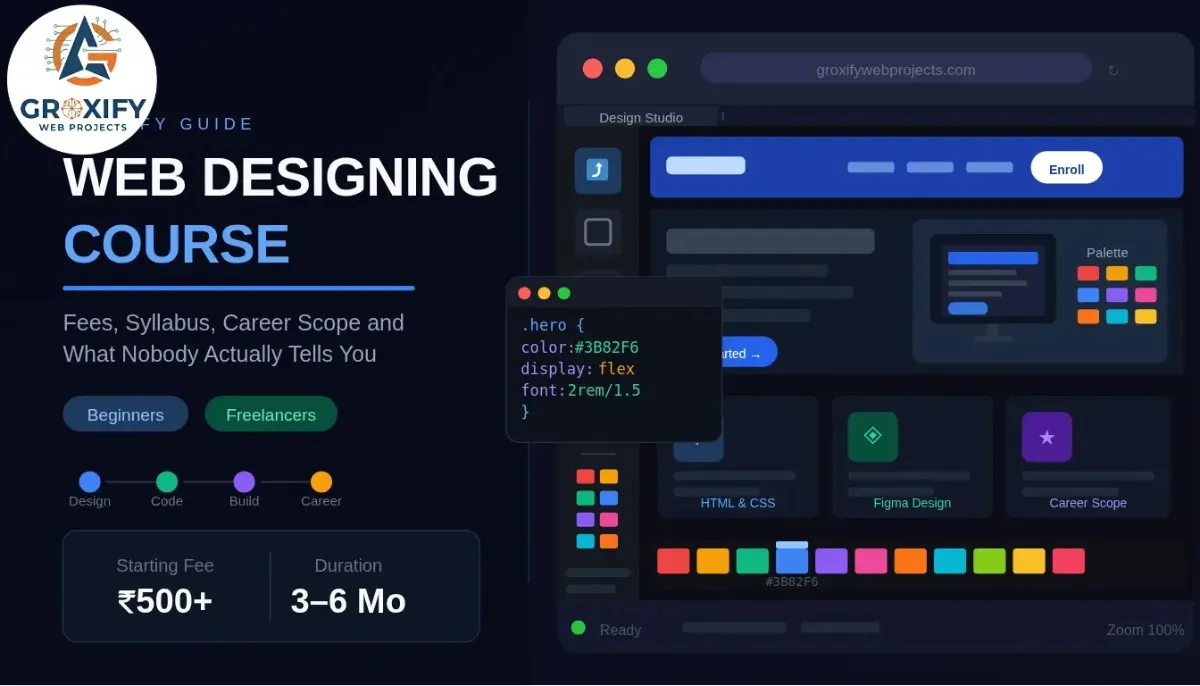
Most people who land on an article about a web designing course are not really sure what they want yet. They just know they want a skill that pays, works from a laptop, and does not require a four-year degree to get started. That is a completely fair place to begin.
This article covers the full picture — what you actually learn, how much it costs (including the free route, honestly), how long it takes, and what the career looks like after. By the end, you will know exactly what to pick and where to start.
What Web Designing Actually Is (Most People Get This Wrong)
Web designing is the process of deciding how a website looks, feels, and guides the people using it. That includes the layout, colors, fonts, spacing, button placement, and how all of it fits together on a screen.
It is not the same as web development. Web development is the code that makes a site work behind the scenes — databases, server logic, user accounts. Web design is what you see and feel. Both matter. They are not the same job.
A lot of beginners also confuse web design with graphic design. Graphic design is mostly for print — posters, logos, brochures. Web design is built for screens, and a screen behaves very differently from a poster. A website responds to clicks, resizes for different devices, and has to load fast. These constraints change how you design entirely.
In practice, web designers work in tools like Figma (a software used to design and prototype websites before any code is written) and write HTML and CSS (the two basic languages that build what a person actually sees on a webpage). Some also know a bit of JavaScript, which adds interactive behavior like dropdowns and animations.
You do not need to become a full developer to be a good web designer. But you do need to understand how a design becomes a real page.
Web Designing Course Syllabus: What You Actually Learn
A good web designing course does not start with code. That surprises people. It starts with fundamentals, because if you cannot explain why something looks right, you cannot design anything that holds together.
Here is how a solid syllabus actually breaks down.
Design Fundamentals
This covers color theory (how colors relate, contrast, and create emotional response), typography (how to choose and pair fonts that are both readable and intentional), and layout principles (how to guide a viewer’s eye across a page without them noticing you’re doing it).
Most courses also introduce UI and UX basics here. UI stands for User Interface — it is how the website looks and responds to interaction. UX stands for User Experience — it is how easy or frustrating the website is to actually use. These two overlap a lot in web design.
Design Tools
Figma is the industry standard right now. You will learn to create wireframes (rough, black-and-white sketches of a page’s structure), mockups (fully detailed visual designs), and prototypes (clickable demo versions of a design that feel like the real thing without any live code). Some courses also cover Adobe XD, but Figma has largely replaced it in most professional workflows.
HTML and CSS
HTML stands for HyperText Markup Language — it is the skeleton of every webpage, defining what is a heading, what is a paragraph, what is a button. CSS stands for Cascading Style Sheets — it controls how that skeleton looks, meaning all the colors, fonts, spacing, and positioning.
Together, these two let you take a design from Figma and turn it into a real, working webpage. This is not optional in a serious web designing course. Even if you plan to use WordPress or a drag-and-drop builder later, knowing HTML and CSS means you can customize things, fix things, and not panic when something looks wrong.
Responsive Design
Responsive design means a website automatically adjusts to look right on any screen — phone, tablet, desktop. Since most web traffic comes from mobile devices, this is not a bonus topic. It is a core one.
You will learn media queries (rules written in CSS that change a site’s layout at specific screen sizes) and the mobile-first approach, which means designing for the smallest screen first and scaling up.
Additional Modules (Varies by Course)
Depending on where you study, you might also cover:
- JavaScript basics for interactive elements like sliders, pop-ups, and form validation
- WordPress, the platform where most freelance web design work actually happens
- Basic SEO principles and how design decisions affect search ranking
- Portfolio building, which some courses treat as a proper module and others just mention in passing
Ask specifically what is included before you pay. Vague syllabuses are a red flag.
Web Designing Course Fees: Free vs Paid, What You Actually Get
This is the section most articles either avoid or oversimplify. Here is the honest version.
Free Web Design Courses Online
Free options exist, and several are genuinely good. FreeCodeCamp, The Odin Project, and Google’s web development documentation are solid starting points for HTML, CSS, and design basics. YouTube has full courses from experienced designers that cost nothing at all.
The real limitation is not quality. It is structure. Free courses have no schedule, no one checking your progress, no feedback on your actual work, and no path that moves you forward automatically. Many people start three free courses and finish none. A free web design course online works well if you are self-disciplined and can build things without someone pushing you. For most people, it is how they start and then get stuck.
Paid Courses: What the Range Looks Like
| Format | Approximate Fees | Duration | Best Suited For |
|---|---|---|---|
| Online self-paced (Udemy, Coursera, etc.) | Rs. 500 to Rs. 5,000 | 20 to 60 hours | Flexible learners who want guided content |
| Online course with mentorship | Rs. 15,000 to Rs. 50,000 | 3 to 6 months | Those who want feedback and career guidance |
| Offline institute (classroom) | Rs. 20,000 to Rs. 80,000 | 3 to 6 months | Those who prefer face-to-face interaction |
| Diploma or university program | Rs. 50,000 to Rs. 2,00,000 | 1 to 2 years | Those who want a formal credential |
Udemy and similar platforms regularly run sales where courses drop to Rs. 500 to Rs. 700. At that price, they are excellent value. The limitation is no mentorship, no live feedback, and no one to tell you when your design is actually broken.
Offline institutes vary enormously. The name on the certificate matters far less than the actual portfolio you build during the course. Before enrolling anywhere, ask to see real projects made by past students. If they cannot show you those, move on.
How Long It Actually Takes to Learn Web Design
Realistically, three to six months of consistent effort gets most people to a point where they can take on freelance work or apply for junior roles. Here is what that looks like in practice.
The first four to six weeks cover fundamentals and design tools. You will feel slow. That is normal. Weeks seven through twelve are where HTML, CSS, and building real pages from scratch happen. This is where it starts clicking.
Month three onward is where you polish everything, build portfolio projects, and move from “I learned this” to “I can actually do this.”
The people who get there fastest are the ones who build things they actually care about. Pick a topic you like — a music project, a small local business, a personal portfolio — and build a website for it. A portfolio of three to five real-looking projects beats a certificate from anywhere.
Future Scope of Web Designing: What the Career Looks Like
The future scope of web designing is strong, and the reason is simple — every business that exists needs a website, and most websites need to be updated or redesigned every few years. That demand is not going away.
What does change is what tools and standards designers are expected to know. Currently, there is a growing demand for designers who understand user experience alongside visual design, and who can design for mobile as the primary experience rather than an afterthought.
Jobs You Can Get
Entry-level web designer roles in agencies and startups in India typically start between Rs. 15,000 and Rs. 25,000 per month. Mid-level designers with a strong portfolio and two to three years of real experience earn considerably more. Specific roles you will see in job listings:
- UI Designer — focused on the visual and interactive design of interfaces
- Visual Designer — focused on layout, branding, and graphic presentation
- UX Designer — focused on user research and experience flow (often needs additional training beyond a standard web design course)
- Front-End Developer — if you push deeper into code, this role pays more and has broader demand
Many web designers eventually move toward product design, which means designing apps and software products. That track tends to pay significantly better.
Freelancing
Freelancing in web design is one of the more accessible independent paths in the field. A working freelance web designer in India can charge anywhere from Rs. 10,000 to Rs. 50,000 per website project, depending on the scope and client type.
But here is what the courses do not tell you: freelancing is not just about design skills. It is about finding clients, writing proposals, managing revisions, and delivering under pressure. Those skills come from doing, not from coursework.
Some agencies like Groxify Web Projects work with freelance designers on live client projects, which is a practical way to build real experience without going fully independent on day one.
Free Web Designing Course: Is It Actually Enough?
This question comes up constantly, so here is a direct answer: a free web designing course can teach you the skills. It will not get you a job on its own.
What gets you hired is your portfolio. Not your platform. Not your certificate.
If you build five strong, real-looking projects using entirely free resources, you are more employable than someone who paid Rs. 60,000 for a course and has nothing to show. But if a free course leaves you with no finished projects, no real feedback, and no clear direction — it was not worth the time either.
The honest framework: start free, build things, and only pay for structured learning if you genuinely feel stuck or know you need accountability to finish what you start. You do not need to spend a lot. You need to finish things.
How to Choose the Right Web Designing Course for You
Before enrolling anywhere, get clear on three things.
What does the syllabus actually cover? Ask for it in writing and read it. Courses that say “we cover everything” without specifics are usually selling confidence, not content.
Will you build a portfolio during the course? Any course worth its fees should take you through at least three portfolio-ready projects. If there is no mention of a final project or portfolio, that is a gap worth asking about.
Is there mentorship or feedback on your actual work? Watching videos and completing exercises in isolation is a slow way to improve. Feedback from someone who can see where your design is breaking down is worth more than additional hours of content.
Beyond that, be honest about how you learn. If you consistently abandon projects without a deadline or someone checking in, pay for structure. If you are self-motivated and consistent, start with free resources and go deep. The course is just the vehicle. What you build along the way is what actually matters.
The One Thing to Take Away
The best thing about starting a web designing course right now is that the barrier to entry is genuinely low. You do not need expensive software, a powerful machine, or a design degree. You need consistent time, real projects, and the willingness to build things that look bad before they start looking good.
Pick a format that fits how you actually learn, give it three to six months of real effort, and build a portfolio you can show to someone. That is the whole strategy. Everything else is just details.
FAQ
Web design is about how a website looks and feels — layouts, colors, fonts, and user experience. Web development is about how it works, meaning the code running behind the scenes. A web designer may know HTML and CSS, but is not typically writing backend code or building databases.
No prior coding knowledge is needed to start. Most courses teach HTML and CSS as part of the syllabus. Knowing these basics lets you build what you design and fix things when they break. Full programming knowledge is not required to become a working web designer.
A focused web designing course typically takes three to six months. Short crash courses run four to eight weeks but cover only surface-level basics. For job-ready skills including design tools, HTML, CSS, and responsive design, plan for at least three months of consistent, regular practice.
Yes, if you are self-disciplined. Platforms like freeCodeCamp and The Odin Project offer solid free content. The limitation is no mentorship or feedback on your actual work. Free courses work best when paired with real project building. If you need accountability and structure, a paid course adds more value.
Offline gives structure, direct feedback, and peer interaction. Online gives flexibility and lower cost. For most learners, a mid-range online course with mentorship offers the best balance. Offline institutes are worth considering only if you can verify the quality of actual student output before enrolling.
No. Most employers and clients care about your portfolio, not your certificate. A certificate shows you completed something, but your actual design work is what gets you hired. Focus on building three to five strong, real-looking projects that demonstrate your skills clearly and explain your design decisions.
Strong. Every business needs an online presence and websites require regular redesigns. Demand for web designers who understand UX and mobile-first design continues to grow across agencies, startups, and the freelance market. Moving into UI or product design over time significantly increases earning potential.
Entry-level roles typically pay Rs. 15,000 to Rs. 25,000 per month. Freelancers can charge Rs. 10,000 to Rs. 30,000 per project depending on scope and client. With two to three years of experience and a strong portfolio, earnings grow considerably, especially in larger cities or with international clients.
Create concept projects. Redesign an existing website you think could look better. Build a landing page for a local business as a spec project. Design a fictional app interface. Three to five strong concept projects with clear reasoning behind your design choices are more powerful than any course certificate.
You need a laptop. Working in Figma, writing HTML and CSS in a code editor, and testing websites across screen sizes all require a proper computer. A basic laptop with 8GB RAM and a modern browser is enough to start. You do not need a high-end machine to begin learning.

Rohit Singh is the Founder of GROXIFY WEB PROJECTS LLP with many years of hands-on experience in digital marketing, including SEO, PPC, social media, email marketing, content writing, and WordPress development. He has worked with global clients across industries and helped businesses achieve 5x–10x revenue growth through data-driven strategies and practical execution. Rohit actively manages digital teams, builds business strategies, plans marketing systems, and oversees execution to drive consistent traffic, leads, and long-term business growth.