Most businesses sign up for email marketing and spend the next three months wondering why nothing is happening. The tool is running. The list is there. The emails go out. But the results? Flat.
Table of Contents
That is usually not a tool problem. It is a “nobody told me what this actually requires” problem.
Email marketing services cover a lot more ground than sending a newsletter once a week. Whether you are thinking about doing it yourself or hiring someone, understanding what is actually involved changes how you budget, what questions you ask, and whether any of it pays off. This article covers all of that — clearly, without the fluff.
What Email Marketing Services Actually Include
Most people think it is just “write emails and press send.” That is maybe 20% of the work.
Here is what is actually involved in a full service:
Strategy and planning — Before a single email goes out, someone needs to decide who gets what, when, and why. This means audience segmentation (dividing your list into groups based on behavior, location, or where someone is in their buying journey) and mapping out which emails go to which group.
Copywriting and design — The actual emails. Subject lines, body copy, call to action, layout. A strong subject line alone can double your open rate (the percentage of people who actually open the email out of everyone who received it).
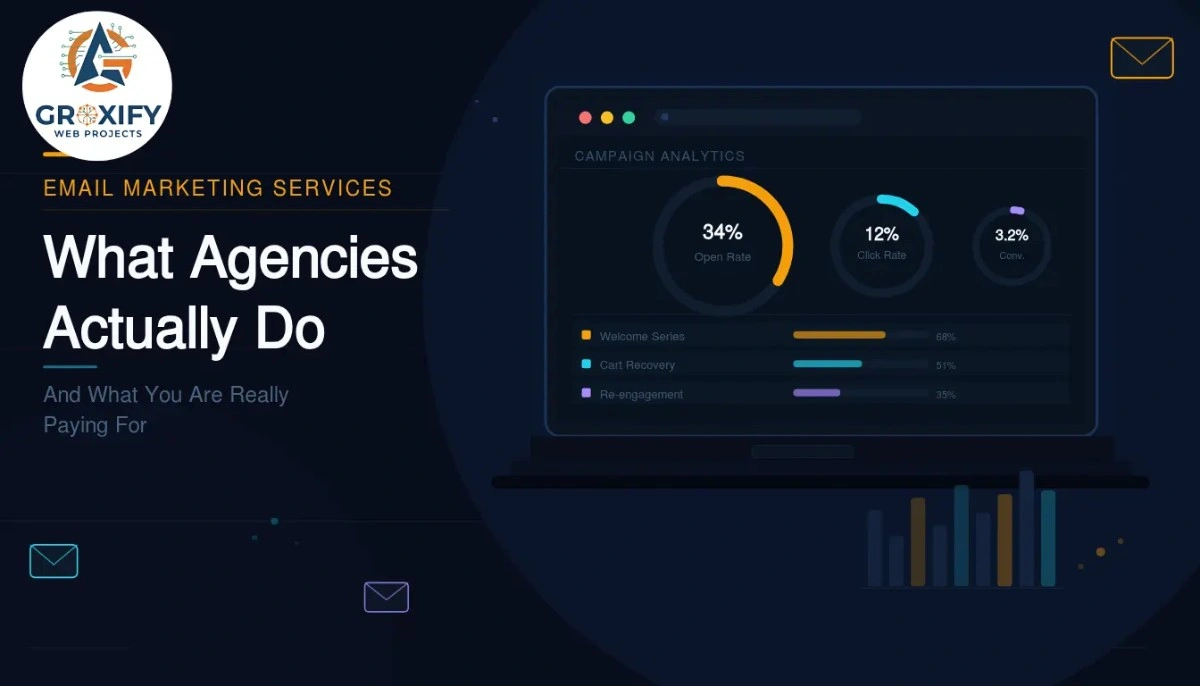
Automation setup — This is where most of the real value hides. Automations are email sequences that trigger based on what a subscriber does. A welcome series when someone joins your list. A cart recovery email when someone leaves without buying. These take time to build but run on their own once they are live.
List management — Keeping the list clean. Removing people who never open anything. Handling unsubscribes. Tagging subscribers correctly so the right emails reach the right people. A dirty list does not just hurt results — it can get your sending account suspended.
Analytics and reporting — Tracking open rates, click rates, conversions, and revenue per email. Then using that data to improve the next campaign, not just document what happened.
So when anyone says they offer email marketing services, ask which of these five areas they actually cover. Some handle everything. Some only run campaigns and leave strategy entirely to you. That is a big difference for the same monthly fee.
The Part Most Providers Do Not Talk About
Deliverability is whether your emails land in the inbox or quietly disappear into spam. It is the single most important thing in email marketing and the least discussed in most agency pitches.
An agency that does not bring this up is not doing the full job.
Good deliverability work looks like this:
- Setting up SPF, DKIM, and DMARC records — these are technical authentication settings that tell Gmail, Outlook, and other inbox providers that your emails are coming from a legitimate source, not a spammer
- Warming up a new sending domain slowly instead of blasting thousands of emails from day one
- Keeping your bounce rate low — a bounce happens when an email cannot be delivered because the address does not exist or the inbox is full
- Monitoring your sender reputation — inbox providers score your sending domain based on how recipients engage with your emails, and a low score means your emails stop reaching inboxes
Some tools handle parts of this automatically. But a serious email marketing services provider will actively maintain all of this — not just set it up once and forget it.
If your emails are going to spam, no amount of great copywriting fixes that. Deliverability comes first.
Email Marketing Services Pricing — What to Expect
Pricing in this space is genuinely all over the place. Here is a straightforward breakdown.
| Service Type | What You Get | Approximate Monthly Cost |
|---|---|---|
| DIY Email Tool (Brevo, MailerLite, Mailchimp) | Platform only, you do all the work | Free to Rs. 5,000 |
| Freelancer | Strategy, copy, basic campaign management | Rs. 8,000 to Rs. 25,000 |
| Small Agency | Full campaign management with reporting | Rs. 20,000 to Rs. 80,000 |
| Full-Service Agency | Strategy, automations, segmentation, ongoing optimization | Rs. 60,000 to Rs. 2,00,000+ |
These are ballpark numbers. Actual pricing depends on list size, email frequency, and how much automation work is involved.
One thing to watch before you sign: some providers charge per email sent, others work on a flat monthly retainer. Neither model is wrong, but you need to know which one you are in. A “per email” model gets expensive fast when you are running automations to a large list.
Email marketing services pricing in India is also generally lower than comparable work from US or UK agencies — which is one reason many international brands outsource this work to Indian teams.
Best Email Marketing Services — Tools vs Agencies
Here is the honest version of this question. You do not always need an agency. A tool is sometimes exactly right.
| Use a Tool If… | Hire an Agency If… |
|---|---|
| You have time to learn and manage campaigns yourself | You want this running without your daily involvement |
| Your list is under 5,000 contacts | You have a large or growing list with complex segments |
| You send simple broadcast emails | You need automations, flows, and advanced targeting |
| Budget is tight right now | You want faster results and can invest in expertise |
The best email marketing services for your situation depend entirely on where you are right now. A solo consultant running a newsletter does not need an agency — Brevo or MailerLite works fine. A D2C brand doing serious monthly revenue needs someone actually managing their email flows, not just sending campaigns.
There is no single “best provider.” There is what fits your stage.
Email Marketing Services in India — What Is Different Here
A few things about the Indian market are worth knowing before you make any decisions.
Most small businesses in India are either not using email marketing at all, or they are using it badly — bulk blasts, no segmentation, no automation. That is actually good news for you. The bar is low, and doing this properly gives you a real edge.
WhatsApp dominates personal and local communication here, which means email is more concentrated in B2B, e-commerce, and SaaS. If you are selling online or running a subscription product, email is highly relevant. If you are a local service business with a regional audience, WhatsApp might genuinely give you faster returns.
The quality of email marketing services providers in India also varies a lot. Many will promise impressive open rates and then run a bulk blast campaign that tanks your domain reputation within two months. Ask specifically about segmentation practices, automation capability, and deliverability management before you commit to anyone.
And here is a number worth knowing: a well-run email channel for an e-commerce brand consistently generates 20 to 30% of total revenue. That is a benchmark across the industry, not a pitch. It is why brands that get this right treat email as a core channel, not an afterthought.
How to Choose the Right Email Marketing Services Provider
Ask these five questions before you commit to anyone:
- What email platforms do you work with, and why do you prefer them?
- How do you handle list hygiene and deliverability monitoring?
- Can you walk me through automations you have built for another client?
- What metrics do you track and report on, and how often?
- Who owns the account and the data if we stop working together?
That last question matters more than people expect. Some agencies run your email platform under their own login. If the relationship ends, you can lose access to your entire subscriber list, your automations, and your sending history. Always confirm the account is registered in your name.
A solid provider answers all of these confidently and without hesitation. Vague answers on deliverability or data ownership tell you what you need to know.
Groxify Web Projects works with businesses on exactly this — setting up email the right way from the start so there are no painful surprises three months in.
Wrapping Up
Email is not the flashiest channel but it is consistently one of the highest-returning ones when it is run properly. The biggest mistake most businesses make is treating it like a broadcast tool instead of a relationship channel. Figure out your current stage first — do you need a tool or a team — and make sure whoever handles it actually understands deliverability, automation, and list health. That is what separates email marketing services that produce real returns from ones that just produce clean-looking monthly reports. Start with the right foundation and the rest follows.
FAQ
Email marketing services typically include strategy, copywriting, email design, list management, automation setup, and performance reporting. Some providers also handle deliverability monitoring and audience segmentation. The exact scope varies by package, so always confirm what is and is not included before signing.
A healthy open rate for most B2B and e-commerce businesses is between 20 and 35 percent. Consistently below 15 percent usually signals list quality issues, weak subject lines, or deliverability problems. Industry and audience type affect benchmarks, so compare your rates within your niche.
Pricing ranges from around Rs. 8,000 per month for a freelancer handling basic campaigns to Rs. 2,00,000 or more for a full-service agency managing complex automations and large lists. DIY tool plans start free and go up to roughly Rs. 5,000 per month depending on list size.
If you have time, a small list, and send simple campaigns, a tool like Brevo or MailerLite works well without any agency. If you need automations, segmentation, and consistent results without managing it yourself daily, hiring a provider makes more sense. Your time and current stage decide it.
Deliverability is whether your emails actually reach the inbox instead of going to spam. Even the best-written email is useless if nobody sees it. It depends on proper technical setup (SPF, DKIM, DMARC records), clean list practices, and healthy sending behavior — all of which a good provider manages actively.
Brevo is strong on affordability and automation features. MailerLite is clean and easy to learn. Mailchimp has a broad feature set but gets expensive as your list grows. The right fit depends on your list size, how much automation you need, and your monthly budget.
Once a week to twice a month works for most businesses just starting out. Sending too frequently leads to unsubscribes. Too rarely and your list goes cold and stops recognizing your name. Watch your unsubscribe rate and open rate over time — they tell you faster than any guide whether your frequency is right.
Yes, especially for e-commerce, SaaS, coaching, and B2B services. Email in India is underused, which means competition in your subscriber’s inbox is lower than in many other markets. The key is building the list properly through genuine opt-ins and sending content people actually want, not just promotions.
Ask about their deliverability practices, which platforms they use and why, how they handle list hygiene, what automations they have built for other clients, and critically — who owns the account and data if you stop working together. A strong provider answers all of this without hesitation.
Basic broadcast campaigns can show results within the first month. Automations and segmented flows take two to three months to build and optimize properly. A full email channel generating consistent revenue typically requires three to six months of focused work. Anyone promising instant results from week one is overpromising.

Rohit Singh is the Founder of GROXIFY WEB PROJECTS LLP with many years of hands-on experience in digital marketing, including SEO, PPC, social media, email marketing, content writing, and WordPress development. He has worked with global clients across industries and helped businesses achieve 5x–10x revenue growth through data-driven strategies and practical execution. Rohit actively manages digital teams, builds business strategies, plans marketing systems, and oversees execution to drive consistent traffic, leads, and long-term business growth.