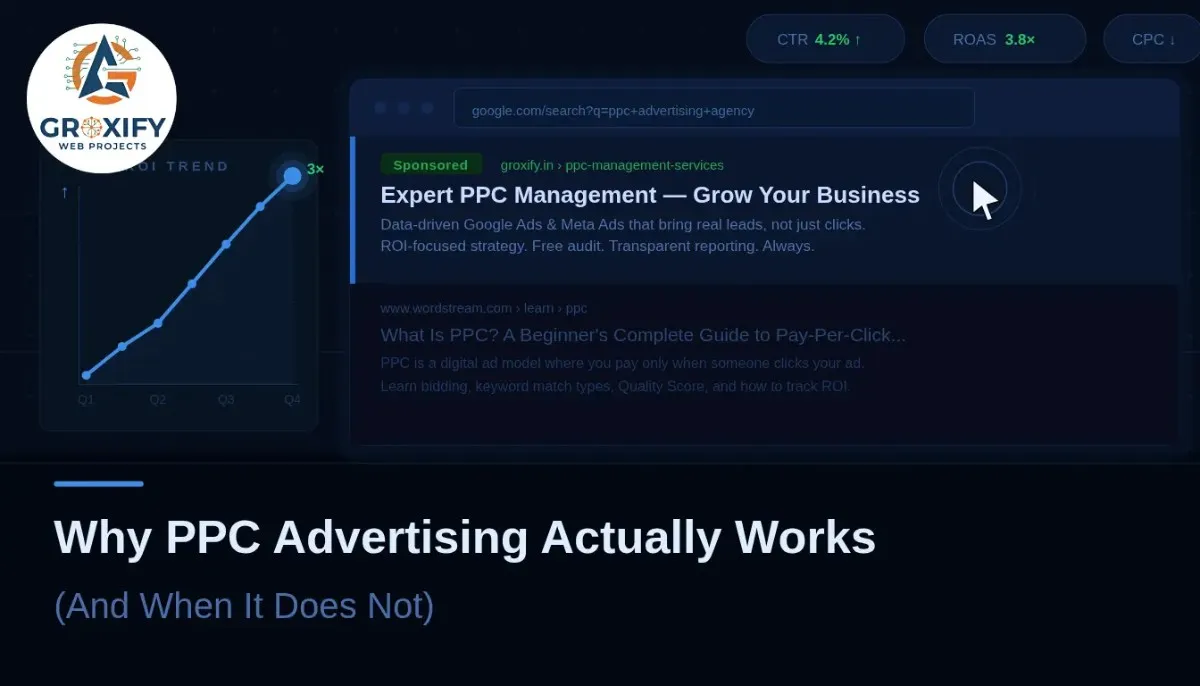
You open Google. Search for something. The first few results have a tiny “Sponsored” tag above them. You scroll past. Most people do. But a surprisingly large number of people click those results. And businesses keep spending real money to show up there, every single day.
Table of Contents
Understanding the importance of PPC is not just about knowing what the acronym means. It is about understanding why businesses that use it correctly grow faster, generate leads on demand, and do not sit around waiting for Google to rank them organically. This article covers all of that, including when PPC is not the right move.
What Is PPC and How Does It Actually Work
PPC stands for Pay-Per-Click. It is a type of online advertising where you pay only when someone clicks your ad. Not for how many people saw it. Only for actual clicks.
Here is how it works in practice. You create an ad. You set a budget. You choose who sees it, based on keywords, location, age, interests, or behavior. Someone searches for something relevant, your ad appears, they click it, and you pay a small fee for that click.
Google Ads is the most popular PPC platform. It shows ads directly in Google search results. Meta Ads, which run on Facebook and Instagram, work differently. They target people based on who they are, not just what they searched for. Both are PPC, but the strategy behind each is quite different.
The cost per click varies by industry. Competitive spaces like insurance or legal services cost more per click simply because more businesses are bidding on the same audience.
The Real Importance of PPC for Business Growth
The biggest reason businesses use PPC is speed. SEO (Search Engine Optimization, the process of getting your website to rank organically on Google) takes months. PPC can get you in front of the right people the same day you launch.
That is not a minor thing. If you just started a business and are waiting six months for organic traffic, that is six months of no customers. PPC gives you a way to test, sell, and grow while your organic presence is still building.
But speed is only part of the picture.
PPC also gives you a level of control that almost no other channel offers. You decide exactly who sees your ad. If your ideal customer is a 35-year-old business owner in Noida who is interested in accounting software, you can target that exact person. With a newspaper ad or even a social media post, you cannot.
You also get measurable data. How many people clicked. How many converted. What it cost to acquire each customer. This is what separates PPC from most traditional marketing. You are not guessing what worked. The numbers tell you directly.
And here is something people often miss. PPC helps even when users do not click. Someone sees your brand name in a sponsored result three times in a week. By the fourth encounter, they already recognize you before they ever land on your site. That familiarity effect is real and it compounds over time.
Benefits of PPC Marketing That Organic Search Cannot Match
Organic search is genuinely valuable. Nobody is disputing that. But there are specific situations where the benefits of PPC marketing are simply faster, more targeted, or more reliable than waiting on rankings.
Launching something new. When you have a new product or service, you have zero organic rankings. PPC puts your offer in front of people from day one. You cannot wait for SEO when you have inventory to move or a deadline to hit.
Targeting by intent. Google Ads targets people at the exact moment they are searching for what you offer. This is high-intent traffic, meaning the person is already looking for a solution. They typed it. They are ready. Catching them at that moment is powerful.
Retargeting. This is the ability to show ads specifically to people who already visited your website but left without taking action. You have experienced this: you look at a product online and then see ads for it everywhere for the next few days. That is retargeting. It converts at a much higher rate than showing ads to cold audiences.
Seasonal and time-sensitive campaigns. Sale season, a product launch, a festival offer. PPC lets you turn traffic on and off like a switch. Organic search cannot do that.
Testing before committing. You can run a small PPC campaign to check if a product idea, service offer, or message actually resonates with your audience before investing in full production or a long-term SEO strategy. That intelligence alone can save a business significant money.
Google Ads vs Meta Ads: Which One Should You Run
This is one of the most common questions, and the honest answer is: it depends on what you are selling and who you are selling it to.
| Google Ads | Meta Ads | |
| Best for | People actively searching for your product or service | Building awareness, retargeting, lifestyle products |
| How targeting works | Based on keywords (what they search) | Based on demographics and interests (who they are) |
| Intent level | High (they are already looking) | Lower (they are browsing, not searching) |
| Works well for | Services, local businesses, B2B products | E-commerce, fashion, food, entertainment |
| Cost per click | Generally higher | Often lower, but more clicks needed to convert |
In practice, most businesses serious about growth run both. Google Ads captures people already looking for what you offer. Meta Ads builds awareness and pulls people in before they even know they need you.
Start with whichever matches your customer’s behavior best. If people search for what you sell (like “plumber in Gurgaon” or “HR software for startups”), start with Google Ads. If your product needs to be seen before someone wants it (fashion, food, lifestyle), Meta Ads often performs better.
When PPC Does Not Work (Most Articles Skip This)
Every blog on PPC talks about how powerful it is. Very few talk about when it fails. This is actually the most useful thing you can understand before spending a single rupee.
PPC does not work when your website is not ready to receive visitors. You can drive hundreds of clicks to a slow, confusing, or untrustworthy website and get nothing from it. The ad gets people to your site. Your website has to do the rest. If your landing page (the page someone arrives on after clicking your ad) is not clear, fast, and convincing, your entire budget goes to waste.
It also does not work as a set-and-forget tool. Campaigns that are not regularly monitored and adjusted bleed money. Bids need refinement. Ad copy needs testing. Audiences need to be checked. If you launch and check back a month later, do not expect good results.
The math also breaks down when profit margins are too thin. If your product earns very little per sale and your cost per click is high, the numbers simply do not work. PPC performs best when your average order value or the long-term value of a customer is high enough to justify what each click costs.
And honestly, for businesses with a very small or hyper-niche audience, PPC is not always the right starting point. When the total pool of potential customers is tiny, paid ads cannot scale meaningfully.
Should You Hire a PPC Marketing Agency or Do It Yourself
This genuinely depends on your situation, budget, and how much time you are willing to put in.
Running Google Ads or Meta Ads yourself is possible. The platforms are designed to be approachable. But approachable does not mean easy. Getting consistently good results takes real time, testing, and some money lost while learning what not to do.
If you are a small business with a modest budget and simple goals, learning the basics yourself is a reasonable starting point. A local service business running a simple Google Ads campaign for a specific area can manage that without too much complexity.
But once budgets grow and you want actual returns with less guesswork, a good PPC marketing agency makes a measurable difference. Agencies have managed campaigns across many industries. They compress the trial-and-error phase significantly, which means less wasted spend. They also handle the ongoing monitoring that most business owners do not realistically have time for.
When evaluating an agency, look for transparency. They should show you exactly where your money is going, explain why decisions are made, and share real performance data. Anyone promising guaranteed results is not being straight with you. No one can guarantee outcomes in advertising.
At Groxify Web Projects, the approach is always to show clients exactly what is happening with their budget and what the data actually means, not just a summary of vanity numbers.
How to Know If Your PPC Is Actually Working
There are a lot of numbers involved in PPC. Focus on the ones that actually tell you something useful.
CTR (Click-Through Rate) is the percentage of people who saw your ad and clicked it. A higher CTR generally means your ad copy is relevant and compelling. A low CTR means the ad is not connecting with the audience.
CPC (Cost Per Click) is what you pay each time someone clicks your ad. Lower is usually better, but not always. A higher CPC is fine if those clicks convert well. It only becomes a problem when combined with poor conversion rates.
Conversion Rate is the percentage of people who clicked your ad and then completed a desired action: a purchase, a form submission, a phone call. This is the number that actually tells you whether PPC is producing results.
ROAS (Return on Ad Spend) measures how much revenue you made for every rupee spent on ads. A ROAS of 3 means you earned three rupees for every one you spent. This is the clearest indicator of whether a campaign is profitable or not.
Do not focus on clicks alone. A campaign generating lots of clicks with zero conversions is not working. A campaign with fewer clicks but strong conversions is. Always read the numbers together, not in isolation.
Importance of PPC in a Complete Marketing Strategy
Most businesses make the mistake of treating PPC and SEO as competing strategies. They are not. They serve different purposes and they work better together than either does alone.
PPC wins on speed and control. SEO wins on compounding long-term traffic and trust. A solid marketing strategy uses both.
Run PPC to generate results now. Use the data from those campaigns (which keywords convert, which messages land, which audience segments actually buy) to shape your SEO content strategy. By the time your organic rankings build up, you already know exactly what works because your ads tested it for you.
The importance of PPC in a long-term strategy is not just about the direct leads it generates. It is also about the market intelligence it produces. That data is valuable far beyond any single campaign.
Conclusion
PPC is not a magic button. It is a paid channel that performs well when the fundamentals are in place: a strong offer, a website built to convert, the right audience, and someone actively managing the numbers. When those things are solid, it is one of the fastest ways to grow a business. The importance of PPC is in the control and speed it gives you, not just the traffic. Start with a clear goal, test with a realistic budget, and scale only what the data tells you is working. That is the whole game.
FAQ
PPC (Pay-Per-Click) is online advertising where you only pay when someone clicks your ad. You set a budget, target your audience, and your ad shows on platforms like Google or Instagram. You are not charged for views, only for actual clicks through to your website.
Yes, but only when your website is ready to convert visitors and your profit margins can support the cost per click. Small businesses often do well with local Google Ads targeting a specific city or service area. Start with a small budget, test honestly, then scale what works.
There is no fixed cost. You control your own daily or monthly budget. Cost per click depends on your industry and competition level. Local service businesses often pay far less per click than competitive national brands. Even modest budgets can deliver results when campaigns are well targeted.
Google Ads targets people actively searching for something specific on Google. Meta Ads (Facebook and Instagram) targets people based on their interests and behavior. Google captures purchase intent. Meta builds awareness and desire. Both work but suit different products and goals.
Unlike SEO, PPC can generate traffic almost immediately after a campaign goes live. However, optimizing campaigns for strong conversions and efficient cost typically takes two to four weeks of active testing and adjustment. Day one traffic is realistic. Profitable campaigns take some tuning.
You can manage it yourself, especially at lower budgets with simple goals. But mistakes during setup can waste money quickly. For businesses with larger budgets or competitive markets, working with a qualified PPC marketing agency typically produces better returns and saves time.
ROAS means Return on Ad Spend. A ROAS of 3 or higher is generally healthy for most businesses, meaning you earn three rupees for every one spent. The right target varies by profit margin and business model. Some low-margin businesses need a ROAS of 8 or more to be profitable.
Retargeting shows ads specifically to people who visited your website but did not convert. These are warm audiences who already know your brand, so they convert at a much higher rate than cold traffic. Yes, most businesses should use it. It is one of the highest-value tactics in PPC.
The most common reasons are a weak or slow landing page, no ongoing monitoring or optimization, incorrect audience targeting, and budgets too small to compete in the chosen market. PPC is not a set-and-forget channel. Campaigns that are not actively managed will underperform consistently.
Use both if budget allows. PPC delivers fast results and market data. SEO builds compounding traffic over time. If you must choose one to start, PPC gives you quicker feedback on what actually converts. Use that data to then build a smarter, more targeted SEO strategy.

Rohit Singh is the Founder of GROXIFY WEB PROJECTS LLP with many years of hands-on experience in digital marketing, including SEO, PPC, social media, email marketing, content writing, and WordPress development. He has worked with global clients across industries and helped businesses achieve 5x–10x revenue growth through data-driven strategies and practical execution. Rohit actively manages digital teams, builds business strategies, plans marketing systems, and oversees execution to drive consistent traffic, leads, and long-term business growth.