Digital Agency

Growth Focus
  • Helping Businesses Grow Worldwide — SEO Services That Drive Visibility,     High-Performance Website Development,     PPC Marketing for Better Reach,     Digital Marketing Built for Growth,     Social Media That Builds Your Brand,     Smart Solutions. Real Business Growth.

2026

email marketing agency

How to Choose the Right Email Marketing Agency in India (Without Getting Burned)

Most businesses that hire an email marketing agency in India end up disappointed. Not because email marketing does not work — it absolutely does — but because they hired based on price or a polished pitch deck instead of asking the right questions. The agency sends a few emails, open rates look okay, and three months later nothing has changed in their revenue. Sound familiar? This article will help you hire smarter. By the end, you will know what to look for, what to ask, what red flags to watch for, and how to tell whether an agency actually knows what they are doing or just knows how to sell. What an Email Marketing Agency Actually Does An email marketing agency is a team that manages your email communication with customers — writing the emails, designing them, setting up automation (pre-scheduled email sequences that go out based on what a user does), managing your subscriber list, and tracking results. But here is what most people miss: the strategy behind it matters more than any of those tasks individually. Any agency can hit send. The question is whether they know when to send, what to say, and why a subscriber should care. Good agencies think about your customer journey — meaning the path someone takes from first knowing your brand to becoming a paying customer. Every email is a step in that journey, not just a broadcast. Why Email Marketing in India Is Different From the Rest of the World This is something almost no agency will tell you upfront. Email behavior in India is distinct. Open rates vary drastically between B2B (business selling to another business) and D2C (brand selling directly to consumers). Timing matters differently — mid-morning sends often outperform evening sends for Indian professional audiences, which is the opposite of what Western playbooks suggest. Language preference is a real factor. Hinglish subject lines (a mix of Hindi and English written in the Roman script) regularly outperform pure English for certain consumer segments. Most agencies will not experiment with this because it takes more effort. Mobile optimization is non-negotiable here. A significant chunk of Indian subscribers open emails on Android phones with smaller screens and slower connections. If your emails are heavy on images and load slowly, you are losing those people before they read a word. An agency that applies a global template to the Indian market without adjusting for these things is giving you a product that sounds right on paper and underperforms in practice. The Real Difference Between Email Marketing Companies in India Walk into ten different email marketing companies in India and they will all show you similar slides. Open rate, click rate, conversion rate. Pretty designs. Case studies with big brand logos. Here is how to actually tell them apart. Their tool stack tells you a lot. Ask which email platforms they use — Mailchimp, Klaviyo, ActiveCampaign, HubSpot, or something else. Each tool has a different strength. Klaviyo is strong for ecommerce automation. HubSpot works well for B2B. If an agency only knows one tool and recommends it for every client, they are fitting your business to their comfort zone, not the other way around. Ask to see a sample strategy document, not just a campaign report. A campaign report shows you what happened. A strategy document shows you that they thought before they acted. Big difference. Find out who actually writes the emails. Many agencies outsource copywriting to freelancers who know nothing about your industry. The person pitching you and the person writing your emails may be two completely different people who have never spoken about your brand. What Good Email Marketing Services in India Should Include When you are evaluating what you are getting for your money, here is a clean breakdown of what solid email marketing services in India should cover: Service Component What It Means Why It Matters List hygiene Removing invalid, bounced, or inactive emails from your list Protects your sender reputation — the score ISPs (Internet Service Providers) give your emails Segmentation Splitting your list into groups based on behavior or profile So the right email reaches the right person A/B testing Sending two versions of an email to see which performs better Makes every campaign smarter than the last Automation setup Building email sequences that run without manual work Saves time and nurtures leads while you sleep Reporting with context Data explained in plain language with recommendations Numbers mean nothing without action If an agency is not doing list hygiene, your emails will start landing in spam. If they are not segmenting, you are blasting everyone with everything, which kills unsubscribe rates. These are not optional extras — they are baseline competence. Red Flags to Watch Before Signing Any Contract This section alone is worth saving. They guarantee specific open rates. No ethical agency does this. Open rates depend on your industry, your list health, your subject lines, and dozens of other variables. A guarantee is a sales trick. They pitch you on list size, not list quality. An agency that boasts about sending to 100,000 subscribers without asking about engagement (how actively those subscribers interact with your emails) does not understand email marketing. A list of 5,000 engaged people will outperform a list of 50,000 cold contacts every time. They cannot explain their deliverability strategy. Deliverability is the percentage of emails that actually land in the inbox rather than spam or promotions. If an agency looks confused when you ask about SPF, DKIM, and DMARC (three technical authentication settings that tell email providers your emails are legitimate), walk away. They push bulk email blasting as a service. Bulk blasting — sending a single email to your entire list without segmentation or strategy — is not email marketing. It is noise. And it damages your sender reputation over time, making it harder to reach people even when you do have something worth saying. Their reporting is a screenshot of a dashboard. Real reporting tells you what

How to Choose the Right Email Marketing Agency in India (Without Getting Burned) Read More »
email marketing services

Email Marketing Services: What Agencies Actually Do (And What You Are Really Paying For)

Most businesses sign up for email marketing and spend the next three months wondering why nothing is happening. The tool is running. The list is there. The emails go out. But the results? Flat. That is usually not a tool problem. It is a “nobody told me what this actually requires” problem. Email marketing services cover a lot more ground than sending a newsletter once a week. Whether you are thinking about doing it yourself or hiring someone, understanding what is actually involved changes how you budget, what questions you ask, and whether any of it pays off. This article covers all of that — clearly, without the fluff. What Email Marketing Services Actually Include Most people think it is just “write emails and press send.” That is maybe 20% of the work. Here is what is actually involved in a full service: Strategy and planning — Before a single email goes out, someone needs to decide who gets what, when, and why. This means audience segmentation (dividing your list into groups based on behavior, location, or where someone is in their buying journey) and mapping out which emails go to which group. Copywriting and design — The actual emails. Subject lines, body copy, call to action, layout. A strong subject line alone can double your open rate (the percentage of people who actually open the email out of everyone who received it). Automation setup — This is where most of the real value hides. Automations are email sequences that trigger based on what a subscriber does. A welcome series when someone joins your list. A cart recovery email when someone leaves without buying. These take time to build but run on their own once they are live. List management — Keeping the list clean. Removing people who never open anything. Handling unsubscribes. Tagging subscribers correctly so the right emails reach the right people. A dirty list does not just hurt results — it can get your sending account suspended. Analytics and reporting — Tracking open rates, click rates, conversions, and revenue per email. Then using that data to improve the next campaign, not just document what happened. So when anyone says they offer email marketing services, ask which of these five areas they actually cover. Some handle everything. Some only run campaigns and leave strategy entirely to you. That is a big difference for the same monthly fee. The Part Most Providers Do Not Talk About Deliverability is whether your emails land in the inbox or quietly disappear into spam. It is the single most important thing in email marketing and the least discussed in most agency pitches. An agency that does not bring this up is not doing the full job. Good deliverability work looks like this: Some tools handle parts of this automatically. But a serious email marketing services provider will actively maintain all of this — not just set it up once and forget it. If your emails are going to spam, no amount of great copywriting fixes that. Deliverability comes first. Email Marketing Services Pricing — What to Expect Pricing in this space is genuinely all over the place. Here is a straightforward breakdown. Service Type What You Get Approximate Monthly Cost DIY Email Tool (Brevo, MailerLite, Mailchimp) Platform only, you do all the work Free to Rs. 5,000 Freelancer Strategy, copy, basic campaign management Rs. 8,000 to Rs. 25,000 Small Agency Full campaign management with reporting Rs. 20,000 to Rs. 80,000 Full-Service Agency Strategy, automations, segmentation, ongoing optimization Rs. 60,000 to Rs. 2,00,000+ These are ballpark numbers. Actual pricing depends on list size, email frequency, and how much automation work is involved. One thing to watch before you sign: some providers charge per email sent, others work on a flat monthly retainer. Neither model is wrong, but you need to know which one you are in. A “per email” model gets expensive fast when you are running automations to a large list. Email marketing services pricing in India is also generally lower than comparable work from US or UK agencies — which is one reason many international brands outsource this work to Indian teams. Best Email Marketing Services — Tools vs Agencies Here is the honest version of this question. You do not always need an agency. A tool is sometimes exactly right. Use a Tool If… Hire an Agency If… You have time to learn and manage campaigns yourself You want this running without your daily involvement Your list is under 5,000 contacts You have a large or growing list with complex segments You send simple broadcast emails You need automations, flows, and advanced targeting Budget is tight right now You want faster results and can invest in expertise The best email marketing services for your situation depend entirely on where you are right now. A solo consultant running a newsletter does not need an agency — Brevo or MailerLite works fine. A D2C brand doing serious monthly revenue needs someone actually managing their email flows, not just sending campaigns. There is no single “best provider.” There is what fits your stage. Email Marketing Services in India — What Is Different Here A few things about the Indian market are worth knowing before you make any decisions. Most small businesses in India are either not using email marketing at all, or they are using it badly — bulk blasts, no segmentation, no automation. That is actually good news for you. The bar is low, and doing this properly gives you a real edge. WhatsApp dominates personal and local communication here, which means email is more concentrated in B2B, e-commerce, and SaaS. If you are selling online or running a subscription product, email is highly relevant. If you are a local service business with a regional audience, WhatsApp might genuinely give you faster returns. The quality of email marketing services providers in India also varies a lot. Many will promise impressive open rates and then run a bulk blast campaign that tanks your

Email Marketing Services: What Agencies Actually Do (And What You Are Really Paying For) Read More »

email marketing course

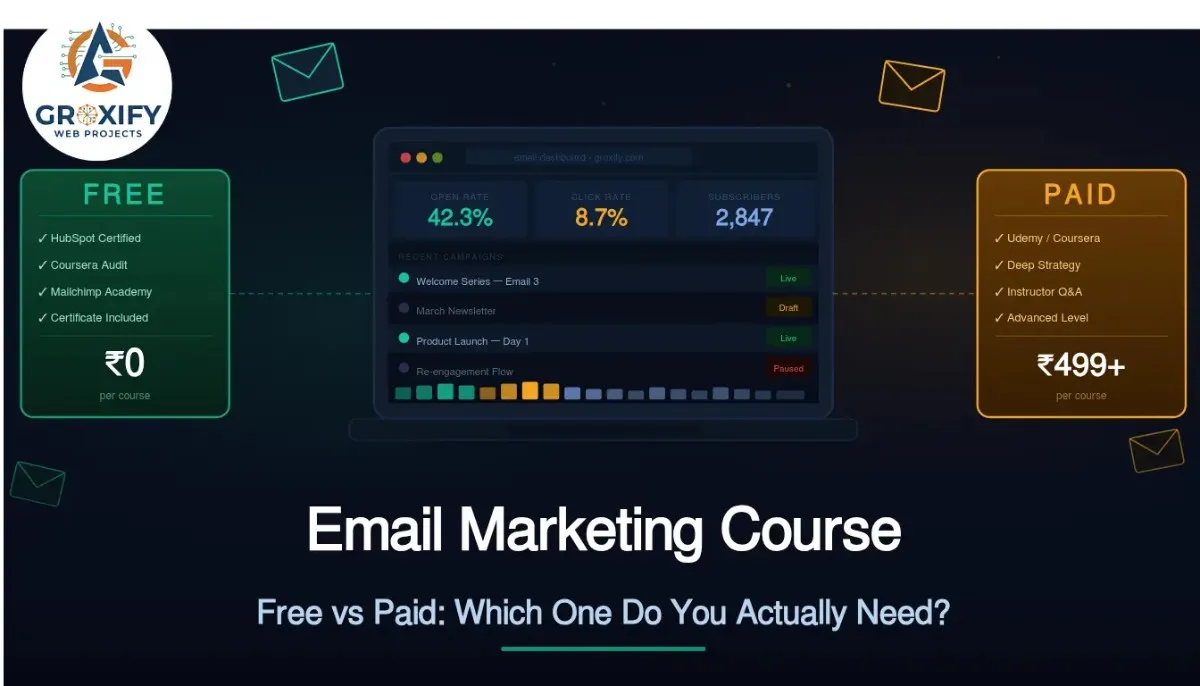
Email Marketing Course: Free vs Paid, Which One Do You Actually Need?

Most people looking for an email marketing course open three tabs, compare nothing, and close everything without starting. The choices look similar on the surface but behave very differently once you are inside them. Email marketing is the practice of sending targeted emails to a list of people to build relationships, drive sales, or share useful content. It consistently delivers one of the highest returns in digital marketing, which is why beginners, business owners, and freelancers all want to learn it properly. This article covers free options, paid options, certificates, and what actually matters after you finish. No filler. Just what you need to pick the right path and move forward. Free Email Marketing Course Options Worth Your Time There are dozens of free options online. Most of them are not great. A few of them actually hold up. Here is what does. HubSpot Email Marketing Certification HubSpot’s free certification is the most recognized option in the market right now. It takes about three to four hours and covers list building (growing a subscriber base), email copywriting (writing emails people actually open), segmentation (dividing your list into specific groups based on behaviour or interest), and basic analytics (measuring how your emails perform). The certificate carries real weight. HubSpot is used by thousands of marketing teams globally. Having their badge on a LinkedIn profile or resume does get noticed. One honest tradeoff: the course naturally pushes HubSpot’s own platform. That is fine if you plan to use it. But if you later switch to a different tool, the strategy transfers but the specific steps will not always match. Mailchimp Academy Mailchimp is one of the most widely used email tools for small businesses and freelancers. Their free learning resources walk you through the basics of their platform and general email strategy. No heavy theory. Practical and fast. Best for someone who wants to start sending emails and learn while doing. Coursera in Audit Mode Coursera has multiple email and digital marketing courses from universities and companies like Google and Meta. You can audit most of them at no cost, meaning you watch every video and access most materials without paying. You do not get the certificate unless you pay, but the content is often identical. Auditing is seriously underused. If the certificate is not your priority right now, it is an easy way to access quality instruction without spending anything. Paid Email Marketing Course: When Does It Actually Make Sense? Not every situation needs a paid course. But some do. If you are a freelancer pitching email services to clients, a credible certificate can close that conversation faster. If you are a business owner who wants structured training with real examples and no confusion, a paid course often delivers that better than free options. Every email marketing course online falls into one of two categories: platform-specific (teaches you one tool deeply) or strategy-based (teaches you how email works across tools). The best paid courses combine both. Always check whether the instructor has actually run campaigns or just teaches about them. Udemy is worth mentioning specifically. Courses there go on sale regularly and can drop to a few hundred rupees. The quality varies, so look for instructors with documented work experience, not just high ratings. Email Marketing Course with Certificate Free: Does It Actually Matter? This is one of the most common questions. The answer depends on what you plan to do with it. If you are applying for a job in a marketing team, a free certificate from HubSpot or Google carries more weight than most people expect. These are recognizable platforms. An interviewer who sees them on your resume knows you completed real structured learning. If you are a freelancer, the certificate gets you in the door. Your work samples and results keep you there. Clients care more about whether you can show them outcomes than what you completed online. If you are a business owner learning for yourself, the certificate is essentially a bonus. You are there for the knowledge. Free certificates worth having specifically: HubSpot’s Email Marketing Certification, Google’s Fundamentals of Digital Marketing (which includes an email section), and Coursera courses when you apply for financial aid. That aid gets approved more often than people expect and can make the certificate free or nearly free. Email Marketing Course in India: What Nobody Tells You Upfront Finding a good email marketing course in India comes with practical realities that most articles skip entirely. Most global courses are priced in dollars. Udemy during Indian sale events is one of the more practical paid options because courses that cost 15 to 20 USD internationally can drop to under 500 rupees. That makes quality training genuinely accessible. For Hindi-language content or material built around Indian business contexts, options are more limited. Platforms like Internshala and some Indian YouTube creators offer beginner content, though these tend to be lighter on depth and strategy. The most efficient path for most Indian learners: start with HubSpot’s free certification to build a strong foundation, then look at Udemy during a sale for deeper, platform-specific training. That combination costs very little and covers more ground than most single paid courses. Free vs Paid: Quick Comparison Factor Free Course Paid Course Cost Zero Few hundred to thousands Certificate Sometimes (HubSpot, Google) Usually yes Depth Beginner to intermediate Beginner to advanced Feedback None Sometimes (instructor Q&A) Platform focus Often tool-specific Can be more general Best for Starting out, quick upskilling Career shift, client work The table covers the surface level. What it does not show is this: a free course finished completely is worth more than a paid course started and abandoned. The format matters far less than whether you actually complete it and apply what you learn. What a Good Course Should Actually Teach You This is where most courses fall short, and where most articles stay quiet. A course that only teaches you how to set up a campaign is teaching you buttons. Real email marketing

Email Marketing Course: Free vs Paid, Which One Do You Actually Need? Read More »

email marketing jobs

Email Marketing Jobs in India: Real Salaries, Skills That Get You Hired, and Where the Scope Is Going

Everyone is talking about digital marketing, but email specifically is having a quiet moment. Brands that went all-in on social media are now realizing that email still delivers the highest return per rupee spent. That is creating consistent demand for people who genuinely know what they are doing. And here is the thing: the supply of skilled email marketers in India is still low relative to that demand. That gap is exactly where email marketing jobs sit right now. This article covers everything you actually need to know: what these roles involve, what skills get you hired, what salary you can realistically expect, what freshers should know before applying, and whether remote options are real or just bait in a job posting. What Email Marketing Jobs Actually Involve Day to Day Most people think email marketing is just writing emails and hitting send. It is not. The actual job involves building strategy, working with segmentation (dividing your email list into groups based on user behavior or profile so the right message goes to the right person), writing copy, running A/B tests (sending two versions of an email to different groups to see which one performs better), setting up automation, and reading performance data to figure out what to do next. On a given day, you might be building a drip campaign (a series of automated emails that go out over a set timeline based on user actions), checking open rates and CTR (click-through rate: the percentage of people who clicked something in your email), rewriting subject lines, or troubleshooting why the last campaign landed in spam. In large companies, this role sits inside the marketing team. In smaller businesses or agencies, you might own email entirely. That means more ownership and more learning, but also more pressure to figure things out without much hand-holding. Skills That Get You Hired for Email Marketing Jobs Tools You Need to Know Every job description will mention at least one email platform. The ones showing up most in Indian job postings right now: You do not need to know all of them. Pick one, get genuinely good at it, and talk about it with confidence in interviews. What Matters More Than Tools Copywriting is the real differentiator. You can learn a new platform in a week. Writing subject lines that get opened, email bodies that hold attention, and CTAs (calls to action: the buttons or links that tell readers exactly what to do next) that actually convert — that takes real practice and iteration. Beyond that, what separates average candidates from strong ones: understanding segmentation logic, reading an analytics report without getting confused, knowing basic HTML for formatting emails without a drag-and-drop builder, and having some awareness of email deliverability (whether your emails land in the inbox or the spam folder, and why). Soft skills matter too. Email marketers regularly coordinate with designers, product teams, and content writers. Being easy to work with is a real professional advantage. Email Marketing Jobs Salary in India: Honest Numbers Most salary articles give inflated numbers that only apply to senior folks at well-funded startups in Bangalore. Here is what actually looks like across experience levels for salaried roles in metro cities. Experience Level Typical Annual Salary Fresher (0 to 1 year) Rs. 2.4L to Rs. 3.6L Mid-level (2 to 4 years) Rs. 4L to Rs. 7L Senior (5+ years) Rs. 8L to Rs. 15L Specialist or Lead Rs. 12L to Rs. 22L+ Tier-2 cities typically run 15 to 25 percent lower than these figures. Freelance email marketers can earn more per engagement, but income is less predictable month to month. The single thing that moves your salary fastest is not years of experience. It is proof of results. If you can show that a campaign you ran increased conversions or revenue by a specific percentage, that one data point carries more weight in a negotiation than two extra years on a resume. Email Marketing Jobs for Freshers: What to Realistically Expect Here is the honest version. Most companies will not hand a fresh graduate a dedicated email marketing role from day one. What they will do is hire you as a digital marketing executive where email is one of several channels you handle alongside social, content, and sometimes paid ads. That is actually not a bad starting point. Working across channels teaches you the full funnel (the journey a customer takes from first touchpoint to final purchase) and shows you how email fits into something bigger. That context makes you better at email specifically. What freshers should actually do to get in the door: Email Marketing Jobs Remote and Work From Home: What Is Real This is one of the most searched questions in this space and also one of the least honestly answered. So here is what is actually happening. Remote email marketing jobs do exist in India and they are growing. The work is screen-based and does not require physical presence, which makes it naturally suited to remote arrangements. Many SaaS companies, digital agencies, and international clients hiring Indian professionals have moved to hybrid or fully remote setups. That said, fully remote entry-level roles are still limited. Most companies want freshers in office at least in the initial phase. Once you have two or more years of experience and a trackable record, remote and work-from-home options open up noticeably. Where to look for remote email marketing roles: The freelance path is the fastest route to full remote work. Many email marketers start with two or three freelance clients, deliver consistent results, and build a fully remote practice from there. Is Email Marketing a Good Career Long Term Email marketing as a standalone skill has a ceiling. After a certain point, companies want someone who also understands marketing automation (using software to automatically send the right message to the right person at the right time based on their behavior), CRM integration, and the broader customer communication strategy. The email marketers who grow quickly are the

Email Marketing Jobs in India: Real Salaries, Skills That Get You Hired, and Where the Scope Is Going Read More »

ai in email marketing

AI in Email Marketing: What It Does, Which Tools Work, and How to Start

You send an email. Half your list never opens it. The subject line felt fine, the content was solid, but something just did not work. This happens to almost every business running email campaigns without data-driven help. That is exactly where AI in email marketing comes in. Not as magic, but as the system that reads patterns you cannot see manually: who opens what, at what time, why some subject lines work and others do not. This article breaks down what AI actually does inside email marketing, which tools are genuinely worth using, what is free, and how to build a strategy that works without guesswork. No jargon without explanation, no tools pushed without honest context. What AI in Email Marketing Actually Means AI in email marketing is when software uses machine learning (algorithms that learn from data over time) to handle or improve tasks that humans used to do manually — things like writing subject lines, deciding when to send, sorting subscribers into groups, or predicting who is about to buy. It does not replace the person behind the emails. It makes that person faster and more accurate. Think of it this way. You have 10,000 subscribers. Manually figuring out which 500 are about to unsubscribe, which 200 are ready to buy, and which 1,000 have not opened anything in 90 days is nearly impossible at scale. AI does that in the background while you focus on the actual message. The thing is, most email platforms already have some AI baked in. You may be using it without realizing it. Core Use Cases of AI in Email Marketing This is where things get practical. These are the areas where AI genuinely makes a difference — not just on paper, but in real campaigns. Subject Line Optimization Subject lines decide whether someone opens your email or scrolls past it. AI tools analyze what subject lines have worked for your audience in the past and suggest variations more likely to get clicks. Some tools go further and test multiple subject lines automatically. They send version A to 20% of your list, version B to another 20%, and then send the winner to the remaining 60%. That is called AI-powered A/B testing (sending two versions of something to a small group to see which performs better), and it removes the guesswork from one of the most important decisions in any campaign. Personalization at Scale Basic personalization is putting someone’s first name in the subject line. That is table stakes now and barely moves the needle. AI personalization goes deeper. It looks at what a subscriber has clicked before, what products they have viewed, how recently they engaged, and then serves them content or offers that match their actual behavior. This is called behavioral personalization, and it significantly improves click-through rates (how many people actually click something inside your email). For small businesses, this used to require a developer and a lot of setup. Now many tools handle it automatically once you connect your data. Send Time Optimization Sending at the same time every week to your full list is a blunt approach. Different people check their emails at different times: some at 7am, some after lunch, some late at night. AI tracks when each subscriber is most likely to open an email and sends to them at their personal peak time. This is called send time optimization (STO), and platforms like Mailchimp and Klaviyo have had versions of it for a while. The lift in open rates is real — usually between 5% and 15% depending on your list. Audience Segmentation Segmentation means dividing your email list into smaller groups based on something they share — location, purchase history, engagement level, or product interest. The more relevant a segment, the more relevant your message. Manually managing segments takes a lot of ongoing maintenance. AI does it dynamically, meaning it updates segments in real time as subscriber behavior changes. Someone who was a cold lead last month might have clicked three emails this week and is now warm. AI catches that and moves them automatically. Predictive Analytics This one tends to be underused by beginners but it is powerful. Predictive analytics uses past data to forecast future behavior: which subscribers are at risk of churning (stopping engagement or unsubscribing), which ones are most likely to convert this month, and what type of content a segment will respond to next. Knowing someone is about to disengage before they actually do gives you a chance to run a win-back sequence — an automated series of emails designed to pull dormant subscribers back in before they are lost. Best AI Email Marketing Tools Worth Knowing There is no shortage of tools claiming to use AI. Some of it is genuine. Some of it is just the word “AI” stuck on a feature that has existed for years. Here is an honest breakdown. Tool Best For Notable AI Features Free Plan? Mailchimp Beginners and small businesses Subject line suggestions, send time optimization, content optimizer Yes (up to 500 contacts) Klaviyo E-commerce brands Predictive analytics, behavioral segmentation, churn prediction Yes (up to 250 contacts) Brevo (formerly Sendinblue) Budget-conscious businesses AI send time, basic segmentation, automation Yes (300 emails/day) ActiveCampaign Growing businesses and agencies Predictive sending, lead scoring, automation AI No (starts ~$15/month) HubSpot Businesses wanting CRM plus email AI content writer, smart segmentation, behavioral triggers Yes (limited) GetResponse Freelancers and course creators AI email generator, autoresponders, conversion funnels Yes (up to 500 contacts) A few honest notes: free plans always come with limits. If your list is growing past a few hundred contacts, expect to pay. The tools with the best AI features — Klaviyo, ActiveCampaign — are also the most expensive at scale. But they earn it. For beginners just starting out, Mailchimp and Brevo are solid first stops. For e-commerce, Klaviyo is almost the industry standard at this point. Free AI Email Marketing: What You Actually Get Free AI email marketing is possible, but it

AI in Email Marketing: What It Does, Which Tools Work, and How to Start Read More »

email marketing tools

Best Email Marketing Tools for Small Businesses (No Fluff, Just the Honest Breakdown)

You signed up for a free email marketing tool, spent two hours setting it up, sent your first campaign, and half your list never got it. Sound familiar? Most small business owners do not fail at email marketing because they picked the wrong strategy. They fail because they picked the wrong tool and did not know it until it was too late. This article covers the best email marketing tools for small businesses right now — what each one is actually good for, where they fall short, and exactly how to pick one that fits where your business is today. No filler. No hype. What to Actually Look for in Email Marketing Software Before jumping into the tool list, let us get one thing straight. Most comparison articles give you a feature list and call it advice. That is not helpful when you are just starting out. Here is what actually matters for a small business: Ease of getting started. Some tools look clean in screenshots but hide complexity behind onboarding flows that assume you already know what a segment or a drip sequence is. A segment is a filtered group of your email list, like “people who clicked last week.” A drip sequence is a series of automated emails sent over time after someone signs up. If the tool does not explain these clearly as you go, you will get stuck. Free plan limits that are honest. Almost every major tool has a free plan. But the limits are where the fine print hides. Some cap you at 500 contacts. Some let you have unlimited contacts but cap how many emails you can send per month. Some put their logo in your emails unless you pay. Know what you are trading. Deliverability. This is the single most important thing nobody talks about. Deliverability means whether your emails actually reach the inbox or get buried in spam. A tool with bad deliverability infrastructure can send your campaigns to spam even when your content is perfectly fine. It is not your fault — but the platform matters. Automation that is not overkill. If you are a freelancer or a small shop, you do not need a 12-step automation builder. You need: a welcome email when someone subscribes, maybe a follow-up sequence, and the ability to send a regular newsletter. If a tool is trying to sell you a visual automation canvas with 40 nodes before you have even sent your first email, skip it. Good email marketing platforms balance simplicity and power. The right one depends entirely on what stage your business is at. Best Free Email Marketing Tools That Actually Work Free tools are not second-rate. Some of them are genuinely excellent, especially when you are under 1,000 subscribers and just building your list. Brevo (Formerly Sendinblue) Brevo is one of the most generous free plans on the market. You get unlimited contacts — meaning no cap on how big your list can grow — but you are limited to a set number of emails per day on the free tier. For most small businesses sending weekly newsletters, that limit is not a problem. What makes Brevo stand out is its deliverability. They run their own sending infrastructure, which means your emails are less likely to get flagged as spam compared to platforms that use shared third-party servers. The interface takes about 30 minutes to learn. Automation is included even on free plans, which is unusual. If you are starting fresh and want something that scales, Brevo is where most beginners should start. Honest limitation: The email template designer is functional but not the prettiest. If visual design matters a lot to your brand, you will feel slightly constrained. MailerLite MailerLite has built a reputation for being genuinely beginner-friendly without dumbing things down. The free plan covers up to a set number of subscribers and monthly sends, with a clean drag-and-drop editor that actually behaves the way you expect it to. Landing pages — standalone web pages designed to capture email sign-ups — are included in the free plan. Most tools charge for these separately. That alone makes MailerLite a stronger free option than it looks on paper. Where MailerLite earns trust is in its simplicity. Every feature is named plainly. You will not open a menu and stare at a term you do not understand. Honest limitation: Advanced automation — like behavioral triggers that fire emails based on what a subscriber clicks or buys — is behind their paid tier. For basics, the free plan is more than enough. Mailchimp Mailchimp is the most recognized name in email marketing software, and for good reason — it helped define the category. But the honest story in recent years is that their free plan has gotten stricter while their interface has gotten more complex. The free plan is decent for absolute beginners who want hand-holding through their first few campaigns. Mailchimp’s audience and reporting tools are solid. The issue is that Mailchimp counts the same person twice if they are on two lists (they call them “Audiences”). So your contact limit fills up faster than you think. If you have 300 people on one list and 200 on another, Mailchimp counts that as 500 contacts. Honest limitation: As your list grows, Mailchimp becomes expensive fast. Many businesses migrate away from it at around 1,000 to 2,000 subscribers and that migration takes real time. Email Marketing Tools Worth Paying For These are not free. But if your list is growing or your business runs on email, the investment makes sense. Kit (Formerly ConvertKit) Kit is built specifically for creators, freelancers, and knowledge-based businesses — coaches, consultants, course creators, bloggers. It is not trying to serve everyone, and that focus shows. The tagging system — where you label subscribers based on what they clicked, bought, or showed interest in — is one of the cleanest in the industry. Instead of managing multiple lists, you manage one list with tags. This keeps things

Best Email Marketing Tools for Small Businesses (No Fluff, Just the Honest Breakdown) Read More »

Scroll to Top