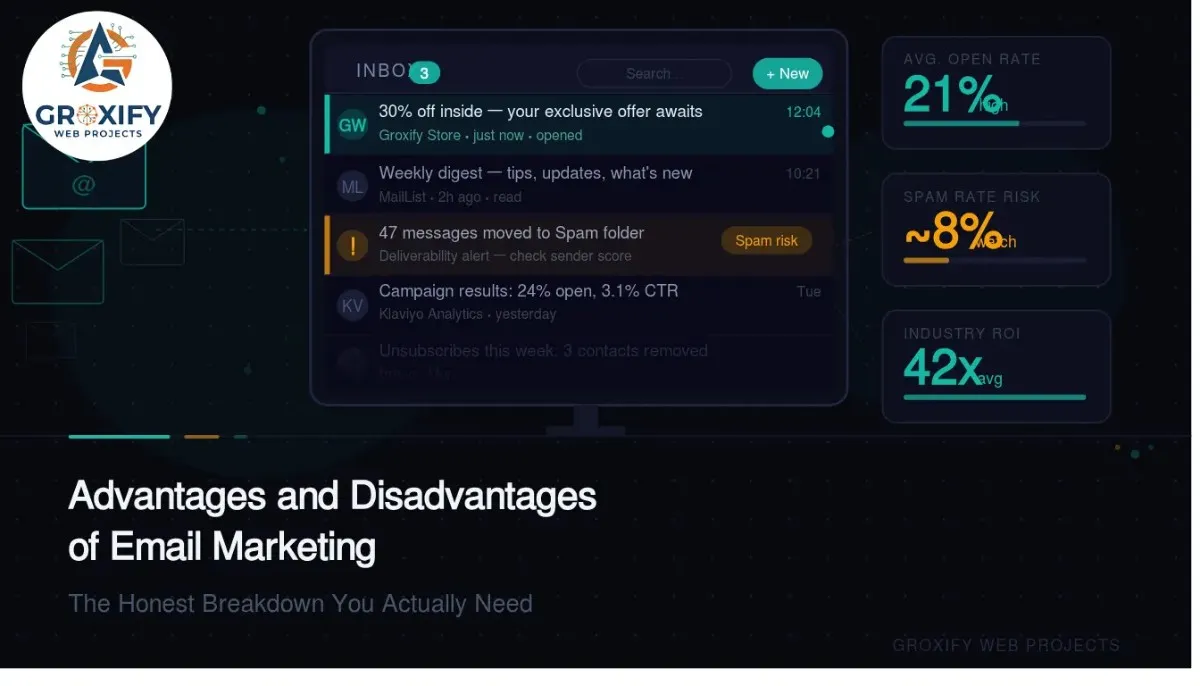
You search for email marketing advice and everyone sounds excited. “It has the highest ROI of any channel.” “Your list is your biggest asset.” All true. But nobody warns you that building that list takes months before a single sale happens. Nobody mentions the emails that quietly land in spam. Or the campaigns that got opened by 8% of people and ignored by the rest.
Table of Contents
The advantages and disadvantages of email marketing are both very real. Whether you are a business owner deciding if this is worth your budget, a freelancer figuring out if you should offer it as a service, or just someone trying to understand the full picture before jumping in, this article gives you exactly that. No hype, no sugarcoating.
What Is Email Marketing (Before We Get Into the Pros and Cons)
Email marketing is sending targeted messages to a list of people who have agreed to hear from you. That consent part is not just a nice-to-have. It is the foundation. Without it, you are not doing email marketing. You are spamming.
These messages can be anything: a welcome email when someone signs up, a weekly newsletter, a product launch announcement, a discount offer, or even a simple “here is something useful” update. The goal is to stay connected with your audience and, at the right moment, get them to take action.
The tool you use is called an ESP, which stands for Email Service Provider. Think Mailchimp, ConvertKit, Brevo, or similar platforms. They handle the sending, tracking, and automation so you do not need any technical background to get started.
One thing to understand early: email marketing is not one big blast to your whole list. Done well, it is a series of relevant, timed messages going to the right people at the right moment.
The Real Advantages of Email Marketing
It Costs Very Little to Start
Compared to paid ads, print, or sponsorships, email marketing is genuinely affordable. Most ESPs have a free plan for smaller lists, and even paid plans are priced for small businesses. You are essentially paying for the tool, not for each person you reach.
For anyone watching their budget closely, this is a real advantage. The cost to send 1,000 emails versus 10,000 emails is not wildly different, which changes the math compared to most advertising channels.
You Actually Own Your Audience
This is the one that does not get enough attention. Your Instagram following, your Facebook page, your LinkedIn connections, none of that is truly yours. If a platform changes its algorithm or gets less popular, your reach shrinks and you have no say in it.
Your email list belongs to you. You can export it, move it to a different tool, or keep it forever. No third party can cut your access to it. That ownership is the foundation that makes email a long-term asset and not just a tactic.
The Return on Investment Is Consistently High
Across industries, email marketing delivers one of the strongest returns compared to other digital channels. The exact numbers vary depending on your industry, your list quality, and your content, but the direction is consistent.
What drives that return is relevance. An email to people who actually want to hear from you and actually care about what you sell performs very differently from a blast to a random list. The channel is not magic. The relationship behind it is.
You Can Personalize Without Doing It Manually
Modern ESPs let you send different messages to different people based on what they clicked, what they bought, where they signed up, or how long they have been on your list. This is called segmentation, which means splitting your audience into groups so each group gets content that fits them specifically.
Someone who just signed up does not need the same email as someone who has bought from you three times. Email lets you set that up once and let it run automatically. That kind of personalization used to require a full marketing team. Now a solo business owner can do it with a basic email tool.
Every Campaign Gives You Data You Can Actually Use
With email, you know how many people opened each message (that is the open rate), how many clicked something inside it (the click-through rate, or CTR), how many bought, and how many left your list. Every send is a learning opportunity.
You can test two different subject lines on two groups of subscribers to see which one gets more opens. This is called A/B testing. Over time, those small improvements compound into much better performance. Compare that to handing out flyers and having no idea what happened next.
It Works Automatically Once You Set It Up
Once you build email sequences, they run on their own. Someone signs up at 11pm, they get a welcome email. They abandon a product in their cart, they get a follow-up three days later. You built it once. It works while you sleep.
This is called email automation, and it is where the real efficiency comes in. A solo freelancer or small business can punch well above their weight because the system handles the repetitive parts.
It Reaches People Directly
Social media is noisy. Your post competes with everyone else’s posts, paid ads, trending content, and whatever is happening in the news. An email lands in someone’s inbox. It is personal and direct, and if your subject line earns the open, you have their full attention for a few seconds.
People also open email with intent. They are not passively scrolling. They sat down to check their inbox. That different mode of reading makes email a better environment for actual communication than a social feed.
The Disadvantages of Email Marketing Nobody Talks About Honestly
Building a Quality List Takes Real Time
This is where most beginners get discouraged. You cannot start today and have 500 engaged subscribers by next month unless you already have a large audience somewhere. Building a quality list, meaning people who genuinely want to hear from you, takes consistent effort over months.
You need something to offer in exchange for an email address (more on this below), a place for people to sign up, and content good enough to make them stay. That whole system takes time to build, test, and refine. Anyone promising you overnight list growth is selling a shortcut that usually does not work.
Deliverability Is Quietly Killing Campaigns You Do Not Even Know About
Deliverability is whether your email actually reaches the inbox or disappears into spam. And this is not just about what you write. It depends on your domain reputation (how trustworthy your sending domain appears to email providers), your sending frequency, how many people mark you as spam, and technical standards like SPF and DKIM, which are email authentication settings that tell providers like Gmail you are a legitimate sender.
Poor deliverability can silently destroy a campaign. You send 1,000 emails, 600 land in spam, and you see a 4% open rate and assume your subject line was bad. The real problem was never seen. Getting deliverability right requires technical setup and ongoing maintenance, and most beginners skip this entirely.
Unsubscribes Are Normal but They Sting
Every time you send, some people leave. That is expected and honestly healthy, because people’s interests change. But if your unsubscribe rate keeps climbing after each campaign, something is off. Either you are sending too often, the content is not what people expected, or you attracted the wrong audience in the first place.
The bigger issue is when people do not unsubscribe but instead mark you as spam. That hurts your sender reputation and affects your deliverability for everyone on your list. Managing this means setting clear expectations from the start about what subscribers will get and how often.
It Can Feel Like Spam Even When It Is Not
Even a well-written, genuinely useful email can feel like clutter to someone who does not remember signing up six months ago. That perception is hard to control. Some people will tune out no matter how good your content is, and inactive subscribers quietly drag down your open rates and metrics over time.
The fix is called list hygiene, which means regularly removing or re-engaging people who have stopped opening your emails. Keeping a smaller, active list beats keeping a larger, dead one every time.
It Is Not Passive. It Takes Real Effort.
Writing emails that people actually want to read takes skill. Coming up with useful content consistently is harder than it sounds. Designing a good-looking email (even with templates), writing subject lines that earn opens, building automations that make logical sense, and testing what works all add up.
This is manageable, but it is not free in terms of time and energy. For a solo business owner already wearing ten hats, email marketing can easily get deprioritized or done half-heartedly. That is often why results disappoint. The channel works. The inconsistency does not.
Legal Compliance Is Not Optional
Laws like GDPR (General Data Protection Regulation, which applies if you have any subscribers in the EU) and CAN-SPAM (the US equivalent) have clear rules. You must get clear consent before adding someone to your list. You must include an unsubscribe link in every email. You must honor removal requests quickly.
Ignoring these is not just a mistake. It can lead to fines and getting your ESP account suspended. If you are collecting emails from people in multiple countries, understanding which rules apply to your situation is a basic requirement, not an optional extra.
Email Marketing Advantages and Disadvantages: Side-by-Side
| Factor | The Upside | The Downside |
|---|---|---|
| Cost | Low to start, free tiers available | Paid plans needed as your list grows |
| Reach | Direct inbox delivery, personal channel | Can land in spam if setup is off |
| Ownership | You own your list fully | Requires ongoing work to grow it |
| ROI | High returns when list is engaged | Low when list is cold or untargeted |
| Effort | Automatable over time | Setup and ongoing content take work |
| Personalization | Strong segmentation possible | Needs planning and good data to work |
| Legal | Clear rules exist | Non-compliance has real consequences |
When Email Marketing Works and When It Does Not
Email works best when you have something genuinely useful to say to people who actually signed up to hear from you. A handmade products shop with loyal buyers. A trainer with a trusted community. A software product helping users get more out of the tool. In these cases, email delivers consistently.
It does not work well when the list is cold or bought (buying email lists almost never ends well and can get your sending account banned), when every email is just a promotion with nothing useful in it, or when there is no real relationship between sender and subscriber.
The pros of email marketing show up most clearly when the strategy behind it is solid. When it underperforms, the channel usually gets blamed. But in practice, the content and the list quality are what decide the outcome.
Should Small Businesses and Freelancers Actually Bother?
Yes. But only if you are willing to treat it seriously.
You do not need a large list. Even 200 to 300 engaged subscribers can drive real revenue if the relationship is genuine and the content is relevant. The mistake most small business owners make is treating email like a broadcast tool, just pushing sale announcements and product updates. The ones who see results treat it like a conversation.
At Groxify Web Projects, we have seen small businesses with fewer than 500 subscribers outperform brands with tens of thousands. The difference is almost always the same: one side talks to people like people, and the other sends campaigns like flyers.
Start with one email a week, or even once or twice a month. Build the habit of writing before you worry about building the automation. Consistency at a small scale beats a big setup that rarely gets used.
The Advantages and Disadvantages of Email Marketing: The Full Picture
Here is the honest summary. Email marketing is one of the most effective tools available to anyone with something valuable to offer. But it rewards patience and punishes shortcuts.
A quality list built over time, content that actually serves the reader, clean technical setup, and consistent sending, when those four things come together, email is hard to beat. When any one of those four breaks down, results suffer and people blame the channel.
The advantages are genuinely strong. The disadvantages are genuinely real. What decides which side wins for you is not the tool you pick or the template you use. It is whether you are willing to do the work it actually takes.
Conclusion
Email marketing looks simpler than it is. The advantages and disadvantages of email marketing both hold true, and which side tips in your favor depends entirely on how you approach it. Build a real list, write content that actually helps people, respect their inbox, and stay consistent. Do that, and email becomes one of the most reliable channels you have. Start with one email. See how people respond. Go from there.
FAQ
Yes, email marketing remains one of the highest ROI digital channels available. Effectiveness depends on list quality and content relevance. A small engaged list consistently outperforms a large unresponsive one. Done right, it still performs better than most other digital channels.
Open rates vary by industry, but a healthy average typically falls between 20% and 40%. Below 15% usually signals issues with subject lines, send timing, or list quality. Tracking your own rate over time and improving it gradually is more useful than chasing a single benchmark number.
Deliverability and list-building time are the two biggest challenges. Getting emails into the inbox requires good sending practices, technical setup, and consistent list engagement. Building a quality list takes months. Both are manageable, but beginners frequently underestimate them at the start.
They serve different purposes. Email gives direct access to an audience you own, with higher conversion rates. Social media is better for discovery and reaching new people. Most businesses benefit from both, with email handling the relationship and conversion side, and social media handling reach and awareness.
No. Even 100 to 200 engaged subscribers can drive real results if the content is relevant and trust is established. Focus on quality over quantity early on. A small responsive list is far more valuable than a large one filled with people who stopped opening emails months ago.
It damages your sender reputation, meaning future emails are more likely to land in spam for others on your list too. Too many spam complaints can get your account suspended by your ESP. This is why consent, genuinely useful content, and easy unsubscribe options matter so much from day one.
There is no universal answer. Once or twice a week is a reasonable starting point for most businesses. The more important question is whether each email has a real reason to exist. Sending too often without value causes unsubscribes. Sending too rarely makes people forget they ever signed up.
Yes. Modern ESPs have drag-and-drop editors, ready-made templates, and simple automation builders. You do not need coding skills. The more challenging part is writing emails people want to read and building a quality list, which is about communication and strategy rather than technical ability.
A lead magnet is something you offer in exchange for an email address, like a free guide, checklist, template, or discount. You do not strictly need one, but it significantly speeds up list growth. Without one, you are asking people to subscribe for nothing concrete, which converts at a much lower rate.
Track four main numbers: open rate (did people open it?), click-through rate (did they click something?), conversion rate (did they take the action you wanted?), and unsubscribe rate (are people leaving?). Review these after every campaign and adjust based on what the numbers tell you over time.

Rohit Singh is the Founder of GROXIFY WEB PROJECTS LLP with many years of hands-on experience in digital marketing, including SEO, PPC, social media, email marketing, content writing, and WordPress development. He has worked with global clients across industries and helped businesses achieve 5x–10x revenue growth through data-driven strategies and practical execution. Rohit actively manages digital teams, builds business strategies, plans marketing systems, and oversees execution to drive consistent traffic, leads, and long-term business growth.