Most people searching this topic end up with a long list and zero clarity. Fifteen types of content marketing, a definition for each, and then nothing telling you which one actually fits your situation. That is why people close the tab and start over.
The types of content marketing are not complicated. What gets confusing is figuring out which one is worth your time, money, and effort right now. Not in general. For you. This article covers all the major types, what each one does well, what it does poorly, and how to decide where to start. Read through once and you will not need to open another article on this topic again.
What Are the Types of Content Marketing?
Content marketing is creating and sharing useful content to attract people to your business, instead of pushing ads at them. You give people something valuable, and they come to you.
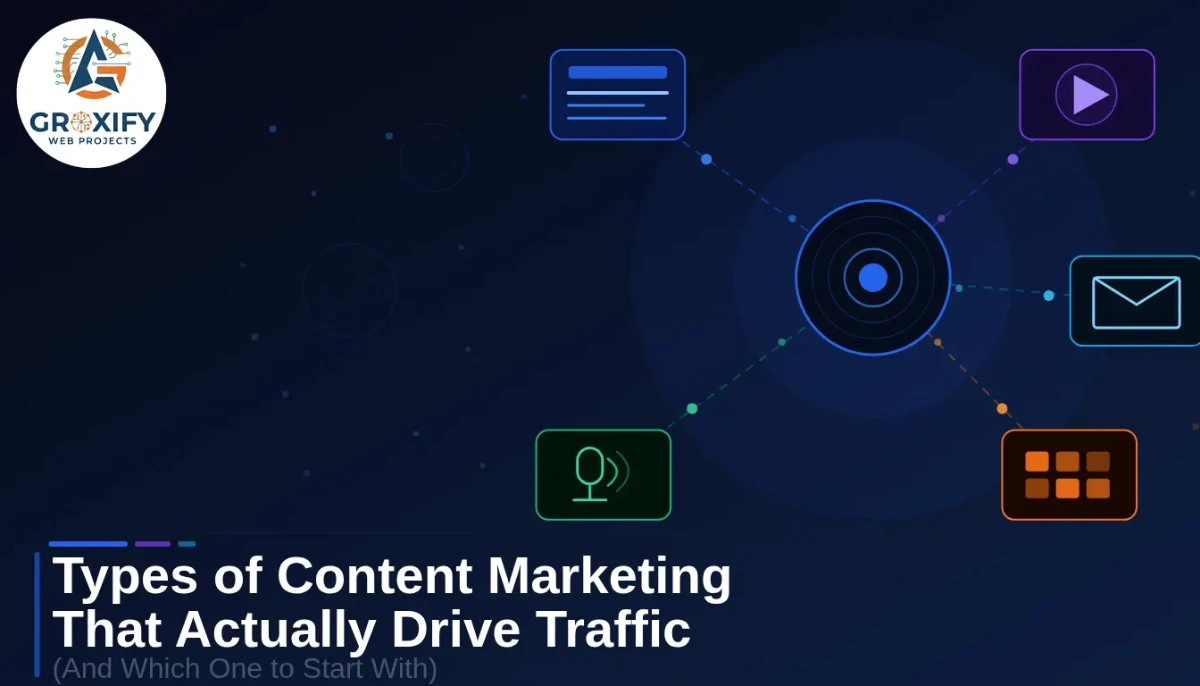
There are roughly ten main types: blog posts, video content, social media posts, email newsletters, infographics, podcasts, case studies, whitepapers, detailed guides, and user-generated content. Understanding the different content marketing types is not the hard part. Knowing which one deserves your time is.
Each type reaches people differently, lives on different platforms, and requires different skills and budgets to produce consistently. The sections below break each one down clearly so you can make an actual decision by the end.
Blog Posts and Written Content
A blog post is a written article published on your website, usually targeting a topic or question your audience is already searching for on Google.
Blogs are one of the most reliable ways to build consistent organic traffic, meaning visitors who come from search engines without you paying for ads. When someone types a question into Google, the results are mostly written articles. If your blog answers that question more clearly than the competition, it ranks. That ranking brings traffic. That traffic can convert into leads, subscribers, or sales.
Results are slow. Expect three to six months before you see real movement. But a blog post that ranks keeps pulling in traffic for years without additional work. That compounding effect is what makes blogging worth the patience.
What makes a blog post worth reading
The best content marketing blogs are not the longest or the most polished. They are the most genuinely useful. A post that answers one specific question completely, in plain language, with zero padding, tends to outperform vague articles that technically cover the topic but say nothing useful.
Write for the person reading, not for search engines. Ironically, search engines reward what readers love anyway.
If you are a beginner, blogs are the lowest-barrier content type with one of the highest long-term payoffs. Start here.
Video Content
Video is the highest-engagement content format online right now. Most major platforms actively prioritize showing it to more people, which makes it one of the more accessible formats to get discovered through.
There are two very different categories, and treating them as the same thing is a common mistake:
Short-form video (under 60 to 90 seconds) on platforms like Instagram Reels or YouTube Shorts is built for discovery. People who have never heard of you can stumble onto your content. Results can come faster, but the audience is mostly browsing passively, and the jump from viewer to paying customer is longer.
Long-form video (5 minutes and above) on YouTube functions more like a search engine. People type what they want to learn, find your video the same way they would find a blog post, and watch with genuine focus. The trust it builds is significant because the viewer sees your face and hears your voice consistently.
The honest tradeoff: video takes far more time than writing. Factor in scripting, filming, and editing, and a single good video can take 8 to 12 hours. Only commit to it if you can do it on a consistent schedule.
Social Media Content
Social media content is anything you publish on platforms like Instagram, LinkedIn, X (formerly Twitter), Facebook, or Pinterest. This includes text posts, short videos, carousels (slideshows of images), polls, and stories.
The biggest difference between social media and other content types is this: it lives on platforms you do not own. If Instagram changes its algorithm, meaning the system that decides who sees what, your reach can drop overnight without warning. That happens regularly and without notice.
That said, social media is excellent for staying visible to people who already know you and for getting your content discovered and shared. It is also the fastest type to produce and test. The realistic expectation for organic social (posts you do not pay to promote) is that it works better as a support channel than a standalone one.
Think of social media as the distribution layer for your other content, not the foundation.
Email Marketing: The Most Underrated Type
Email marketing means sending content directly to people who have signed up to receive it. This includes newsletters, educational email sequences, product updates, and promotional campaigns.
Email is consistently one of the most effective content types, and the reason is simple: the person opted in. They are not scrolling past it. They opened it deliberately. That level of attention is genuinely rare compared to any other channel.
An email list is also something you fully own. No algorithm change can wipe it out. No platform can take your subscribers away. That makes a strong email list one of the most valuable and durable content assets a business can build.
The challenge is that you need traffic or an existing audience somewhere to get people to subscribe in the first place. Email marketing works best when it is connected to a blog, social presence, or any other channel bringing in new people. The two build each other over time.
Infographics and Visual Content
An infographic is a designed image that presents information, data, or a process in a way that is far easier to absorb visually than as written text.
Complex processes that take 400 words to explain in writing can be understood in under 30 seconds as a well-designed infographic. That compression is the core appeal. Infographics also get saved and reshared at much higher rates than plain text posts.
The limitation is real: search engines read text, not images. So infographics alone do not drive much SEO traffic. They work best as supplements to written content or as standalone social media posts where visual formats consistently outperform everything else.
One practical note: if you are designing infographics for mobile audiences, simpler is almost always better. Complex designs with small text look sharp on desktop but become unreadable on a phone screen, which is where most people are viewing social content.
Podcasts and Audio Content
A podcast is an audio show published in episodes, usually built around a theme or industry. People listen while commuting, working out, cooking, or doing anything where staring at a screen is not practical.
Podcasts build a type of trust that is hard to replicate through any other content format. When someone listens to your voice for 30 to 60 minutes regularly, they start to feel like they know you personally. That relationship accelerates buying decisions, especially for high-ticket services or products.
The honest reality: podcasting is one of the slowest formats to grow. Most podcasts take 6 to 12 months of consistent publishing before they build a meaningful audience. It is a strong long-term play, not a quick win, and it is not where most beginners should start.
If you do want to start a podcast, beginning with a guest interview format tends to produce better early content and helps you reach new audiences through each guest’s existing network.
Case Studies, Whitepapers, and Detailed Guides
These are the longer, more in-depth content types. They take the most time to produce and tend to generate the highest quality results.
A case study shows how a specific client or customer got results using your product or service. It answers the most important question any potential buyer has: “Has this actually worked for someone like me?” One strong case study can close deals that would otherwise take months of back-and-forth, especially in B2B situations, meaning businesses selling to other businesses.
A whitepaper is a detailed report or guide targeting a professional audience. These are often gated, meaning the reader provides their email address to access the content, which makes them a natural lead generation tool. Lead generation means attracting genuinely interested people and collecting their contact information for follow-up.
A detailed guide or pillar post covers a broad topic completely and becomes a reference page people keep returning to. These also tend to earn backlinks, which are links from other websites pointing back to yours. Backlinks are one of the strongest signals that help a page rank higher on Google.
High effort. Strong results. Worth it for businesses with even a small amount of content experience already.
User-Generated Content
User-generated content, or UGC, is content created by your customers rather than your business. Reviews, testimonials, photos, short videos, and social posts about your product or service all count.
This is one of the most underused content marketing types, especially among smaller businesses. The logic is direct: people trust other customers far more than they trust anything a brand says about itself. A genuine review from a real person carries more weight than the most polished marketing copy you could write.
The smart approach is to actively encourage customers to share their experiences, and then feature that content across your website, social profiles, and email campaigns. You get powerful trust-building material without producing it yourself.
As your customer base grows, the volume of UGC grows with it. That built-in scalability makes it one of the most efficient content types available to any business at any stage.
Which Types of Content Marketing Should You Start With?
This is the question most content marketing articles skip entirely. They list every type and leave you to figure out the rest. Here is a more useful way to think about it.
| Content Type | Effort Level | Time to See Results | Best For |
|---|---|---|---|
| Blog Posts | Medium | 3 to 6 months | Long-term SEO traffic |
| Email Marketing | Low to Medium | Immediate | Conversions and retention |
| Social Media | Low | Immediate | Visibility and distribution |
| Short-Form Video | Medium | 1 to 3 months | Discovery and awareness |
| Long-Form Video | High | 3 to 6 months | Trust and search traffic |
| Podcast | High | 6 to 12 months | Deep relationship building |
| Infographics | Low to Medium | Varies | Social sharing and support |
| Case Studies | Medium | Immediate for sales | B2B trust and conversion |
| User-Generated Content | Low to collect | Varies | Social proof at scale |
For most people starting from zero, this sequence makes the most sense:
- Start with a blog. It builds long-term traffic and every blog post can later be repurposed into social content, short videos, and email campaigns.
- Build an email list from day one. Even ten subscribers is worth something. The habit of writing to an audience sharpens your content thinking fast.
- Choose one social platform based on where your specific audience already spends time. Not where you feel most comfortable. Where they actually are.
- Add video or a podcast only once you have a content rhythm and have learned what topics your audience actually responds to.
If you run a B2B business or sell high-ticket services, bring case studies into the mix earlier than you think. Even one strong case study, well written and prominently placed, can move deals that nothing else will.
At Groxify Web Projects, the most consistent observation across business types is this: starting simple and staying consistent outperforms trying to be everywhere at once, every time.
The Part Most Content Marketing Articles Get Wrong
Almost every content marketing article presents the types as a menu. Pick one. Do that. What they miss is that the types work best as a connected system, not isolated choices.
Here is what that looks like in practice: a blog post draws in a visitor through Google. That visitor subscribes to your email list. Your next email sends them back to your newest post. You repurpose that post into a short video. Someone discovers you through the video and searches your brand name. They find your site, read several posts, and subscribe.
That loop is what content marketing actually looks like when it works. Each type feeds the others.
You do not need to run all types at once. But the types you do choose should be built to connect. A blog and an email list running together will almost always outperform either one alone. Add one social platform to distribute the blog, and suddenly the same content is doing three jobs.
Most people understand individual content marketing types well enough. The missed piece is building the connections between them. Once that clicks, everything else starts to make more sense.
Conclusion
The right type of content marketing is not the one with the most success stories behind it. It is the one you can produce consistently for your specific audience with the time and resources you actually have. Start with one or two types, build a real rhythm, and layer in more as your confidence and audience grow. Most content marketing efforts fail not because of the wrong format but because people spread too thin and quit when results move slowly. The types of content marketing that drive real traffic are not secrets. They are just used steadily, by people willing to play the longer game. Pick yours. Start there.
FAQ
Content marketing is creating useful content like blog posts, videos, or podcasts to attract people to your business instead of pushing ads at them. You give people something valuable so they come to you on their own. Over time, this builds trust and generates consistent leads or sales.
There are around ten main types: blog posts, video content, social media posts, email marketing, infographics, podcasts, case studies, whitepapers, detailed guides, and user-generated content. Most businesses use two or three consistently. Doing fewer types well beats doing many types poorly.
A content marketing blog is a section of your website where you publish articles targeting topics your audience searches for online. Done well, it drives consistent traffic from search engines over time. The goal is to attract visitors through helpful content and convert them into leads, subscribers, or customers.
No. Content marketing is one of the most accessible strategies for small businesses and solo operators because it primarily costs time rather than money. A freelancer with a consistent blog and an email list can compete directly with larger businesses for the same search traffic and audience attention.
It depends on your audience and resources. Blog posts paired with email marketing are consistently effective for long-term traffic and conversions. Video builds trust faster but requires more production time. The most effective type is always the one you can execute consistently for your specific audience.
Not definitively. Both blogs and YouTube function as search engines and can drive long-term consistent traffic. Short-form video builds awareness faster but converts more slowly. Blogs require less production time and lower upfront cost. For most beginners, blogs offer a better ratio of effort to results, at least at the start.
Both serve different purposes. A blog builds content on your own website that ranks on Google over time. Social media builds visibility but lives on platforms you do not control. For long-term traffic and stability, a blog is the stronger foundation. Social media works best to support and amplify it.
A blog post is a publicly accessible article, usually 800 to 2,500 words, aimed at attracting a broad audience through search. A whitepaper is a longer, more formal report targeting a professional audience, often gated behind an email sign-up. Whitepapers generate leads directly. Blog posts generate traffic first.
Start by identifying where your target audience spends time and what content format they already consume. Then consider what you can realistically produce on a consistent schedule given your time and budget. Match the format to the platform, the audience behavior, and your own capacity. Start with one type and build from there.
It depends on the type. Email and social media can show results within days or weeks. Blog posts typically take three to six months to generate meaningful organic traffic. Podcasts can take six to twelve months to find an audience. Content marketing is a long-term investment, and consistency matters far more than speed.

Rohit Singh is the Founder of GROXIFY WEB PROJECTS LLP with many years of hands-on experience in digital marketing, including SEO, PPC, social media, email marketing, content writing, and WordPress development. He has worked with global clients across industries and helped businesses achieve 5x–10x revenue growth through data-driven strategies and practical execution. Rohit actively manages digital teams, builds business strategies, plans marketing systems, and oversees execution to drive consistent traffic, leads, and long-term business growth.