Why White Hat SEO vs Black Hat SEO Still Confuses Business Owners
Last month a small business owner from Laxmi Nagar, Delhi asked me a very direct question. He said, “Rohit ji, one SEO person promised ranking in 15 days. You are saying 4 months. Why such a big difference?” This is exactly where the confusion between white hat SEO and black hat SEO starts.
In many founders, startups, and even students learning SEO still face this situation. One side talks about fast ranking by SEO tricks. The other talks about slow but stable growth. Both sound convincing if you do not know what Google actually checks today.
What makes this more confusing now is:
- Cheap freelancers promising instant ranking
- AI generated spam content increasing
- Businesses watching competitors jump suddenly in rankings
- Lack of clarity about bounce rate SEO and real ranking signals
- Local businesses in areas like Noida Sector 62, Gurgaon Cyber City, and Karol Bagh wanting quick leads
While working with businesses through Groxify Web Projects, I regularly see this pattern. Companies that chase shortcuts usually come back after traffic drops or penalties hit. Those who stay patient with clean SEO usually build stable enquiries.
If you are:
- Just learning SEO
- Comparing agencies
- Running a startup
- Doing freelance SEO
- Planning long-term growth
then understanding this difference can save months of time and money.
Let us first clearly understand what white hat SEO actually means and why Google prefers it.
What is White Hat SEO and Why Google Actually Rewards It
In simple words, white hat SEO means doing SEO the way Google officially recommends. No tricks. No shortcuts. Just real work that improves website quality and user experience.
When I explain this to business owners in places like Nehru Place or Connaught Place, I usually say one thing. Google is not trying to rank websites. Google is trying to rank helpful answers. If your site genuinely helps users, ranking by SEO becomes a natural outcome.
White hat SEO usually includes work like:
- Writing useful content that answers real questions
- Improving website speed and mobile experience
- Fixing technical errors
- Building genuine backlinks from relevant sites
- Reducing bounce rate SEO by improving page usefulness
- Clear site structure so users find information easily
At Groxify Web Projects, when we onboard new clients, we first fix basics. Many times we see sites with good products but poor structure. After improving content clarity and page speed, engagement improves within weeks. Rankings usually follow in a few months.
Why Google rewards this approach:
- Users stay longer on helpful websites
- Lower bounce rate signals content relevance
- Real backlinks show trust
- Consistent updates show site activity
- Good experience matches Google’s Helpful Content system (very important after recent updates)
Simple reality I tell every client:
White hat SEO feels slow in the beginning but becomes very difficult to shake once rankings stabilise.
Now let us understand the other side. Why black hat SEO still attracts people even after so many risks.
What is Black Hat SEO and Why It Looks Attractive but Risky
Black hat SEO is the opposite approach. It focuses on manipulating search rankings instead of improving user experience. The goal is fast ranking by SEO tactics that try to exploit algorithm gaps rather than build real authority.
Many business owners get attracted because the promises sound very tempting. I still remember a trader from Karol Bagh who showed me a message from an SEO seller promising page-1 ranking in 10 days. The method they suggested was bulk backlinks and AI spun pages. This is a very common trap.
Typical black hat SEO methods include:
- Buying hundreds of low-quality backlinks
- Keyword stuffing just to force ranking
- Hidden text or cloaking tricks
- Copying content from other websites
- Auto-generated pages made only for traffic
- Fake engagement signals to manipulate bounce rate SEO
Why it looks attractive:
- Fast initial ranking sometimes happens
- Very low pricing compared to real SEO work
- Easy to sell to beginners
- Competitors sometimes appear to grow quickly using it
But the risks are very real:
- Sudden ranking drop after Google updates
- Manual penalties (traffic can go near zero)
- Loss of domain trust
- Recovery taking 6–12 months sometimes
- Wasted budget with no long-term asset built
At Groxify Web Projects, we sometimes get recovery projects where businesses from Noida Extension or Ghaziabad come after traffic crashes. Cleaning spam links and rebuilding trust takes much more effort than doing clean SEO from day one.
Reality is simple. Black hat SEO sells speed. White hat SEO builds stability. Next, let us compare both clearly side by side.
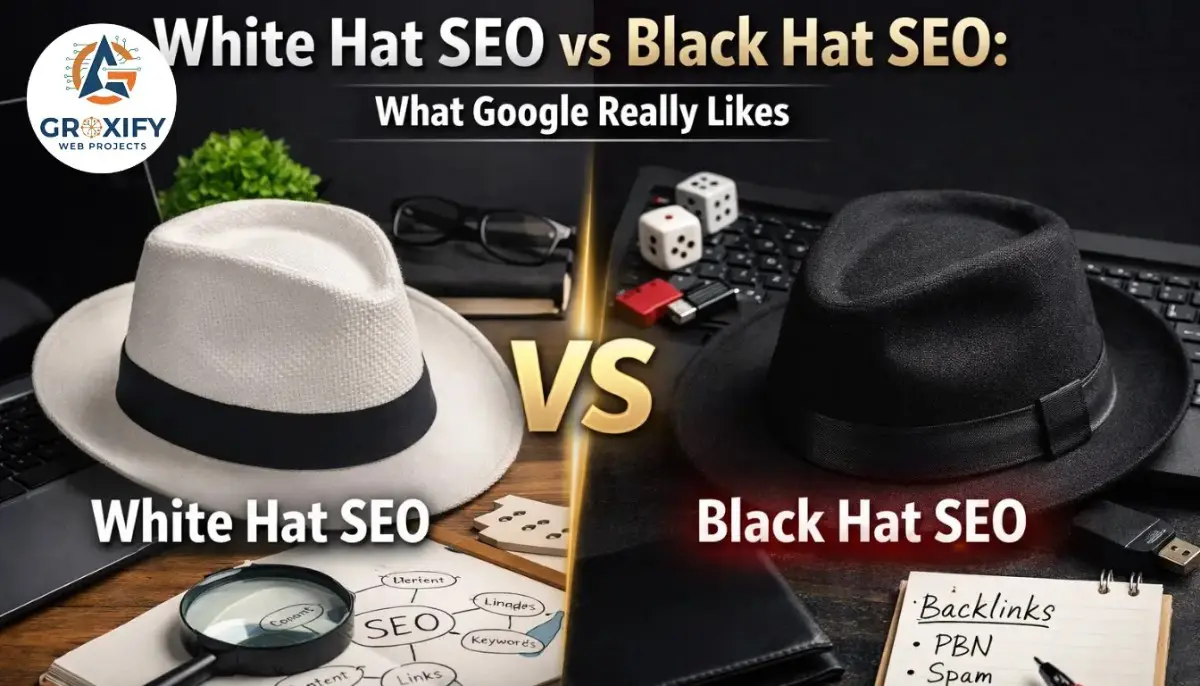
White Hat SEO vs Black Hat SEO: Side-by-Side Comparison Table
When founders ask me which approach is better, I usually do not explain theory first. I show a simple comparison. Once people see long-term impact clearly, decision becomes much easier.
Here is the same comparison I often explain to business owners from Preet Vihar, Mayur Vihar, and startup teams in Noida Sector 18 when they are evaluating SEO vendors.
| Factor | White Hat SEO | Black Hat SEO |
| Approach | Follows Google guidelines | Breaks or manipulates rules |
| Ranking Speed | Slow but stable growth | Fast but unstable jumps |
| Risk Level | Very low risk | High penalty risk |
| Content Strategy | Useful, original content | Copied or AI spam content |
| Backlinks | Natural, relevant websites | Paid or spam link networks |
| Bounce Rate SEO Impact | Improves user engagement | Users leave quickly due to poor quality |
| Long Term Results | Rankings can stay for years | Rankings often disappear suddenly |
| Google Penalty Chance | Rare | Very common after updates |
| Cost Reality | Investment type expense | Cheap upfront but costly later |
| Business Value | Builds brand authority | No real brand value created |
What most businesses realise after some time:
- White hat SEO becomes a digital asset
- Black hat SEO becomes a repeated expense
- Clean SEO builds enquiry consistency
- Shortcut SEO creates dependency on tricks
One pattern I repeatedly observe while guiding clients at Groxify Web Projects is this: businesses that choose clean SEO may wait 3–5 months, but after that their leads become more predictable. Businesses choosing shortcuts often restart SEO again after penalties.
Key Takeaways
- If you want quick experiments → black hat may look tempting
- If you want stable growth → white hat SEO is the practical choice
- If your domain is new → avoid risks completely
- If your brand matters → trust building matters more than speed
Now the real question becomes more important.
How does Google actually judge which site deserves ranking?
How Google Really Decides Rankings (Bounce Rate, Trust Signals & User Behaviour)
Many people still think ranking by SEO means just keywords and backlinks. That was true years ago. In Google is much more focused on how users behave after clicking your website.
When we audit websites at Groxify Web Projects, we do not just check keywords. We check what real visitors are doing. Are they staying? Are they clicking another page? Or leaving in 5 seconds?
Some real signals Google indirectly watches:
User behaviour signals
- How long people stay on your page
- Whether they visit another page
- Whether they return to Google quickly
- Mobile usability (most Indian users browse on phone)
Bounce rate SEO reality
Bounce rate alone is not a direct ranking factor, but behaviour patterns matter. If users land and leave instantly, Google assumes the page did not help.
We improved one service website for a Gurgaon Sector 48 business just by:
- Making content clearer
- Improving page speed
- Adding FAQs
- Fixing mobile layout
Within about 8–10 weeks, engagement improved and rankings moved gradually without any aggressive backlinks.
Trust signals Google looks for:
- Consistent content updates
- Author credibility (E-E-A-T signals)
- Real business details
- Secure website (HTTPS)
- Natural backlinks
- Good Core Web Vitals (page speed and stability)
Simple way I explain this:
Google rewards websites that behave like real businesses, not ranking machines.
If your site helps users genuinely, rankings usually follow as a side effect.
Next, let us talk about the biggest practical mistakes that stop businesses from getting SEO results.
Common SEO Mistakes I See Indian Businesses Making
Across the last few years while working with startups, coaching institutes, and service businesses around Delhi NCR, one thing is very clear. Most SEO problems do not happen because of competition. They happen because of wrong decisions taken early.
Some mistakes I repeatedly come across when auditing websites from areas like Janakpuri, Vaishali, and Noida Sector 63:
Common practical mistakes
- Choosing cheapest SEO without checking strategy
- Expecting ranking in 30 days
- Focusing only on backlinks not content quality
- Ignoring mobile experience (huge mistake in India)
- Publishing AI content without editing for usefulness
- Not tracking bounce rate SEO behaviour
- Changing agencies every 2–3 months
- Targeting only high competition keywords
- No patience for organic growth timeline
One startup founder once told me after switching three SEO providers, “Everyone promised ranking but nobody explained process.” That happens often.
Mistakes that cost the most later:
- Black hat link packages
- Duplicate location pages
- Keyword stuffing service pages
- Buying fake traffic
At Groxify Web Projects, when we guide businesses, we usually fix clarity first. Once expectations become realistic, SEO performance improves because the strategy stays consistent.
Key Takeaways
- SEO fails more due to impatience than competition
- Cheap shortcuts usually mean future recovery work
- Consistency beats aggressive experiments
- Understanding process matters more than promises
Now let me share some real client situations where the difference between clean SEO and shortcut SEO became very visible.
Real Client Case Studies From My Work at Groxify Web Projects
Instead of theory, let me share a few real situations from projects we handled at Groxify Web Projects. Names are kept general for privacy, but the situations are very real and common in India.
Case Study 1 – Local Service Business Recovery (Delhi NCR)
Situation:
A home services company operating around Mayur Vihar and Indirapuram contacted us after their traffic suddenly dropped.
Problem:
Previous vendor used black hat SEO:
- Spam backlinks
- Duplicate city pages
- Keyword stuffing
After a Google update, their ranking dropped from page 1 to page 6.
Action taken:
- Removed toxic backlinks (took about 5 weeks)
- Rewrote service pages for real users
- Improved site speed
- Added helpful local FAQs
- Focused on white hat SEO content
Result:
- Traffic started recovering after about 10–12 weeks
- 40% enquiry recovery in 4 months
- Stable rankings returned gradually
Client said something simple which I still remember:
“Now ranking is slower but enquiries feel real.”
Case Study 2 – Startup Growth With Clean SEO Approach
Situation:
A SaaS startup team working from Gurgaon Cyber Hub wanted fast growth but also long-term brand visibility.
Problem:
- Very competitive keywords
- High bounce rate SEO issue
- Blog content not answering real questions
Action taken:
- Built topic clusters instead of random blogs
- Improved user intent content
- Fixed internal linking
- Reduced page load time
Result:
- Bounce rate improved within 6 weeks
- Blog traffic doubled in about 5 months
- Demo requests increased steadily instead of spikes
One team member told us during review:
“Earlier traffic came but did not convert. Now visitors actually read.”
Case Study 3 – Freelancer Website Turnaround
Situation:
An SEO freelancer from Noida Sector 75 approached us because his own site was not ranking.
Problem:
- Over-optimised anchor text
- Bought backlinks package
- Thin service pages
Action taken:
- Disavowed bad links
- Rebuilt service pages with real examples
- Added case proof content
- Focused on topical authority
Result:
- Rankings improved slowly over 3–4 months
- Organic leads started coming instead of cold outreach dependency
His feedback was very honest:
“I was doing shortcuts for clients but not building my own authority. Now I understand the difference.”
Key Takeaways
From different projects, one pattern becomes very clear:
- Shortcut SEO creates instability
- White hat SEO builds enquiry quality
- Recovery always takes longer than prevention
- Content clarity reduces bounce problems
- Real SEO timelines usually start showing direction after 8–16 weeks
These situations are why I always recommend building SEO like an asset, not like a quick campaign.
Groxify Web Projects – How I Started and What We Learned Working With Real Businesses
My name is Rohit Singh, founder of Groxify Web Projects. I started this company after spending years working directly on SEO campaigns, websites, and digital marketing projects where I saw one common problem. Businesses were spending money but not always understanding what was really being done.
The idea behind Groxify was simple. Build a small focused team that works practically, explains things clearly, and treats SEO like business growth work, not just ranking work.
Over the years, we have worked with:
- Local Delhi NCR service businesses
- Startups trying to build organic visibility
- E-commerce stores struggling with traffic quality
- Coaches and education businesses improving reach
- International clients needing structured SEO systems
One important lesson came early. Rankings alone do not mean success. Real success is when:
- Leads become consistent
- Bounce rate improves because visitors find answers
- Businesses stop depending only on ads
- Websites start working like sales support systems
Inside our team, we usually follow a simple working style:
- First understand business model
- Then study competitors
- Then fix technical gaps
- Then build content authority slowly
One client from Noida Sector 137 once told us after six months, “Earlier SEO felt like a mystery. Now at least I understand what is happening.”
That kind of clarity matters more than big claims. Real digital growth usually comes from steady improvements, not dramatic tricks.
Who Should Focus Only on White Hat SEO Today
Honestly, in almost every serious business should stay with white hat SEO. But some categories should avoid black hat SEO completely because the risk is simply not worth it.
From what we see while consulting businesses around Delhi NCR, these groups benefit the most from clean SEO:
Best suited for white hat SEO
- Startups building long term brand value
- Founders planning investor funding (due diligence checks website trust)
- Local businesses depending on Google leads
- E-commerce stores building repeat customers
- SEO freelancers building personal authority
- Students learning real ranking by SEO skills
- Agencies managing client reputation
Who should especially avoid black hat SEO:
- New domains (Google trust not built yet)
- Medical, finance, education websites (high trust niches)
- Businesses depending on local search traffic
- Companies already affected by penalties before
Simple decision rule I usually share:
- If your goal is quick experiment, risk exists
- If your goal is business stability, choose white hat SEO
- If reputation matters, shortcuts usually backfire
At Groxify Web Projects, when someone asks whether fast tricks are possible, we usually ask one question back: “Do you want temporary ranking or dependable enquiries?” That question itself clears most confusion.
Next important thing most people ask is timing. How long does white hat SEO actually take and what should you realistically expect?
How Long White Hat SEO Takes and What Results to Expect
This is probably the most honest question business owners ask. And the correct answer is always: it depends on starting condition, competition, and consistency.
From projects handled at Groxify Web Projects, a realistic white hat SEO timeline usually looks like this:
| Time Period | What Usually Happens |
| First 4–6 weeks | Technical fixes, content improvements, indexing corrections |
| 6–10 weeks | Engagement signals improve, bounce rate SEO starts stabilising |
| 3–4 months | Keyword movement begins for low to medium competition terms |
| 4–6 months | Traffic consistency starts if work is steady |
| 6–12 months | Strong authority signals build for competitive keywords |
What results people should realistically expect:
Early stage results
- Better site structure
- Faster loading pages
- Improved user behaviour
Mid stage results
- Ranking improvements for targeted topics
- More relevant traffic
- Lower bounce patterns
Long term results
- Consistent enquiries
- Brand trust improvement
- Reduced dependency on paid ads
One business owner from Rajouri Garden once told me after 5 months, “Earlier we were checking ranking daily. Now we track enquiries instead.” That mindset shift usually shows SEO is working correctly.
Reality check I always share:
White hat SEO rewards patience. But once momentum builds, results usually become more predictable than shortcut methods.
Next question people often compare is cost. Why cheap SEO often becomes expensive later.
SEO Cost Reality in India: Cheap Tricks vs Sustainable Investment
One very practical confusion I see with founders across Delhi, Noida, and Gurgaon is pricing. Many businesses compare SEO like they compare printing costs. Lowest price wins. Later they realise SEO is closer to business development than a one-time task.
Here is a realistic comparison based on market patterns we regularly see.
| Factor | Cheap SEO Packages | Sustainable White Hat SEO |
| Monthly Cost (India avg) | ₹3K–₹10K | ₹15K–₹80K depending scope |
| Work Focus | Mostly backlinks | Content, technical + authority |
| Reporting | Generic reports | Strategy based reports |
| Risk | High penalty chance | Safe growth approach |
| Result Stability | Temporary | Long-term |
| Hidden Cost | Recovery work later | None if done properly |
| Business Impact | Traffic spikes | Lead consistency |
What cheap SEO usually includes:
- Bulk directory backlinks
- Automated submissions
- AI blogs without research
- No technical improvements
What real SEO investment usually covers:
- Technical fixes
- User intent content
- Conversion focused improvements
- Competitor analysis
- Authority building
At Groxify Web Projects, sometimes we get recovery cases where businesses already spent 6–8 months on low-cost SEO. Cleaning damage takes more budget than doing it properly from the beginning.
Key Takeaways
- Cheap SEO is not always wrong, but often incomplete
- Real SEO cost depends on competition and scope
- Long-term SEO reduces paid ads dependency
- Think investment, not monthly expense
Next important thing many people are asking now. What will change in SEO in the next couple of years and what should businesses prepare for?
What Will Change in SEO in the Next 1–2 Years
SEO is changing faster now than it did a few years back. Many founders I meet in Noida, Delhi, and Gurgaon are already noticing traffic patterns changing because of AI answers, Google AI Overview, and better spam detection.
Based on trends we are already adjusting for at Groxify Web Projects, here are some practical changes likely to matter most:
What will matter more:
- Experience based content (real examples beat generic blogs)
- Author credibility signals (real people behind content)
- User satisfaction signals (did visitor get answer?)
- Topical authority instead of random keywords
- Mobile experience (India still heavily mobile-first)
- Core Web Vitals (site speed and stability)
- Helpful content updates from Google
What will slowly lose value:
- Mass backlink packages
- Thin AI generated pages
- Exact match keyword stuffing
- Fake traffic manipulation
- Shortcut black hat SEO experiments
What businesses should prepare for now:
- Build content around real questions
- Show real expertise (case proof, experience)
- Improve engagement not just traffic
- Focus on trust building signals
One pattern we already see. Websites that genuinely help users are surviving updates better than those chasing algorithm tricks.
Simple future rule I usually tell clients:
SEO is moving from technical tricks toward proof of real usefulness.
Key Takeaways Before You Decide Your SEO Strategy
If you reached this point, you probably fall into one of three groups. Either you are learning SEO, comparing providers, or planning to invest. Before deciding anything, these are the most practical lessons that usually matter.
Quick decision checklist
- If someone guarantees ranking → be careful
- If strategy is not explained → ask questions
- If timeline sounds unrealistic → verify process
- If price is extremely low → check what work is included
- If only backlinks are discussed → incomplete SEO plan
What usually works in normal situations
- Consistent white hat SEO work
- Content built around real search questions
- Fixing user experience issues
- Patience for 3–6 months minimum
- Tracking enquiries not just ranking
What usually fails
- Changing SEO providers too quickly
- Expecting instant results
- Black hat SEO experiments on main domain
- Ignoring bounce rate SEO behaviour
- Treating SEO like a one-time setup
From what we guide businesses through at Groxify Web Projects, the safest decision most companies make is simple. Build SEO like a long-term asset and avoid decisions based only on speed.
Key Takeaways
- Stable SEO beats fast SEO
- Process clarity matters more than promises
- Real growth shows in enquiries, not reports
- Good SEO decisions usually feel slow but safe
Next section answers some very common questions people normally ask before starting SEO.
Frequently Asked Questions
Yes, if your goal is stability. Quick tricks may bring temporary ranking, but most businesses I guided later preferred steady enquiries over short spikes. Clean SEO usually takes time but reduces future risks.
Yes, sometimes. Recovery is possible but takes months. In a few recovery projects we handled, traffic took around 4–8 months to normalise after penalty cleanup.
Not directly as a single metric. But poor user behaviour signals can affect trust. If visitors leave quickly because the page is not useful, rankings usually struggle over time.
Ask simple questions:
What work will be done monthly?
What timeline should I expect?
How are backlinks built?
Clear answers usually indicate a professional approach.
Yes. Search behaviour is changing, not disappearing. Helpful websites with real expertise are still getting traffic. In recent projects, strong informational content is still driving leads.
Normally at least 3–6 months. In competitive niches sometimes longer. SEO rarely shows full direction in the first few weeks.
If your customers search on Google, yes. Many local businesses around Delhi NCR get consistent leads once visibility improves, especially service providers.
Yes, basics can be learned. Focus on content quality, site clarity, and user value first. Advanced technical parts usually need experience.
Chasing ranking instead of solving user problems. Websites that answer real questions usually perform better long term.
Compare clarity, process explanation, and realistic timelines. In real situations, transparent communication matters more than big promises.
Final Thoughts Before You Choose Your SEO Direction
If you are still comparing options, take your time. Good SEO decisions usually come from understanding, not pressure. The simple difference to remember is this. White hat SEO builds trust. Black hat SEO borrows risk.
If you are learning, focus on skills that will still work after updates. If you are a business owner, think about where you want your website to be one year from now, not next month.
From the work we continue doing at Groxify Web Projects, one practical lesson stays consistent. Businesses that treat SEO as a long-term foundation usually worry less about ranking fluctuations.
If needed, take time to evaluate your current strategy, ask the right questions, and move step by step. Careful decisions in SEO usually save much more effort later.

Rohit Singh is the Founder of GROXIFY WEB PROJECTS LLP with many years of hands-on experience in digital marketing, including SEO, PPC, social media, email marketing, content writing, and WordPress development. He has worked with global clients across industries and helped businesses achieve 5x–10x revenue growth through data-driven strategies and practical execution. Rohit actively manages digital teams, builds business strategies, plans marketing systems, and oversees execution to drive consistent traffic, leads, and long-term business growth.