You publish a blog post. Nobody reads it. No traffic, no backlinks, nothing. That is not a writing problem — that is a distribution problem. Article submission is one of the oldest, most underused fixes for exactly this. Done right, it builds backlinks (links from other sites pointing to yours — a key signal Google uses to rank pages), sends referral traffic, and gets your content indexed faster. Done wrong, it wastes hours and might even hurt your site.
This article covers everything: what article submission actually is, how it works for SEO, which sites are worth your time, and what mistakes quietly kill your results.
What Is Article Submission in SEO?
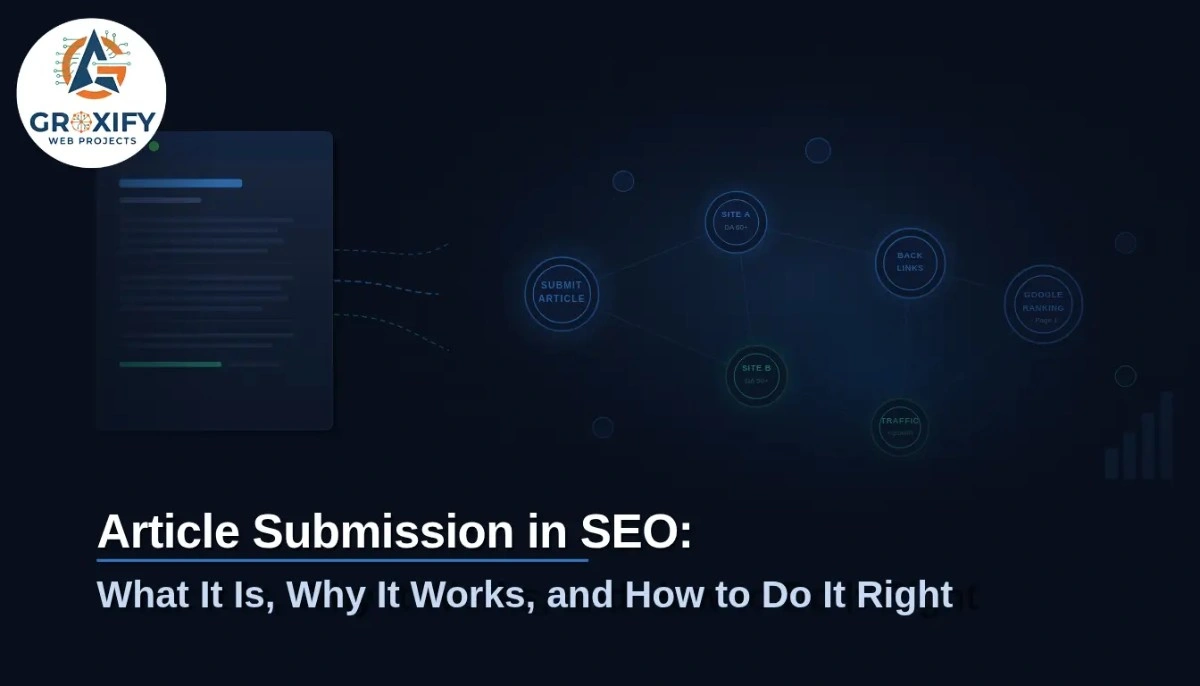
Article submission is the process of publishing your written content on third-party websites or directories — sites that accept articles from outside contributors and display them publicly.
These platforms let you include an author bio or a resource box at the end of your article, where you can place a link back to your own website. That link is called a backlink, and backlinks are one of Google’s top-ranking signals. The more quality backlinks pointing to your site, the more authority Google assigns to it.
It is not the same as guest posting. Guest posting means writing for a specific blog in your niche, usually with editorial review, and often getting a link within the content itself. Article submission is broader — you submit to directories or platforms that accept general content, and your link usually appears in the author bio section.
Both have their place. But article submission is faster, more accessible, and a solid starting point if you are just building your backlink profile.
How Article Submission Helps Your SEO
This is where most guides just list “benefits” without explaining the actual mechanism. Here is how it actually works.
It Builds Backlinks From Indexed Pages
When your article gets published on a site that Google already crawls and indexes, the link in your author bio gets crawled too. Google follows that link to your site, which signals to its algorithm that another site trusts your content enough to reference it. Over time, these signals accumulate and help your pages rank higher.
Not every backlink carries the same weight. A link from a high-authority article directory carries more SEO value than a link from a brand new, unknown site. That is why choosing the right article submission sites matters.
It Gets Your Content Indexed Faster
Google has crawl budgets — meaning it does not crawl every page on the internet every day. New sites and new pages sometimes take weeks to get indexed. But if your article is published on a platform Google visits regularly, it often gets picked up within hours. The link in that article then points Google toward your own site, speeding up indexation there too.
It Drives Referral Traffic
Referral traffic is visits that come from another website, not from search. If your article is genuinely useful and gets read on a submission platform, some of those readers will click through to your site. That traffic does not depend on your Google ranking at all — it is direct human interest.
It Helps Build Topical Authority
Topical authority means Google sees you as a credible source on a specific subject. When you consistently publish articles across multiple platforms — all related to your niche — it reinforces the signal that you know what you are talking about. It is not just about one backlink. It is about the pattern.
What Makes an Article Submission Site Worth Using
Here is something most guides skip entirely, and it is the reason people waste weeks submitting to sites that do nothing for their SEO.
Not all article directories are equal. Some were genuinely useful once and are now abandoned or penalized. Some accept anything, which means Google treats them as low-quality content farms. A few are still actively maintained and carry real domain authority (DA — a score from 1 to 100 that estimates how much authority a site has, higher is better).
When evaluating an article submission site, look at three things:
- Domain Authority — Anything above 30 is generally worth considering. Sites with DA above 50 can make a meaningful difference.
- Is it indexed? — Search for
site:thatdomain.comon Google. If hundreds or thousands of pages appear, it is being crawled actively. If almost nothing shows up, skip it. - Does it allow do-follow links? — A do-follow link passes SEO value. A no-follow link (rel=”nofollow”) tells Google not to count it for ranking purposes. Many directories now use no-follow links, which limits their SEO impact, though they still have value for traffic and brand visibility.
Best Free Article Submission Sites That Still Work
These are platforms that are currently active, indexed by Google, and accept contributor articles without a paid subscription. Domain authority figures fluctuate, so treat these as a directional guide, not a permanent score.
| Platform | Type | Key Strength |
|---|---|---|
| Medium | Blogging/Publishing | High DA, massive readership, fast indexation |
| LinkedIn Articles | Professional Network | Strong authority, indexed quickly, professional audience |
| EzineArticles | Classic Directory | Long-standing, niche-specific categories |
| HubPages | Community Publishing | Topical focus, allows author bios |
| Tumblr | Microblogging | Good for shorter-form content, indexed well |
| Quora Spaces | Q&A + Content | Niche reach, high engagement |
| Vocal Media | Content Platform | Clean publishing, growing DA |
| ArticleBiz | Article Directory | Free submissions, do-follow options |
| GoArticles | Classic Directory | Simple process, broad category coverage |
| IdeaMarketers | Niche Directory | Business and marketing focused |
One honest note: the classic article directory model has weakened since Google’s algorithm updates over the past decade. Sites that once held enormous power now carry less weight. Medium and LinkedIn Articles, on the other hand, have grown in authority and are currently among the strongest free options for both SEO value and actual reader reach.
Article Submission Sites for SEO: What the Process Actually Looks Like
A lot of beginners submit articles once, see no immediate ranking change, and conclude it does not work. The process is not that simple. Here is how it works in practice.
Step 1: Write an original article Do not spin content (spinning means rewriting an existing article using synonym-swapping tools — Google detects it and the result is unreadable anyway). Write something genuinely useful for the niche you are targeting. 500 to 800 words is a reasonable length for most directories.
Step 2: Optimize for the target platform Each platform has its own formatting preferences. Medium rewards longer, story-driven content. EzineArticles prefers structured how-to pieces. Adapt your format slightly for each, but keep the core content original.
Step 3: Write a strong author bio with a relevant link Your link should point to a page on your site that is genuinely relevant to the article topic. If you wrote about email marketing, link to your email marketing service page or a related blog post — not your homepage.
Step 4: Submit and track Most platforms approve articles within 24 to 72 hours. Once live, check whether the page gets indexed using the site: search trick mentioned earlier. Track referral traffic in Google Analytics (Google’s free tool for monitoring website visitors and their behavior).
Step 5: Repeat consistently One submission does nothing. Ten submissions to quality sites over two months starts to build a pattern Google notices.
Common Mistakes That Kill Your Results
Most people do not fail at article submission because the strategy is wrong. They fail because of small, avoidable errors.
- Submitting duplicate content — If you post the exact same article on five platforms, Google may see it as duplicate content and devalue all of them. Vary the content or rewrite it meaningfully for each platform.
- Choosing dead directories — Submitting to sites that Google has stopped crawling is genuinely useless. Always verify indexation before investing time.
- Using keyword-stuffed anchor text in bios — Anchor text is the clickable word or phrase in a hyperlink. Using exact-match keywords like “best SEO services in Delhi” repeatedly as anchor text looks manipulative to Google. Use your brand name or a natural phrase instead.
- Ignoring platform guidelines — Most directories have content quality policies. Articles that are purely promotional, too short, or poorly formatted get rejected or removed.
- Expecting overnight results — Backlinks take time to get crawled, indexed, and factored into rankings. Give it at least 6 to 8 weeks before evaluating.
Free Article Submission vs Paid Submissions: Is It Worth Paying?
Some platforms offer paid submission options that promise faster approval, featured placement, or do-follow links. Here is an honest take.
For most small business owners and freelancers, paid article submission services are not worth the cost — especially when starting out. The free options on high-authority platforms like Medium and LinkedIn will outperform a paid submission to a low-DA directory every single time.
Where paid makes sense is if you are using a managed outreach service that submits to genuine high-DA sites with editorial review. But that is a different category from standard article directories and comes with a much higher price tag.
Start free. Build a baseline. Then decide if paid amplification makes sense for your goals.
How to Get More From Every Article You Submit
This is the part most guides leave out, and it is where the real compounding effect happens.
After submitting an article and getting it published, share it on your social profiles. Even a few genuine shares can trigger early traffic to the platform page, which signals to Google that the content is getting engagement — and that helps the backlink on that page carry more weight.
Also, when you write related content later on your own blog, reference the topic you covered on that external platform. You are not just building backlinks to your site — you are building a web of related content that Google can connect.
At Groxify Web Projects, the approach we have seen work consistently is not volume — it is relevance. Five well-written articles on niche-relevant platforms outperform fifty thin articles on random directories, every time.
Article Submission Still Matters — If You Do It Right
Here is the simple truth: article submission is not dead. It just got more selective. The spray-and-pray approach of submitting to hundreds of directories stopped working years ago. But submitting original, quality content to the right platforms — ones that are active, indexed, and respected — still builds real SEO value.
The tactic works best as part of a broader strategy: combined with on-page optimization, consistent blogging, and other link-building efforts. Used that way, article submission becomes one of the most cost-effective tools available, especially for those working with zero budget for paid ads or expensive outreach campaigns.
Pick two or three solid platforms. Write genuinely useful content. Be consistent for three months. Then look at your backlink profile and referral traffic — and you will have your answer.
FAQ
Article submission means publishing your written content on third-party websites or directories that display it publicly. These platforms usually let you include a link back to your own site in your author bio, which creates a backlink that helps improve your search engine rankings over time.
Yes, but selectively. Submitting to active, high-authority platforms like Medium or LinkedIn Articles still builds genuine backlinks and referral traffic. Submitting to abandoned directories or content farms does little to nothing. Quality and platform authority matter far more than volume.
Guest posting means writing a custom piece for a specific blog in your niche, usually with editorial review, often getting a link inside the content. Article submission targets directories or publishing platforms that accept general contributor content. Both build backlinks, but guest posting typically yields higher-quality links.
Start with five to eight high-quality platforms rather than dozens of mediocre ones. Submitting unique, valuable content to fewer strong sites consistently outperforms mass submissions to low-authority directories. Quality of the site and quality of the article both determine the SEO value you get.
A do-follow link passes SEO authority to your site — it tells Google to count the link as a vote of trust. A no-follow link (tagged rel=”nofollow”) does not pass that authority directly. Many directories now use no-follow links, but they still have value for referral traffic and brand visibility.
Submitting identical content to multiple platforms can trigger duplicate content issues, where Google devalues or ignores some versions. Either rewrite the article meaningfully for each platform or focus submissions on one or two strong platforms with unique versions elsewhere.
Currently, Medium and LinkedIn Articles are among the strongest free options due to their high domain authority and consistent Google indexation. Classic directories like EzineArticles still function but carry less weight than they once did. Always verify that a site is actively crawled before investing time.
Backlinks need to be crawled, indexed, and factored into Google’s algorithm — a process that typically takes 6 to 12 weeks. Referral traffic from the platform itself can show up faster, sometimes within days of publication if the content gets traction.
Keep it short and natural. Include your name, a one-line description of what you do, and a link to a relevant page on your site — ideally one that matches the topic of the article. Avoid stuffing keywords into the anchor text; use your brand name or a natural phrase instead.
For most beginners and small businesses, free article submission on high-authority platforms delivers better returns than paying for submissions to low-DA directories. Paid services only make sense if they offer access to genuinely high-authority, editorially reviewed sites — and those typically cost significantly more than standard directory fees.

Rohit Singh is the Founder of GROXIFY WEB PROJECTS LLP with many years of hands-on experience in digital marketing, including SEO, PPC, social media, email marketing, content writing, and WordPress development. He has worked with global clients across industries and helped businesses achieve 5x–10x revenue growth through data-driven strategies and practical execution. Rohit actively manages digital teams, builds business strategies, plans marketing systems, and oversees execution to drive consistent traffic, leads, and long-term business growth.