
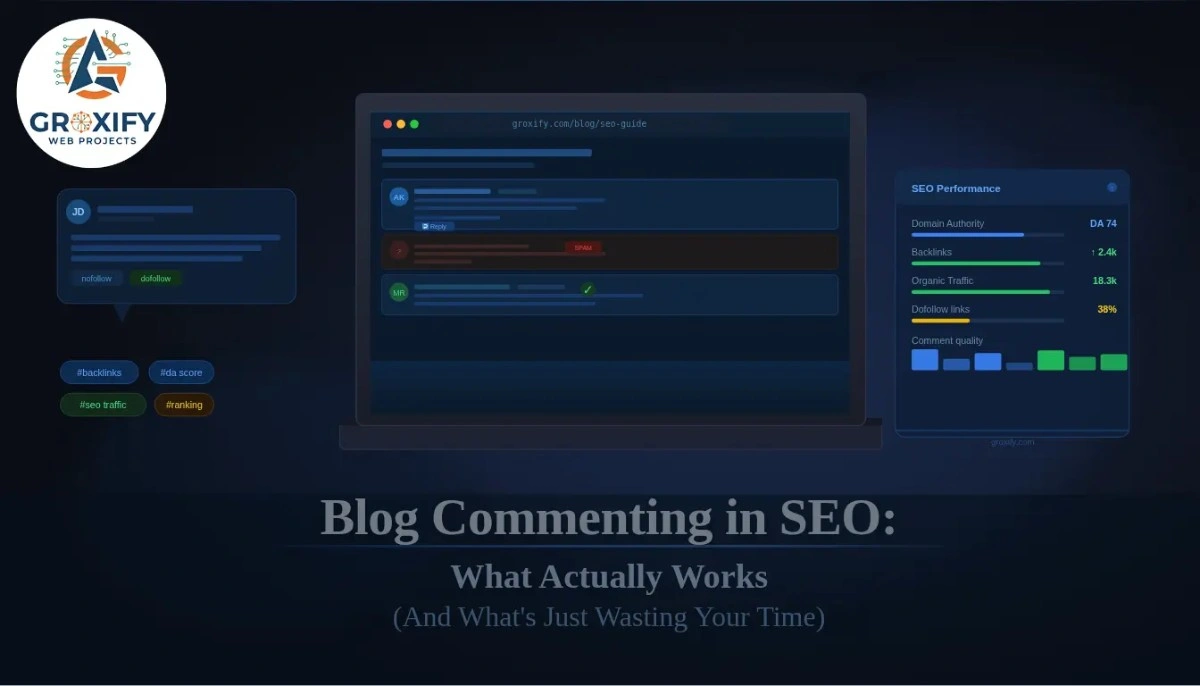
You leave a comment on a popular blog. You put your website URL in the field. You hit submit. And then you wait for the traffic to pour in.
It doesn’t.
So you wonder — is blog commenting in SEO even real, or is it just one of those things people keep repeating because someone said it in 2015? The answer is more interesting than a simple yes or no. This article breaks down exactly how blog commenting works for SEO, when it helps, when it’s a complete waste of time, and what you should actually be doing if you want results.
Does Blog Commenting in SEO Actually Work?
Short answer: yes, but not the way most people think.
Blog commenting can help your SEO — but not because every comment you leave magically boosts your rankings. The way it works is indirect, and understanding that changes everything about how you approach it.
Here is what actually happens. When you leave a genuinely helpful comment on a relevant blog, a few things can follow. The blog owner notices you. Other readers notice you. Some of them visit your site. Over time, if you are consistently showing up in the right conversations, you start building a name in your niche. That reputation leads to real backlinks, collaborations, and mentions — which are the things that directly move rankings.
The comment itself? Usually not a direct ranking signal. But what it starts? That can be.
Think of blog commenting as a door-knocker, not a shortcut.
The Nofollow vs Dofollow Problem Nobody Explains Clearly
Almost every article on blog commenting for SEO skips explaining this properly. So here it is, clearly.
When a website links to another website, search engines like Google follow that link and count it as a vote of confidence. This is called a dofollow link — it passes what SEO people call “link juice” (basically, credibility points that help rankings).
A nofollow link has a small tag in the code that tells Google: “don’t count this as a vote.” The link still exists, people can still click it, but it does not pass SEO value directly.
Here is the thing — almost every blog commenting section uses nofollow links by default. WordPress does it automatically. That means the URL you drop in the website field of a comment form is not giving your site any direct ranking power.
So why bother at all?
Because nofollow links are not worthless. Google has said that nofollow is now a “hint” — meaning they may choose to follow and consider some nofollow links anyway. And even if they don’t, the referral traffic, brand visibility, and relationship-building still happen. A nofollow link from a highly read blog in your niche can send you real visitors who actually convert.
Just don’t go into this expecting every comment to be a ranking boost. That’s where most people get disillusioned.
What Makes a Comment Worth Leaving (And What Gets You Ignored)
This is the part that separates people who get results from blog commenting and people who give up after two weeks calling it useless.
Most comments that people leave fall into one of three buckets:
Bucket one — Spam. “Nice post! Very helpful. Do check my website too.” Every blog owner has seen thousands of these. They get deleted in seconds. If your comment reads like this, you are wasting your own time.
Bucket two — Generic. “Great explanation of on-page SEO. I learned a lot.” This does not get deleted, but it also does not get noticed. You blend into the noise.
Bucket three — Valuable. You read the article. You add something the article didn’t say. You share a real experience, a counter-point, a practical tip, or a genuine question that opens a discussion. The blogger responds. Other readers engage. Your name sticks.
Only bucket three works.
Before leaving a comment, ask yourself: if I removed my website link from this comment, would it still be worth posting? If yes, it’s a good comment. If no, you’re just link-building in disguise — and that’s rarely effective.
How to Find the Right Blog Commenting Sites
Not every blog is worth your time. Commenting on low-traffic, irrelevant blogs is the SEO equivalent of shouting in an empty room.
Here is what to look for when finding the right blog commenting sites:
The blog should be in your niche or closely related to it. A comment on a food blog is useless if you sell accounting software.
Check if the blog actually gets traffic and engagement. If there are comments already and some of them have thoughtful replies from the author, that’s a good sign. Dead blogs where nobody responds are not worth the effort.
Look at the Domain Authority (DA) of the blog. DA is a score from 1 to 100, created by Moz, that estimates how much trust and credibility a website has built over time. Higher DA generally means the site is well-established and respected. Commenting on high DA blog commenting sites gets your name associated with credible spaces online — even if the link is nofollow.
That said, don’t obsess only over DA. A smaller blog with 5,000 loyal readers in your exact niche can be more valuable than a massive generic blog with a DA of 70 but no relevant audience.
Also, check if the blog moderates comments. If comments go live without approval and the section is full of spam, the blog owner isn’t maintaining it. Your comment will sit next to a hundred fake ones and nobody will take it seriously.
Blog Commenting Sites vs Article Submission Sites: What’s the Difference?
A lot of beginners mix these up, so let’s clear it up fast.
Blog commenting sites are platforms or blogs where you leave comments under published articles. You are contributing to an existing conversation. The link you leave (in the website field of the comment form) is typically nofollow.
Article submission sites are platforms where you submit your own original content — a full article — and publish it under your name. These often give dofollow backlinks because you are creating the content, not just commenting. These are sometimes called guest posting sites or article directories.
Both have their place, but they serve different purposes. Blog commenting builds visibility and relationships. Article submission builds direct backlinks and positions you as an author and expert.
If you’re just starting out, blog commenting is easier to begin with. It requires no writing from scratch — just reading and responding. Article submission takes more effort but gives stronger direct SEO signals.
The smartest approach is using both together. Comment to get noticed. Submit articles to sites where you already have a relationship.
The Right Way to Build a Blog Commenting Routine
Consistency matters more than volume here. Leaving 50 comments in one day and then disappearing for two months does nothing. Here’s a simple approach that actually works in practice.
Pick 10 to 15 blogs in your niche that are actively maintained, have real traffic, and whose audience overlaps with yours. Subscribe to their RSS feeds or email newsletters so you know when new posts go live.
When a new post goes up, read it properly. Not skimming — actually reading. Then leave a comment that adds something real. This takes maybe 5 to 10 minutes per comment.
Do this consistently — even 3 to 5 comments a week across your chosen blogs — and within a few months you become a familiar face. Blog owners remember you. Regular readers recognize your name. Some of them visit your site out of curiosity. Some of them share your articles later because they already trust you.
This is slow. But it compounds. And it doesn’t get penalized by Google because you’re just being a real participant in online conversations.
What Is a High DA Blog Commenting Sites List and Should You Use One?
You’ll find these lists everywhere — “200 high DA blog commenting sites list,” “top blog commenting sites with DA 90+.” The idea is to give you a shortlist of blogs where your comments will carry the most weight.
These lists are useful as a starting point, but use them with common sense.
First, verify that the blogs on the list are still active. Many of these lists are outdated, and some of the blogs on them no longer exist or stopped updating years ago.
Second, check whether the blog is actually relevant to you. A DA 80 blog about finance is useless if your business is about fitness.
Third, check the comment section. If it looks like a spam dump, your thoughtful comment will be buried and ignored.
The best blogs for commenting aren’t always on any public list. Sometimes the most valuable ones are smaller, tightly focused communities that the “DA 90+ lists” never covered. Do your own research. Look at where your ideal customers or peers are already spending time online.
At Groxify Web Projects, when doing outreach and link-building work for clients, the first thing we check isn’t the DA — it’s relevance and real audience engagement. DA without relevance means very little.
Common Mistakes That Make Blog Commenting Useless
Most people who say “blog commenting doesn’t work” made at least one of these mistakes.
- Leaving comments only for the backlink and not for the conversation
- Using keyword-stuffed names in the Name field (like “Best SEO Agency Delhi” instead of your real name) — most blog platforms flag this as spam
- Commenting on irrelevant blogs just because they have high DA
- Ignoring reply notifications and not continuing the conversation when someone responds to your comment
- Expecting results in two weeks instead of two to three months
The biggest one is treating blog commenting as a link-building tactic instead of a community-building tactic. The results are completely different depending on that mindset.
Blog Commenting in SEO: The Realistic Expectation
Blog commenting is not a shortcut to page one. It never was. But it is a legitimate part of an SEO strategy that builds brand recognition, referral traffic, and industry relationships — all of which eventually support rankings indirectly.
The people who get real value from it are the ones who focus on quality, stay consistent, and think of it as showing up in the right rooms rather than leaving sticky notes all over the internet.
If you are doing SEO the right way — creating good content, doing proper on-page optimization, building real relationships — blog commenting fits in naturally as one piece of the puzzle. Not the whole strategy. One piece.
Start with five blogs in your niche this week. Read them. Comment on them like a real person. Give it three months. Then judge whether it works.
Conclusion
Blog commenting in SEO still works — just not in the way most listicles describe it. The links are usually nofollow. The direct ranking impact is indirect. But the visibility, relationships, and referral traffic are real. Focus on adding genuine value in every comment, stick to relevant and active blogs, and stay consistent over months, not days. That’s the version of blog commenting that actually builds something. Start small, show up regularly, and let it compound.
FAQ
Blog commenting in SEO is the practice of leaving relevant, thoughtful comments on blog posts — usually with your website URL — to build visibility, referral traffic, and indirect SEO signals. It works best as a relationship and branding tool, not a direct ranking trick.
Most blog platforms, including WordPress, set comment links to nofollow by default. This means the links typically don’t pass direct ranking value. Some blogs use dofollow, but they’re rare. The real value of commenting comes from visibility and referral traffic, not the link type.
Yes, but the value has shifted. It’s less about backlinks and more about brand visibility, niche authority, and relationship building. Consistent, genuine commenting on the right blogs can drive real traffic and get you noticed by people who matter in your space.
DA stands for Domain Authority, a score from 1 to 100 developed by Moz. It estimates how credible and trustworthy a website is based on its backlink profile. Commenting on high DA sites associates your name with well-established, respected platforms — even if the link is nofollow.
Search for active, well-maintained blogs in your industry. Check if they have real engagement in the comments section, consistent publishing, and a relevant audience. Look for DA as one factor, but prioritize relevance and audience fit over raw scores.
Blog commenting sites are where you leave comments under existing articles — links are usually nofollow. Article submission sites are platforms where you publish your own full articles — these often give dofollow backlinks. Both serve different purposes in an SEO strategy.
Quality beats quantity every time. Three to five well-written, genuinely valuable comments per week on relevant blogs will outperform 50 generic comments scattered everywhere. Consistency over months matters more than volume in a single week.
Always use your real name or your actual brand name. Using keyword-stuffed names like “Best Digital Marketing Agency” in the name field is flagged as spam by most platforms and damages your credibility. Authenticity is the only approach that builds trust.
Don’t expect quick results. Meaningful outcomes — referral traffic, relationship building, brand recognition — typically start showing after two to three months of consistent, quality commenting. Treat it as a long-term strategy, not a quick win.
Spammy blog commenting — bulk comments, irrelevant blogs, keyword-stuffed names — can attract manual penalties. Genuine, thoughtful comments on relevant blogs will never get you penalized. The risk only comes from doing it the wrong way at scale.

Rohit Singh is the Founder of GROXIFY WEB PROJECTS LLP with many years of hands-on experience in digital marketing, including SEO, PPC, social media, email marketing, content writing, and WordPress development. He has worked with global clients across industries and helped businesses achieve 5x–10x revenue growth through data-driven strategies and practical execution. Rohit actively manages digital teams, builds business strategies, plans marketing systems, and oversees execution to drive consistent traffic, leads, and long-term business growth.